






















Introduction: The July Revolution and the Rise of a New Political Consciousness
I want to practice Insāf (justice) even with my enemy.
- Sharif Osman bin Hadi
This analysis examines the July Revolution of 2024 and its transformative impact on Bangladesh’s political landscape, focusing on the emergence of youth-led resistance and the moral-political vision embodied by Sharif Osman Hadi. It also analyzes Hadi’s assassination and its aftermath, exploring how these events shaped the trajectory of insāf (justice), the struggle against cultural fascism, and youth mobilization in Bangladesh. The report further considers the implications of these developments for democratic transition and nation-building.
For sixteen uninterrupted years, Bangladesh was ruled under the increasingly authoritarian grip of the Bangladesh Awami League (BAL). During this period, the country witnessed widespread human rights violations: thousands of political activists, opposition supporters, and ordinary citizens were killed, injured, forcibly disappeared, or detained without due legal process. State institutions—including the judiciary, police, intelligence agencies, and public administration—underwent deep politicization, gradually transforming into instruments of partisan control. As constitutional safeguards eroded, public participation became perilous, and dissent was criminalized through surveillance, intimidation, and violence (al-Mamun 2025).
Against this backdrop of shrinking civic space, students stepped forward as the central force of resistance. Historically, university campuses have shaped the nation’s political destiny; from the Language Movement to the 1990 anti-autocracy uprising, Bangladeshi student activism has repeatedly acted as the conscience of the nation. This role reemerged forcefully in 2018 during the first major rupture: the Quota Reform Movement. Students demanded transparency and meritocracy in public sector recruitment, yet the government responded with violent suppression. The brutality—despite the students’ reformist intentions—exposed the entrenched authoritarian character of the regime and politically awakened a new generation.
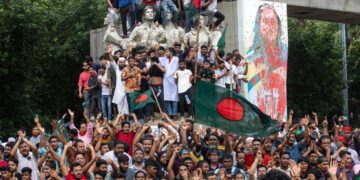
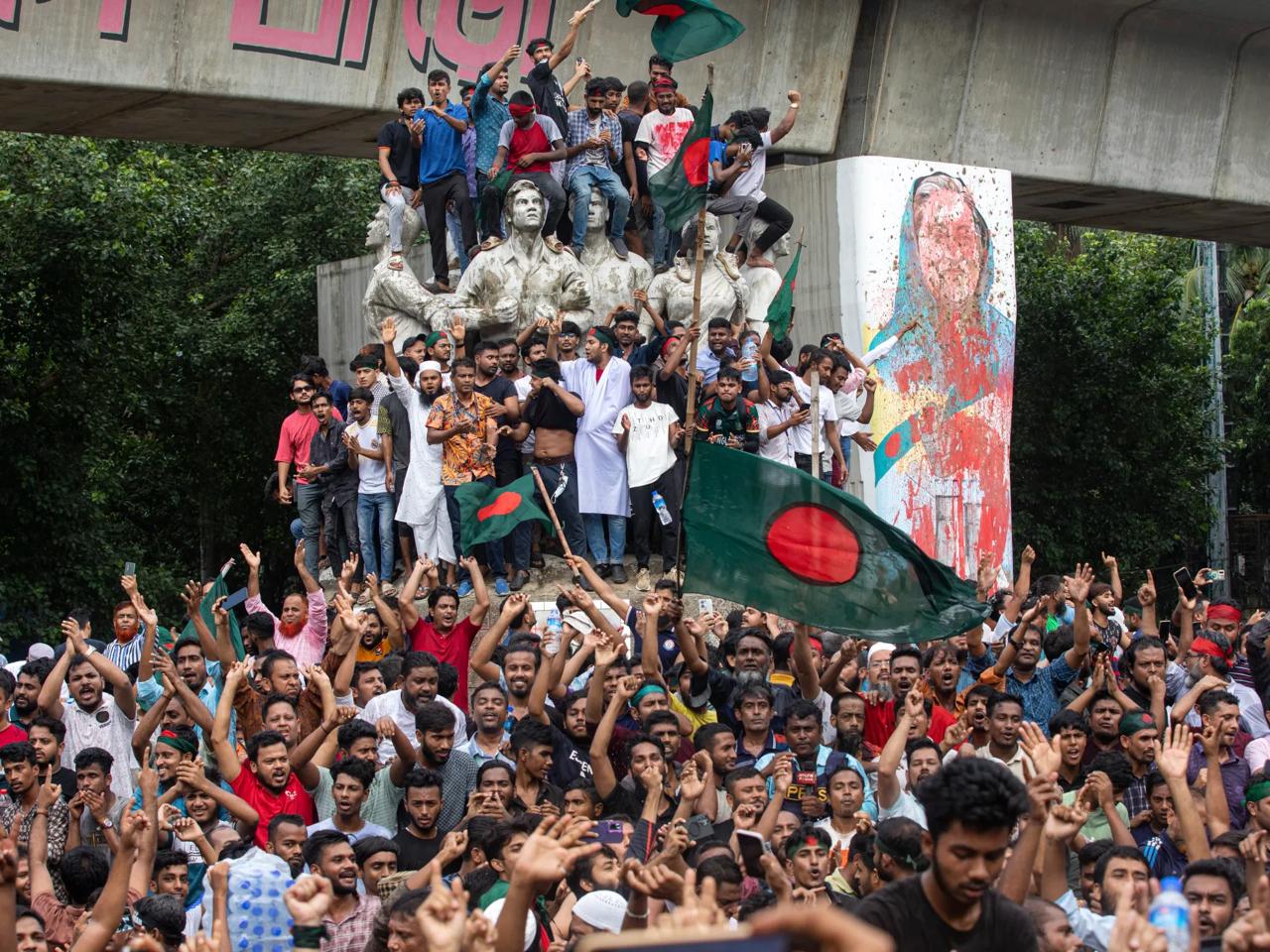
Six years later, in 2024, the reinstatement of the controversial quota system reignited nationwide frustration. What began as peaceful student-led demonstrations quickly expanded into a broader anti-discrimination and anti-authoritarian mobilization. As the state escalated repression—raiding university halls, abducting movement leaders, shutting down campuses, and deploying lethal force—the protests evolved into an unprecedented nationwide uprising directly challenging the regime’s legitimacy. By July and August 2024, Bangladesh witnessed the largest wave of popular mobilization since 1971. Over 1,400 civilians, many of them university students, were killed, and thousands more were wounded as security forces attempted to crush the uprising. Yet each killing deepened public outrage. Every fallen student became a symbol of state brutality and a catalyst for further resistance. Rather than restoring control, violence accelerated the regime’s collapse, culminating in Sheikh Hasina’s escape from the country (Abdulla al-Mamun 2025).
The fall of Sheikh Hasina’s fifteen-year rule is now widely described as Bangladesh’s “second independence” or “second revolution.” But the July Revolution was not merely a transfer of power; it was a profound rupture in the nation’s political imagination. A new consciousness emerged among the masses—rooted in demands for insāf (justice), accountability, dignity, and the rebuilding of national institutions free from partisan capture. However, as the post-revolutionary period unfolded, it became clear that the aspirations of the people were colliding with the inertia of entrenched structures. This analysis explores that tension, tracing the rise of Osman Hadi as a moral-political leader, the formation of youth-driven platforms such as Inquilab Moncho, and the implications of Hadi’s assassination for Bangladesh’s democratic future.
Post–July Revolution Youth Perceptions: The Emergence of Osman Hadi
The aftermath of the July Revolution in Bangladesh marked the beginning of an unpredictable political shift. With the fall of the long-standing authoritarian regime, major political parties quickly refocused on electoral negotiations and securing power. However, their efforts were more focused on political succession and power consolidation than on upholding the moral and ethical values that had fueled the revolution. This shift created a widening gap between the ideals of the revolutionary youth and the actions of the established political elite.
As traditional political forces engaged in power struggles, they failed to embody the moral clarity and ethical demands central to the July uprising. This political vacuum opened space for new, youth-driven movements. In this context, Osman Hadi emerged as a key figure. Known for his unwavering commitment to justice (insāf), anti-hegemonic politics, and democratic values, Hadi became a beacon for the youth’s aspirations. While only a few youth-led platforms continued to defend the revolution’s core ideals—such as resistance to institutional fascism, critique of cultural authoritarianism, and rejection of hegemonic political practices—Hadi’s clarity of purpose and moral courage set him apart. He distinguished himself from both traditional politicians and other student leaders, positioning him as a moral and political symbol of the youth-driven political awakening in post-revolutionary Bangladesh.
Osman Hadi as a Symbol of Youth-Led Resistance
Graffiti across Chittagong University illustrated the depth of Hadi’s symbolic authority after the revolution. Two prominent slogans declared may help to understand him (CU 2025):
We may surrender our lives, but not the spirit of July (“জান দেব, জুলাই দেব না”).
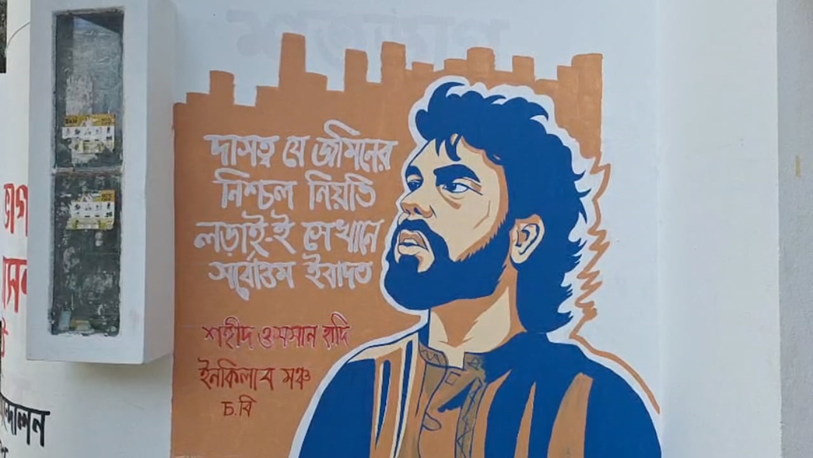
This graffiti tells: Where subjugation becomes the land’s destiny, struggle becomes the highest form of worship (ibadat) (দাসত্ব যে জমিনের নিশ্চল নিয়তি, লড়াই সেখানে সর্বোত্তম ইবাদত).
These inscriptions demonstrate how deeply Hadi’s message resonated with the youth. His words were not merely political slogans; they were moral declarations that captured the ethical core of the July Revolution—justice, truth, dignity, and independence from authoritarian domination.
As Md. Saidul Islam documents in Noya Jamanar Muazzin Osman Hadi, several traits that defined Hadi’s meteoric rise (Islam 2025):
- Extraordinary Oratory: His speeches electrified audiences, dismantling conventional analysis and awakening a new political imagination.
- Exceptional Structural Insight: He demonstrated a deep understanding of Bangladesh’s institutional crisis and public grievances—often surpassing senior intellectuals.
- Resistance to Cultural Fascism: Hadi exposed subtle authoritarian mechanisms embedded in language, history, media, and education systems.
- Boundless Patriotism: He centered sovereignty, independence, and the dignity of the Bangladeshi people in his activism.
- Justice as Political Foundation: Insāf—a justice-oriented moral philosophy—was the cornerstone of his politics.
- Anti-Corruption Integrity: Hadi understood that fighting corruption often meant standing alone, yet he remained steadfast.
- Anti-Hegemonic Vision: He opposed all forms of foreign domination, insisting on a Bangladesh-centered political and cultural future.
Saidul Islam concluded that Hadi’s character gave him profound optimism about the nation’s future, writing: “As long as there are people like Hadi, Bangladesh will never lose its way” (Islam 2025).
Hadi emerged as more than just a student activist; he became the symbolic center of a new political consciousness among the youth. His advocacy for justice, dignity, and sovereignty resonated deeply with a generation disillusioned by the corrupt practices of political elites yet driven by the transformative potential brought about by the July Revolution. In the wake of the old regime’s collapse, the youth saw in Hadi a compelling fusion of moral integrity, revolutionary courage, anti-hegemony discourse, and a justice-centered political ideology. He bridged the raw moral force of the revolution with the ongoing struggle to reshape Bangladesh’s political landscape. For many, Hadi was not just a political leader but a moral compass, embodying the aspirations of a generation striving for a just and sovereign future.
The Formation of Inquilab Moncho: Cultural Resistance to Cultural Fascism and Hegemonic Politics
1) A Youth–Driven Political–Cultural Platform
Inquilab Moncho emerged after the July–August 2024 student uprising as a youth-led platform seeking to convert mass mobilization into durable civic and moral claims. It frames itself as a “revolutionary cultural platform” committed to resisting domination and advancing a justice-based, sovereign state. Its repertoire—sit-ins, blockades, outreach caravans, and oath-taking—was widely understood as an effort to preserve the July momentum within a civic, non-partisan register.
Sharif Osman Hadi became the platform’s central public figure; his assassination in December 2025 transformed commemorative activities into renewed agitation, including the March for Insaaf.
2) Cultural Fascism, Political Monopolization, and Hegemony
The Moncho understands its struggle as resistance to “cultural fascism”: the normalization of party-state dominance over knowledge, culture, and religious expression. This critique is linked to a strongly sovereigntist stance against perceived Indian interference. After Hadi’s killing, the platform escalated deadlines and blockades as tests of national accountability, while media narratives increasingly cast Hadi within an “anti-India” frame, illustrating the geo-politicization of its discourse.
3) Institutionalizing the July Revolution
The July Revolution, which resulted in an estimated 1,400 deaths and over 11,700 arrests, serves as the Moncho’s foundational moral framework. The process of institutionalizing the revolution is unfolding through several key mechanisms. First, it is marked by the establishment of routine deadlines for justice and the formation of tribunals aimed at ensuring accountability. Second, the culturalization of public spaces has played a crucial role in transforming the revolution’s ideals into a form of street pedagogy, where oaths, songs, poetry, and neighborhood marches serve as tools of public moral education. Lastly, the Moncho’s efforts to archive the revolution’s history are vital, as they involve the creation of websites, exhibitions, and youth policy translation projects, which work to preserve the street aesthetics and translate them into institutional memory. Through these efforts, the July Revolution’s moral and cultural impact is being institutionalized, ensuring its legacy in both public consciousness and political processes.
4) Bangali Muslim Vernacular Politics
Moncho’s discourse draws on a Bangali Muslim vocabulary of insaaf, dignity, and sovereignty. This hybrid, non-sectarian vernacular complicates binary readings of youth politics as secular vs. religious. Graffiti and slogans produced during the uprising—often invoking ethical restraint and justice—serve as a moral grammar for the movement’s post-uprising identity.
5) Responding to Islamophobia and Elite Cultural Anxiety
The platform views Islamophobia as a state and media-driven narrative that unfairly labels various Islamic groups as “extremists.” This perception has evolved over the past decade, during a period of tension between the state and Islamic movements. While some Islamic groups have returned to public life after a regime change, Moncho rejects the blanket labeling of all Islamic people as extremists. Instead, it advocates for sovereignty and justice as its core principles, emphasizing these over any form of religious control. Reports of state violence in 2024 further reinforce the movement’s moral stance and challenge the oversimplified divide between secular and religious perspectives.
Under the previous government, many public institutions in Bangladesh discriminated against people based on their religious beliefs and the visibility of their religious culture. Osman Hadi, for example, shared his experience of being discriminated against at Dhaka University simply for wearing religiously inspired clothing. Such discrimination is widespread in Bangladesh, particularly affecting female students. Moncho has vocally raised these concerns, urging the nation to be more aware of their rights and freedom, and encouraging people to fight for justice and equality.
6) The Hadi Legacy
Osman Hadi’s commitment to July’s ideals—symbolized by his vow not to “give up July”—became central to the Moncho’s martyrdom narrative. His state‑level funeral, accompanied by official praise, briefly produced cross‑party resonance even as media simultaneously cast him in anti‑India terms, reflecting the tensions any cultural resistance movement navigates in a polarized, geopolitically sensitive environment.
The Assassination of Osman Hadi: Facts, Actors, and Political Interpretations
On 12 December 2025, at approximately 2:25 p.m., Hadi was shot in the head by masked motorcycle-borne assailants while traveling through Bijoynagar in central Dhaka shortly after leaving a mosque. Multiple reports confirmed the attack occurred at close range and caused catastrophic brain stem injury. He was treated first at Dhaka Medical College Hospital, then airlifted on 15 December to Singapore General Hospital, where Singapore’s Ministry of Foreign Affairs stated he received the “best efforts” of neurosurgical teams. Hadi died on 18 December 2025, prompting widespread protests and unrest (Shamim 2025).
Why was Osman Hadi targeted?
The assassination of Osman Hadi was not a random act of violence but a calculated attempt to decapitate the moral leadership that had emerged in the wake of the July Revolution. Understanding why Hadi was targeted requires a thorough examination of his role as a disruptive force against Bangladesh’s established political and cultural structures. Despite ongoing state investigations, the ultimate orchestrators behind his death remain inconclusive. What is clear, however, is that Hadi emerged as a non-partisan youth leader who fundamentally challenged the prevailing political landscape by rejecting both the systemic corruption of domestic institutions and the perceived external influence of Indian hegemony. This “anti-hegemonic” stance placed him in direct opposition to the interests of the ousted Awami League (BAL) and its regional allies. His resistance to the BAL’s 16-year autocratic rule, which was marked by widespread human rights violations and extrajudicial killings, made him a high-value target for a regime that sought to preserve its influence from exile.
Beyond his involvement in electoral politics, Hadi challenged the so-called “cultural establishment” that had provided intellectual cover for the previous regime’s fascist policies. He was instrumental in exposing the “secrets” of the political and cultural elite, bringing uncomfortable truths to light regarding institutional complicity in maintaining the old order. By critiquing the phenomenon of “cultural fascism,” Hadi threatened the soft-power networks that had long sustained the old political culture, making his voice a significant threat to those seeking to maintain social control through manipulation. Additionally, Hadi identified and vocally opposed institutionalized Islamophobia, which had been used as a tool of systematic oppression during the previous decade. His demand for a “rebuilt political landscape” envisioned a society in which religious identity was neither criminalized nor ridiculed by the state apparatus. This moral clarity resonated deeply with the youth but antagonized those invested in secular, authoritarian narratives.
Hadi’s most effective weapon was his unwavering demand for Insāf (justice). He publicly advocated for the prosecution of those responsible for the estimated 1,400 deaths during the July Revolution and insisted that the “fascist regime and its collaborators” be held accountable. His calls for justice challenged the government’s sluggish pace of reform and exposed the lingering influence of the old guard within the current administration. To the perpetrators of state violence, Hadi’s insistence on accountability posed an existential threat. As post-revolutionary disillusionment began to set in, Hadi acted as the “conscience of the movement,” striving to keep the “July Spirit” alive. His ability to mobilize the masses and his refusal to be “boxed in” by traditional political expectations marked him as a “timeless soldier against domination.”
Investigations and Political Implications
The assassination of Osman Hadi serves as a critical diagnostic of the volatile nature of Bangladesh’s political transition. Far from a random act of criminality, the Dhaka Metropolitan Police (DMP) concluded that the killing was rooted in “political vengeance,” directly implicating seventeen individuals in a coordinated strike against the rising youth leadership. The investigation specifically identified members of the Chhatra League, the student wing of the Awami League (BAL), as primary actors. Key suspects included Faisal Karim Masud, the alleged gunman, and Alamgir Sheikh, while Taizul Islam Bappi, an Awami League–endorsed councillor, was accused of facilitating the logistical escape of the perpetrators (Correspondent 2026).
The aftermath of the shooting triggered a significant diplomatic and geopolitical impasse. Bangladeshi authorities claimed that the primary suspects utilized the Haluaghat border to flee into the Indian state of Meghalaya, a narrative that was promptly denied by Indian officials. These competing claims underscored the embedded geopolitical tensions surrounding the fall of the BAL regime and the perceived sanctuary found by its remnants in neighboring territories. This friction reinforces the youth movement’s discourse regarding “hegemonic interference” and the external shielding of actors who seek to destabilize the nascent democratic order (Sakib 2025).
The timing of the assassination further validates its interpretation as a calculated political intervention. The attack occurred just one day after the official announcement of the February 2026 election schedule. As an independent candidate for the Dhaka-8 constituency, Hadi had transitioned from a grassroots activist to a viable political contender, posing an immediate threat to entrenched networks of power. In the eyes of the remnants of the BAL, Hadi had become a singular moral icon whose removal was deemed necessary to fragment the youth-led democratic mobilization.
Ultimately, Hadi’s martyrdom illustrates the dangerous persistence of the “old political culture” in Bangladesh—a system that continues to deploy targeted violence to suppress dissent. His death highlights the immense challenges facing the transition, where the emergence of a truly sovereign and justice-centered order is actively contested by legacy forces determined to stifle the revolutionary spirit through bloodshed.
Mobilization and Youth Resistance
Hadi’s killing did not silence the movement; it catalyzed a new wave of justice-centered resistance. Key dynamics (Shamim 2025):
- Demands for Accountability: Calls for resignation of Home Affairs and Law Ministers; extradition of suspects believed to be in India.
- Targeting of Pro-India Media: Outlets like Prothom Alo and The Daily Star faced public anger and attacks for alleged editorial bias.
- Geopolitical Friction: Protests escalated after reports of suspects fleeing to India, amplifying anti-hegemonic sentiment.
- Revival of the “July Spirit”: Hadi said: “I will give my life, but not give up July.” Protesters renamed a square “Martyr Hadi Square,” embedding his memory into national consciousness.
National Mourning
The announcement of Osman Hadi’s death on 18 December 2025 triggered an immediate and widespread national response. Major cities like Dhaka, Chattogram, Rajshahi, Khulna, Sylhet, and various district towns saw a surge in protests, with large-scale blockades, sit-ins, prayer marches, and spontaneous assemblies. The violence directed at media offices perceived as aligned with pro-India narratives underscored the intensity of public anger and the rising anti-hegemonic sentiment. The funeral, held on 20 December 2025 at the South Plaza of the National Parliament, became a defining moment in the nation’s political history.
Over 1.5 million people participated in the funeral, making it one of the largest non-state gatherings in Bangladesh’s history. The participants, representing a diverse spectrum of society—including students, workers, religious leaders, lower-middle-class families, and professional groups—signified that Hadi’s message had transcended political and social divides. The interim government declared a national mourning period, with special prayers held in mosques across the country, further elevating Hadi’s death to the level of a national tragedy.
Thus, the funeral transformed from a mourning event into a political statement, marking a shift from grief to mobilization, reflecting the growing strength of the movement Hadi had inspired.
Major politicians’ comments on his unexpected death
Chief Adviser Dr. Muhammad Yunus called the assassination a “devastating blow” to Bangladesh’s democratic landscape. BNP’s Tarique Rahman hailed Hadi as a “courageous political worker,” while Jamaat-e-Islami’s Dr. Shafiqul Rahman described him as a “bright example of steadfastness and sacrifice.” Tributes from clerics, academics, and youth framed Hadi as a “martyr of sovereignty” and a moral compass for a new generation (Ayub 2025).
Muslim Youth Political Identity: Lessons From Bangladesh
The July Revolution and the subsequent martyrdom of Osman Hadi generated a distinctive moral–political consciousness among Bangladeshi Muslim youth. This emerging identity fuses Islamic ethical concepts—insāf (justice), zulm (oppression), and shahādah (sacrifice)—with democratic demands for accountability, sovereignty, and equal citizenship. Youth activists thus appeared simultaneously as agents of democratic transformation and as primary targets of repression during and after the July 2024 uprising.
Ethical–Political Language as Democratic Practice
Bangladeshi Muslim youth articulated democratic claims through an Islamic moral vocabulary. Concepts such as insāf framed demands for transparent governance, while anti-zulm discourse exposed state violence and authoritarian practices. Rather than relying on partisan loyalty, youth movements grounded political participation in ethical obligation. In doing so, they bridged a long-standing tension in Bangladesh between religious sentiment and democratic aspiration by treating justice as a moral imperative rather than a political tactic.
This synthesis was visibly expressed through campus graffiti and memorial practices, particularly those commemorating Osman Hadi. Slogans such as “I want justice even for my enemy” and “I will give my life, but not give up July” framed resistance as an ethical duty rooted in conscience and sacrifice, reinforcing justice as the core grammar of youth politics.
Martyrdom and the Formation of Moral Agency
Osman Hadi’s assassination in December 2025 consolidated his role as the moral nucleus of youth resistance. His death triggered nationwide campus mobilization centered on accountability and state responsibility, confirming youth not only as political vanguards but also as the most vulnerable actors within contentious politics. Hadi’s rhetoric—anchored in dignity, restraint, and sovereignty—transformed student activism into a form of moral resistance that transcended party boundaries.
Through memorial sites, wall art, and collective rituals, Hadi’s presence was institutionalized within public memory. These practices sustained moral agency beyond his death and embedded his legacy into Bangladesh’s evolving political imagination.
Anti-Hegemonic Consciousness and Global Solidarity
Hadi’s political language resonated beyond Bangladesh, situating Muslim youth within a broader global struggle against domination and colonial violence. References to Gaza, Kashmir, and Myanmar reflected a transnational moral solidarity in which local resistance was understood as part of a universal fight against oppression. Youth discourse increasingly linked national sovereignty with global justice, positioning Bangladesh within a wider Muslim political awakening.
Following Hadi’s assassination, many student leaders framed his killing as an attempt to silence resistance to regional hegemony. Chief Adviser Dr. Muhammad Yunus described Hadi as “an immortal soldier in the struggle against hegemony and domination,” reinforcing the movement’s interpretation of his death within a broader anti-imperial narrative.
Youth as Vanguard and the Precarity of Resistance
The July Revolution reaffirmed a structural reality of Bangladeshi politics: youth are central to democratic rupture yet remain disproportionately exposed to coercion. Documentation indicates that student activists, particularly those associated with platforms such as Inquilab Moncho, faced surveillance, intimidation, and violence even under the transitional government.
Post-assassination mobilization highlighted this duality. Youth leadership gave legitimacy to justice-centered demands, while simultaneously provoking intensified repression from entrenched political networks seeking to restore control.
Synthesis: A Justice-Centered Muslim Democratic Subjectivity
The political identity emerging among Bangladeshi Muslim youth can be characterized as:
- Ethically grounded, guided by insāf, izzah (dignity), and amanah (public trust);
- Democratically aspirational, demanding accountability and sovereign governance;
- Anti-hegemonic, opposing both domestic authoritarianism and external domination;
- Culturally confident, reclaiming Muslim identity as a source of justice rather than exclusion.
This hybrid subjectivity challenges the conventional secular–religious divide in South Asian politics by showing that Islamic ethics and democratic participation can be mutually reinforcing. The life and martyrdom of Osman Hadi crystallized this moral-political vision, linking personal integrity with collective resistance and framing opposition to injustice as both a civic and ethical responsibility.
Bangladesh’s post-July youth movement is not isolated. It reflects a broader global pattern in which Muslim youth—from North Africa to Southeast Asia—are mobilizing for dignity, representation, and democratic participation. As Bangladesh faces an uncertain political transition, this justice-centered youth consciousness remains a key force shaping the country’s democratic trajectory and offers wider lessons for understanding Muslim youth political agency under conditions of repression and instability.
Conclusion: The Unfinished Revolution and the Path to Nation-Building
The assassination of Osman Hadi represents far more than the loss of a prominent youth leader; it exposes the unfinished and deeply contested nature of Bangladesh’s post–July political transition. Hadi’s death revealed the fragility of the democratic moment that emerged after the July Revolution, where popular demands for justice, sovereignty, and accountability collided with the persistence of entrenched power structures. The revolution generated moral clarity and mass mobilization, yet its core grievances—justice for mass killings, institutional reform, and the dismantling of authoritarian networks—remain unresolved.
Despite the collapse of the BAL-led regime, targeted violence, intimidation, and surveillance have continued against young political leaders who raise their voices against past crimes and ongoing impunity. Networks linked to the Awami League and its collaborators remain active, seeking to suppress dissent and obstruct accountability for the killings of more than 1,400 people during the July uprising and thousands more over the preceding sixteen years. These persistent threats underscore how deeply entrenched the old political culture remains. Hadi’s assassination crystallized this contradiction: the revolution’s moral energy survives among the youth, but its structural realization is actively resisted by forces invested in preserving the old order.
Yet, amid this turbulence, signs of hope have emerged. Hadi’s funeral drew millions and united diverse segments of society—students, workers, clerics, professionals, and political leaders from across the spectrum. All major parties paid tribute, and youth from different backgrounds raised their voices in solidarity, demanding clear justice for Hadi. This convergence signals a growing civic consciousness that transcends partisan divides. It suggests that the ethical horizon forged by the July Revolution is not fading; it is deepening into a shared national demand for accountability and dignity.
Hadi’s legacy continues through platforms like Inquilab Moncho, which he founded to fight cultural fascism, challenge irregularities in state and social affairs, and revive the spirit of July. These movements aim to institutionalize justice (insāf), dismantle hegemonic structures, and advance a vision of nation-building rooted in moral integrity and democratic participation.
As Bangladesh faces an uncertain political future, Hadi’s martyrdom serves as a beacon for youth-led activism, ensuring that the fight for justice, accountability, and sovereignty continues. The unity displayed after his death and the rising demand for reform reflect a deepening political consciousness that could lay the foundation for a more inclusive and sovereign future. If this momentum persists, Bangladesh may yet transform the moral energy of its revolution into a durable nation-building process—anchored in justice, transparency, and the collective resolve of its youth.
*Opinions expressed in this article are the author’s own and do not necessarily reflect Platform: Current Muslim Affairs’ editorial policy.
Bibliography
Ayub, Mia Muhammad. 2025. “হাদির আধিপত্যবিরোধী মনোভাব ও আমাদের অনুভব (Osman Hadi’s Anti-Dominance Attitude and Our Perception).” দৈনিক নয়া দিগন্ত, December 19. https://dailynayadiganta.com/opinions/sub-editorial/79n5XyPVSTt1.
Correspondent, Staff. 2026. ‘Hadi Killed out of Political Vengeance.’ January 6. https://www.thedailystar.net/news/bangladesh/crime-justice/news/hadi-killed-out-political-vengeance-4075076.
CU, Representative. 2025. “Graffiti on wall in memory of Osman Hadi at CU (চবিতে ওসমান হাদির স্মরণে দেওয়াল লিখন-গ্রাফিতি).” আমার দেশ | স্বাধীনতার কথা বলে । জনপ্রিয় বাংলা নিউজ পেপার।, December 25. https://www.dailyamardesh.com/feature/campus/amdyyxdfc4qxh.
Islam, Md. Saidul. 2025. “নয়া জমানার মুয়াজ্জিন ওসমান হাদি (The new era muezzin Osman Hadi).” দৈনিক আমার দেশ, December 28. https://www.dailyamardesh.com/op-ed/amdgvebcj4tkq.
Mamun, Abdullah al-. 2025. Bangladesh’s July Revolution: A Youth-Driven Paradigm Shift in Nation-Building. Analysis Report. İLKE İlim Kültür Eğitim Vakfı. https://doi.org/10.71174/anr15.
Sakib, SM Najmus. 2025. Bangladesh Police Say Killers of Political Activist Hadi Fled to India. December 28. https://www.aa.com.tr/en/asia-pacific/bangladesh-police-say-killers-of-political-activist-hadi-fled-to-india/3783125.
Shamim, Sarah. 2025. “Who Was Sharif Osman Hadi; Why Is Bangladesh on Fire over His Death?” Al Jazeera, December 19. https://www.aljazeera.com/news/2025/12/19/who-was-osman-hadi-why-is-bangladesh-on-fire-over-his-death.