




When we look at the studies on Muslim minorities, it appears that the South Korean Muslim community has received limited coverage because most of the studies on Muslim communities generally focus on Western Muslim minorities. According to Korean studies, Islam and Muslims in Korea are mostly discussed in the contexts of refugee population, immigration, tourism, and economy. On the other hand, due to their prejudiced and critical attitudes toward Islamic activities and the conversion of Koreans, studies on Islam in Korea are the focus of Christian missionaries. Therefore, the situation of contemporary Korean Muslims and their daily life in Korea still needs further research. In this sense, analysing the case of the contemporary South Korean Muslim community will shed light on the developments related to this community and their interaction with the Muslim world.
The Situation of Contemporary Korean Muslims
Most people today know South Korea for its outstanding success in the music world that has exponentially improved its overall image too. Although the Korean War or the negotiations with North Korea come to mind when the Korean peninsula is mentioned, many things about the entertainment industry are now associated with South Korea. In such a conjuncture, speaking of the South Korean Muslim minority is not a familiar situation. However, the relations between South Korean society and Muslims have a very ancient connection dating back to the 7th century. Despite the ancient beginning of the mutual relations, the Muslim minority does not correspond to even one percent in the country where Christians constitute thirty percent of those who belong to any religion today.
Although the population of South Korean Muslims is not officially stated, according to the statements of Seoul Central Mosque officials, the local Korean Muslim community is estimated to be around 35-45,000 out of the total foreign Muslim population of 200,000 (Hussein Jang, Personal Interview, South Korea, October 2019). Although Muslims dispersed to other parts of the country, the Itaewon neighbourhood in the heart of the capital Seoul is home to a vibrant Islamic cultural space with markets, restaurants, and Seoul Central Mosque. The majority of the Itaewon Muslim community consists of South Asian, Central Asian and Middle Eastern Muslims. Included within the community of Itaewon Muslims are native-born Korean Muslims, namely “Koslims”[1]. One of the most important moves of the government is to make Iteowon, a shantytown as a “Muslim neighbourhood”. Muslims together with all other foreign minorities generally live in the capital Seoul, a centre of attraction for Muslim and foreign tourists coming to the country. In recent years, Korea has been exercising its soft power on Muslim countries, primarily with Muslim-friendly venues and halal marketing strategies that have been opened in the country, one after another.
Abdurrahman Lee, the imam of Seoul Central Mosque, whom I interviewed in 2019, states that for Itaewon, it has become a representative space that is free from prejudices of belief and has ethnic diversity as the common ground for its multiple identities (Abdurrahman Lee Ju-Hwa, Personal Interview. South Korea, November 2019). Besides, Imam Lee adds that Korean high schools and universities organize group trips to the Seoul Central Mosque to teach multiculturalism to their students. In this sense, Itaewon Muslim street also helps Koreans discover their neighbours. These developments may prove instrumental in breaking the prejudice of Koreans towards Muslims in the near future. The mosque in Itaewon provides a place of worship for Muslims as well as a means of communication for Koreans interested in Islam.
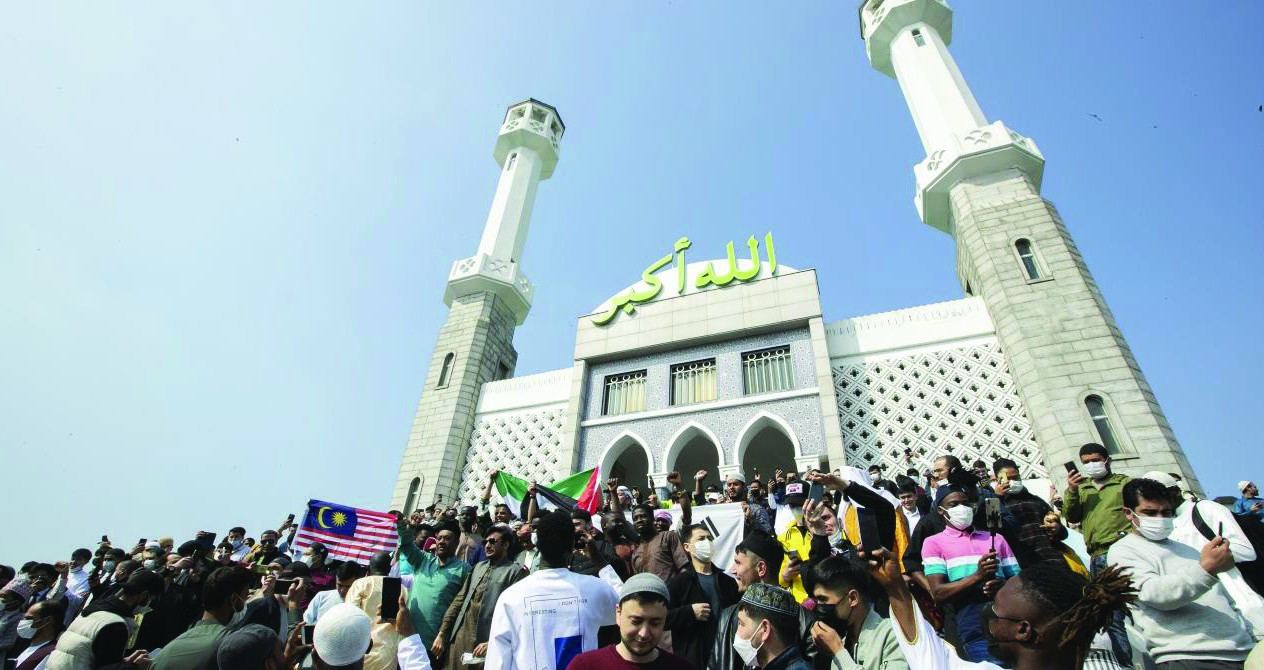
Photograph 1. Eid Celebration at Seoul Central Mosque
On weekends, the central mosque administration offers Arabic and religious studies trainings both for Muslims and non-Muslims. Activities and meetings are organized between children from various Muslim families and the Korean Muslim Students Association. Unfortunately, the activities here are minimal and are mostly accessible only for Muslims in the capital. Muslims in other regions face many difficulties, such as finding halal food, places of worship, and funeral places. Korean Muslims continue their religious lives working together with their local mosques. However, Muslims are still a tiny minority. Muslims neither have their own schools and Islamic Institutions, nor is there a political authority representing them in the country.
The Journey of Islam in Korea from Past to Present
Korea’s relationship with the West dates back to the 17th century. When we compare, the relations with the Islamic world go back to earlier times. The first contact of Koreans with Muslims between the 7th and 9th centuries was established by Arab and Persian traders who came to the shores of China for overseas trade (Lee, 1997). Although there were some contacts in earlier periods, the religion of Islam did not have a permanent presence there until the Korean War. Since no actual Korean Muslim community formed until the 20th century, the main event in which the religion of Islam spread in Korea was the Korean War (Öztürk, 2021).
During the Korean War, the first Korean Muslim community emerged with the help of the imams of the Turkish Brigade, and the Korean Muslim League was established, which is the basis of today’s Korean Muslim Federation. In this sense, the Korean Muslim community’s social and mental construction of its own Islamic culture and ground coincides with a recent historical process. If we start with the first conversion process in 1955, we can track the 67 years history of the Korean Muslim community. However, it becomes clear that the interest Koreans showed in Islam in the post-war period did not continue in the later periods. The lack of previous experience of living with different nationalities and religions of the Korean nation played an essential role in this regard. According to Nam (2012), many Koreans still cannot distinguish between terms such as Islam, Muslim, and Arab. Many Koreans seem unaware of the ethnic diversity within Muslims.
Also, there are some contrasting elements between Korean culture and Islamic culture. The main problems faced by Muslims is the social structure that focuses on appearance, heavy alcohol consumption as a means of social communication, and the prevalence of pork consumption. Most importantly, there is still a need for scholars who will address Koreans regarding social, linguistic, and religious communication in Korean society to reach accurate Islamic information. On the other hand, due to what anti-Islamic media conveyed after September 11, 2001, prejudices against Islam and Muslims have increased. This had a negative impact on the spread of Islam and the acceptance of the Muslim community (Sheikh, 2019). As a result, the religion of Islam is gaining acceptance rather slowly.
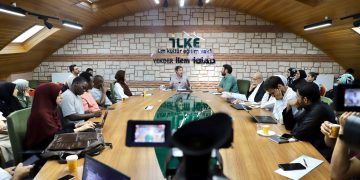
Today, there are more than 60 small mosques in Korea, which are not official but used for worship purposes, besides 15 actively operating mosques. Many South Korean Muslim Community activities are channelled through the Korean Muslim Federation and Seoul Central Mosque in Itaewon. The booklet named Muslim Weekly, published by the Federation, delivers the sermon of that week, prayer times, religious lessons, pieces of advice, and the latest news about Muslims.
Korean Society’s Perspective on Muslims and Other Developments
The most crucial reason why the world did not know about South Korean Muslims until recent years was the negative view of the people towards Muslims, the Muslim minority living in seclusion, and the government’s cautious approach towards the Muslim minority. Although the main factor in forming a negative image against Muslims seems as Islamophobic media, another critical factor is the work of Christian missionaries. Many Christian writers and academics use negative definitions of Islam and Muslims. Some studies openly admit that these definitions are unnecessarily polemical and highly hostile; also, these studies state that Koreans’ limited and corrupt understanding of Islam is at the root of Islamophobia in Korea (Park, 2013; Gi, 2018). Thus, one can say that Korean society generally sees Muslim culture as a threatening other. In his interview, Professor Lee stated that Korean society has a very high rate of Islamophobia among OECD countries. He underlined that Western media channels are the most important cause of this misunderstanding (Lee, 2022). However, South Korean decision-makers have recently started giving significance to Muslims and their identity and hence are manipulating this soft power for their domestic gains (Eum, 2017).
Especially after the Korean wave, policies targeting Muslim countries aroused the interest and sympathy of Muslims from different countries. Thus, Korean Muslims in the country, on the one hand, became the focus of attention of foreign Muslims due to being “Korean”, and on the other hand, they caught the freedom to express themselves a little more comfortably in public and on social media. The most obvious example is Korean Muslims having numerous followers on social media today. Muslim digital creators convey the daily routine and life of Korean Muslims in Korea. A digital content producer named Bora Song is one of these Korean Muslims (Bora Song. Instagram Account, Accessed Aug. 2022). Bora has 185 thousand followers on her Instagram account. She teaches Arabic at the Bora Seoul Central Mosque and conducts Islamic activities. In addition, Koreans who sympathize digitally with Muslim countries in cooperation and support also contribute significantly to Korean society’s prejudice against Islam and Muslims. Kim Cho Won, nicknamed “Chomad”, shares his positive experiences and travels to the Middle East and other Muslim countries with 717 thousand followers on Instagram and 779 thousand on Youtube (Cho Won Kim, Youtube, Access Aug. 2022). Looking at the interactions of these posts, we can see that Kim Cho Won’s video titled “Korean goes to the local market in Saudi Arabia” on April 6, 2020, received over three million views and over sixteen million comments.
Conclusion
Although Korea successfully exports its culture to different countries today, it has not been able to show the same success against multiple cultures within the country. Watching the relationship of Muslims with Korean society from past to present, it is clear that Korea needs to re-establish this bond, which dates back to a longer time than its bond with the West. Limiting the situation of Korean Muslims in the country to the scope of immigration or Islamophobia and ignoring them among foreign minorities will open the door to different problems in the near future. Every move that the government makes in terms of economic or political interests and social harmony and order will contribute to cultural acceptance and peace in Korean society. Considering the situation and developments of Muslims, it comes to light how critical the relationship between the Korean Muslim community and other Muslim countries is. In this respect, Muslim societies need to show greater interest in this geography and its Muslim population.
References
Baker, D. (2006). Islam struggles for a toehold in Korea., Harvard Asia Quarterly, 10(1), 25-30.
Cho, H.-S., Kim, D.-S., Ahn, J. K., Oh, C., Kim, H.-J., Yoo, W.(2010). Study on the Korean attitude and perception toward Koslim (1.5 and 2nd Generation Muslim Immigrants of Korea): Based on the Survey Research, Journal of International Area Studies [제지역연] 14(1), 277-308.
Eum, I.-R., (2017). Korea’s response to Islam and Islamophobia: Focusing on veiled Muslim women’s experiences, Korea Observer, 48(4), 825-849.
Fathil, F. (2017). Japonya ve Güney Kore’de İslam ve Müslüman azınlıklar. Yeni Türkiye [İslam Dünyası Özel Sayısı], 96(2), 303-316.
Koo, G.-Y. (2018). Islamophobia and the politics of representation of Islam in Korea. Journal of Korean Religions, 9(1), 159–92.
Lee, H.-S. (1997). The advent of Islam in Korea, Istanbul: Research Centre for Islamic History, Art and Culture (IRCICA).
Lee H.-J., (May 2022) “Korea still grappling with acceptance of Muslim residents”, The Korea Times. Retrieved from https://m.koreatimes.co.kr/pages/article.amp.asp?newsIdx=328456.
Nam, J. C. (2012). Itaewon, Muslims and Koslims: Inter-cultural Dynamics in the Muslim Neighborhood of Seoul, Situations, 6, 52-54.
Öztürk, S. (2021). Kore Savaşı ve sonrası süreçte (1950-1958) Türk tugayı ve tabur imamlarının Korelilerin İslam anlayışına etkisi / The effect of Turkish brigade and battalion imams during and after the Korean War (1950-1958) on Korean perception of Islam, Master Thesis, Ibn Haldun University.
Park, S. (2013). Islamic, a study of Korean’sr Religius conversationt to Islam taking place in the twenty-first century. (Ph. D. Thesis), Asbury Theological Seminary.
Sheikh, F. (2019). Exploring ‘Korean Islam’ in a climate of exclusion and Islamophobia. International Journal of Diaspora & Cultural Criticism, 9(2), 196-215.
Song, D.-Y. (2016). Ummah in Seoul: the creation of symbolic spaces in the Islamic Central Masjid of Seoul, Journal of Korean Religions, 7(2), 37-68.
[1] The expression “Koslim”, which is still new in the literature, is formed by the combination of English words Korean + Muslim. It refers to the second-generation children born to a foreign Muslim and a Korean Muslim (Cho et al., 2010)