


Introduction
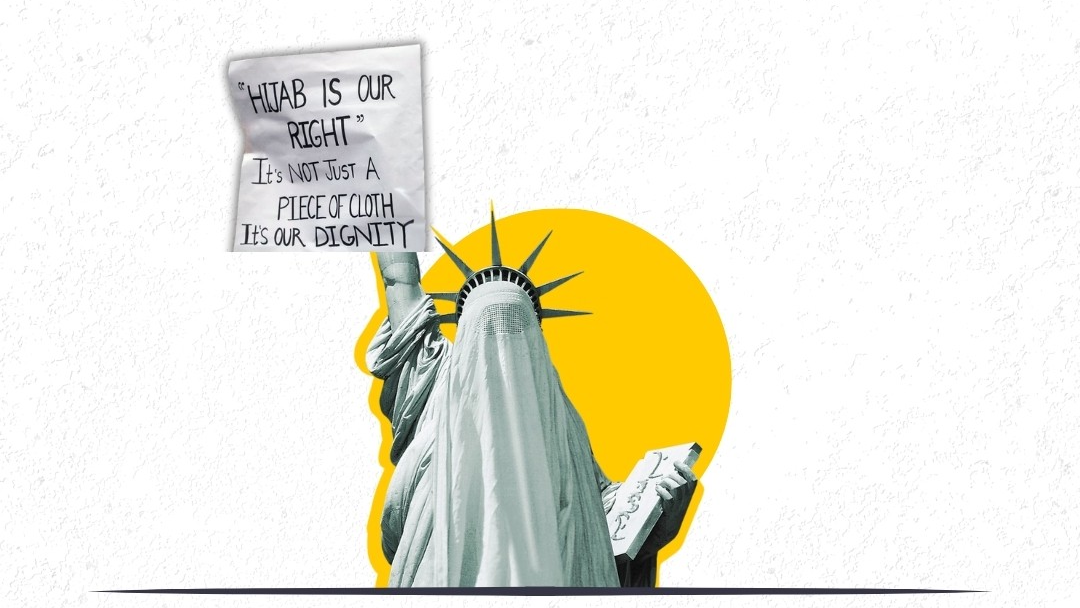
In June 2025, US Representative Marjorie Taylor Greene posted a manipulated image of the Statue of Liberty cloaked in a burqa following Zohran Mamdani’s victory in New York’s Democratic mayoral primary.[1] This striking visual act encapsulates contemporary Western anxieties around Islam, revealing striking ideological discomfort with Muslim visibility. The Statue of Liberty, the symbol of freedom, enlightenment, and Western civilization, was transformed into an object of fear and oppression with the mere addition of cloth. Here, the burqa symbolizes more than difference; it represents a civilization’s perceived antithesis, a regression to cultural backwardness and authoritarian darkness.
This highlights how Western anxieties are projected onto the bodies of Muslim women. In Britain, the recent revival of debates concerning the burqa ban demonstrates this dynamic. The burqa, a full-face covering and the most modest expression among a range of visible Muslim women’s expressions of Muslim identity, including the veil, hijab, and jilbab, is framed both as a security threat and a symbol of gender oppression, becoming an arena for asserting cultural superiority and political control. Secular Western narratives rationalize interventions against Muslim communities through dual anxieties: religious violence labelled as “terrorism” and patriarchal oppression, particularly the subjugation of women (Baldi, 2017). It is through these twin anxieties that the Muslim female body, epitomized by the veil or covering, emerges as a central object of political intervention and control (Asad, 2003).
The Burqa Debate: Visibility as a Threat
British debates around the burqa are not new and have resurfaced recently. In June 2025, Reform UK MP Sarah Pochin used her first parliamentary question to ask whether the Prime Minister intended to follow other European countries in banning the burqa. This was followed by comments from opposition leader Kemi Badenoch, who invoked the language of security and workplace decorum to justify excluding veiled women from political surgeries. These remarks, framed as matters of public safety and cultural cohesion, highlight longstanding tensions around Muslim visibility in Britain.
Such interventions are part of a recurring pattern, where the burqa acts as a symbol for broader anxieties about immigration, integration, and national identity. Although only a tiny minority of Muslim women in the UK wear the face veil or burqa, their presence continues to attract disproportionate political and media attention. The veil is cast as both a security threat and a marker of cultural nonconformity, placing Muslim women at the center of political narratives about the limits of British liberalism. These narratives do not emerge in a vacuum but are embedded within a deeper ideological framework, where visible religious difference unsettles the secular state’s claim to neutrality and reactivates older logics of moral and civilizational dominance.
The Secular Logic of Domination
Central to modern secular governance is the presumption of universal rationality, framing itself as an impartial arbiter between religious and secular domains. Yet secularism, far from neutral, consistently reinforces a hierarchy between the secular and the religious, positioning secular liberalism as rational, moral and inherently superior (Baldi, 2017). Historically, this has justified colonial conquest and domination, portraying non-Western societies as deficient in reason, morality, and civilization, thus legitimizing their subjugation in the name of education and improvement (Asad, 2003).
This logic is evident in Enlightenment thought, captured by Kant’s claim in Perpetual Peace, which equates immorality with unreason, savagery, and eligibility for conquest and civilization (1795/2006). Herein lies a critical paradox: the justification for conquest relies upon the imposition of a moral system assumed superior through reason (Kant, 1795/2006). Consequently, visible opposition from alternative moral systems constitutes an existential crisis, as morality, according to this logic, must be singular and dominating. The visible presence of other moralities thus represents a form of counter-domination, threatening the very foundations of the Enlightenment project. If multiple moralities exist, morality itself becomes unknowable by reason, thereby causing the Enlightenment rationale to collapse.
Today, secular Western states, including Britain, mobilize these historical discourses to control and regulate religious minorities. Thus, the burqa symbolizes a rupture in the secular public sphere, where Muslim women’s visibly religious identities are perceived not just as foreign but as existential threats requiring regulation through state intervention (Baldi, 2017).
Islamophobia, Gender, and the Racialized Muslim Body
In Britain, secular anxieties surrounding Islam manifest through gendered Islamophobia, transforming Muslim women’s attire into political battlegrounds of national security and cultural purity. Muslim women are simultaneously depicted as victims of patriarchal oppression and as ideological threats to secular liberal democracy. This duality constructs two dominant figures: the imperiled Muslim woman, who must be liberated, and the perilous Muslim woman, whose visibility must be contained (Shareef, 2025).
Discourses of “imperilment” paint Muslim women as perpetual victims of oppressive practices such as honor killings, forced marriages, and female genital mutilation. Such narratives create a moral imperative for secular interventions ostensibly aimed at rescuing Muslim women, exemplified in the political instrumentalization of figures like Malala Yousafzai. Conversely, discourses of “peril” portray Muslim women as security threats, exemplified by the vilification of figures like Shamima Begum (Shareef, 2025). Here, visibility becomes existentially threatening, as the presence of another moral system constitutes domination versus counter-domination. The woman who rejects the burqa must be rescued, but the woman who chooses it actively opposes the dominant moral system, becoming an agent of counter-domination who must be vilified. Muslim women’s bodies thus become sites of oppression, either willingly complicit or unwillingly victimized.
Public support for burqa bans reflects an implicit secular expectation that citizenship requires visibility, that is, the open legibility of one’s identity in terms deemed acceptable by the state. Visible markers of religious difference, such as the burqa, disrupt the presumed neutrality of the secular public sphere and evoke anxieties about the erosion of secular-liberal norms (Ganesh & Abou-Atta, 2016). The UK’s Prevent strategy further entrenches this logic, intertwining Muslim women’s visibility with security discourse, positioning them as either victims to be saved or potential informants to be scrutinized (Shareef, 2025). Visibility, in this context, is politicized not to promote cohesion, but to assert control over expressions of moral and religious difference.
Resistance and Activism among Young Muslim Women in Britain
Against this backdrop of suspicion and control, Muslim women’s activism in Britain emerges not as an exception to the rule but as a direct challenge to it. Rather than passive subjects of rescue or surveillance, Muslim women have historically asserted their agency in ways that confound the binaries imposed upon them. Their activism has deep roots, stretching back to often overlooked contributions in the late nineteenth and early twentieth centuries. Early female British Muslim figures like Fatima Cates and Nafeesah Mary Keep played critical roles in establishing institutions such as the Liverpool Muslim Institute, serving as early examples of female participation and leadership within British Islam. Their contributions, alongside notable individuals like Nawab Sultan Jahan, who championed Muslim women’s leadership and supported the renovation of Woking Mosque, provide essential historical context for contemporary Muslim women’s activism, demonstrating a long-standing tradition of resistance to exclusionary societal norms and patriarchal structures (Hamid, 2024).
Building on this historical legacy, young Muslim women today engage in activism, reshaping conceptions of citizenship beyond traditional forms of political participation (Lewicki & O’Toole, 2017). Campaigns like Integrate Bristol’s anti-FGM activism creatively leverage digital media and arts-based performances to challenge harmful practices, asserting their voices against paternalistic frameworks (Lewicki & O’Toole, 2017). These women actively demonstrate that the burqa and other forms of religious attire can be sources of liberation and agency. Their choices represent an explicit rejection of secular logic that attempts to frame them solely as oppressed or oppressive. Such expressions of agency directly confront secular Western assumptions, showcasing the critical limitations and inconsistencies of secular liberal philosophy.
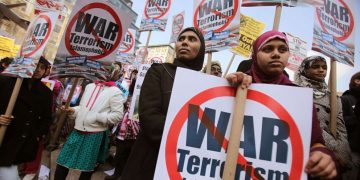
Contemporary activism, including creative cultural expressions such as Suhaiymah Manzoor-Khan’s play, disrupts Islamophobic narratives by presenting Muslim identities as ordinary and deeply human. Young Muslim women’s leadership within anti-racist and Palestine solidarity movements further underscores their strategic importance to transformative political resistance in Britain, thereby challenging dominant narratives and reshaping the conditions of their public and communal belonging.
Conclusion
When Marjorie Taylor Greene draped the Statue of Liberty in a burqa, she revealed the West’s continued hallucination. This image, absurd as it is, lays bare the paradox at the heart of liberal secular modernity: a promise of emancipation that demands submission, a freedom that begins by stripping away your name, your garments, and your God.
The burqa has never been just cloth. It has been the screen onto which the empire projects its fears of disorder, of moral ambiguity, of a religious subject who refuses domestication. Security discourse masks this discomfort in the language of safety. Feminist rhetoric veils it in the language of liberation. But beneath both lies the same conviction: the Muslim woman must be made legible to the state or erased.
***
References
[1] See. https://www.ndtv.com/world-news/burqa-on-statue-of-liberty-how-maga-is-fuming-over-zohran-mamdanis-win-876 7750
Asad, T. (2003). Formations of the secular: Christianity, Islam, modernity. Stanford University Press.
Baldi, G. (2017). What the veil reveals: A critique of religious and secular debate over the headscarf [Master’s dissertation, Birkbeck, University of London]
Ganesh, B., C Abou-Atta, I. (2016). Forgotten women: The impact of Islamophobia on Muslim women in the United Kingdom. European Network Against Racism (ENAR). https://www.enar-eu.org/wp-content/uploads/forgotten_women_report_united_kingdom_-_final. pdf
Hamid, S. (2024). Muslim women in Britain, 1850–1S50: Unpacking 100 years of untold stories. The New Arab. http://bit.ly/40Ehw2b
Kant, I. (1795/2006). Perpetual peace: A philosophical sketch (M. Campbell Smith, Trans.). Cosimo Classics. (Original work published 1795)
Lewicki, A., C O’Toole, T. (2017). Acts and practices of citizenship: Muslim women’s activism in the UK. Ethnic and Racial Studies, 40(1), 152–171. https://doi.org/10.1080/01419870.2017.1245430
Shareef, A. (2025). Gendered Islamophobia: Submission to the Women and Equalities Committee. University of Cambridge.