





Today, higher education institutions are engaged in research, education, and community service. While carrying out these activities, higher education institutions also contribute to economic and social benefits alongside knowledge production and the acquisition of vocational and social skills. Although the levels of education in the past were not as open as they are today, higher education institutions have functioned as the foremost educational and knowledge-producing institutions of their periods. In this context, we can talk about the thousand-year history of the university. Nizamiyya Madrasas in the Islamic world and Bologna, Oxford, and Paris universities in the West are cited as the first examples of universities. Through many religious, political, social, and economic struggles, the concept and functions of the university have evolved from the 11th century to the present day. The fundamental transformations in the development of the university are commonly defined as the Medieval University, the Humboldtian Model, and the Third Generation University. Expectations for the commercialization of scientific production and the generation of economic benefits have also increased alongside education and research in today’s universities (Erdoğmuş, 2023).
It is crucial for Muslims and Muslim countries to invest in research, education, and knowledge production for their economic and social development. Furthermore, there is a need for Islamic countries to contribute more to global science and education and solutions for fundamental problems of humanity. This paper presents a basic overview of the current state of higher education institutions and research and development activities in Muslim countries. Due to data sources and identification challenges, the focus is on the member countries of the Organization of Islamic Cooperation (OIC) since it is not feasible to determine the contribution of Muslim scientists outside these countries. Various studies have covered different periods and fields of science, particularly in the last thirty years, to gauge scientific productivity and performance in the Islamic world. We have tried to reveal the current situation based on the most recent and comprehensive studies available.
Universities in Islamic Countries and Their Ranking
It is not easy to determine the exact number of universities in each country, and there are often approximate numbers and estimates available. The website statista.com provides estimated numbers of universities for different countries. Based on the numbers on this website, the number of universities in prominent Islamic countries is listed in Table 1.
Table 1. Estimated Number of Universities Worldwide by Country as of July 2023
| Country | Number of Universities |
| Indonesia | 3277 |
| Iran | 440 |
| Pakistan | 359 |
| Malaysia | 351 |
| Nigeria | 278 |
| Tunisia | 236 |
| Türkiye | 208 |
Source: statista.com
When analyzing the table above, it is essential to consider the size of universities in each country. In this context, since Türkiye’s universities are relatively larger, it appears to have fewer universities than some countries with lower figures in terms of population and number of university students.
University rankings have been closely monitored in recent years, albeit subject to ongoing debates. Ranking institutions utilize different methodologies. The Times Higher Education (THE) ranking system focuses on research-intensive universities. In contrast, the QS World University Rankings focuses more on reputation criteria and the research factor has less compared to THE. This section presents the positions of universities in Islamic countries in the top 500 university rankings according to these two ranking systems. The universities in Islamic countries within the top 500 of The Times Higher Education 2024 rankings are listed below.
Table 2. Universities in Islamic Countries in the Top 500 According to The Times Higher Education 2024 Ranking
| Ranking Range | University | Country |
| 201-250 | King Fahd University of Petroleum and Minerals | Saudi Arabia |
| 251-300 | Abu Dhabi UniversityKhalifa UniversityQatar UniversityKing Abdulaziz UniversityUniversity of Malaya | UAEUAEQatarSaudi ArabiaMalaysia |
| 301-350 | Universiti Teknologi PetronasUnited Arab Emirates University | MalaysiaUAE |
| 351-400 | Amirkabir University of TechnologyUniversity of SharjahKoç UniversityOrta Doğu Technical UniversitySabancı University | IranUAETürkiyeTürkiyeTürkiye |
| 401-500 | Universiti Brunei DarussalamZayed UniversityQuaid-i-Azam UniversityKing Saud UniversityPrince Sultan University (PSU)Imam Mohammad Ibn Saud Islamic UniversityIran University of Science and TechnologyUniversity of Tehran Universiti Utara MalaysiaUniversiti Kebangsaan MalaysiaUniversiti Teknologi MalaysiaUniversiti Sains Malaysia | BruneiUAEPakistanSaudi ArabiaSaudi ArabiaSaudi Arabia IranIranMalaysiaMalaysiaMalaysiaMalaysia |
Source: The table was created by the author from The Times Higher Education 2024 rankings.
In The Times Higher Education 2024 ranking, 25 universities from Islamic countries (members of the Organization of Islamic Cooperation) are within the top 500. In this ranking, while 14 universities were in the top 500 in 2020, this number has increased to 25 today. Among the OIC member countries in the 2024 ranking, 6 universities are from Malaysia, 5 from Saudi Arabia, 5 from the UAE, 3 from Türkiye, and 3 from Iran. Pakistan, Qatar, and Brunei each have 1 university in the ranking. It is worth noting that larger countries with higher education systems, such as Türkiye and Iran, have fewer universities in this ranking compared to smaller countries with smaller higher education systems.
Another ranking system, QS World University Rankings 2024: Top Global Universities, lists the top 50 universities in Islamic countries (OIC), which is presented below.
Table 3. Top 50 Universities in Islamic Countries (OIC) in QS World University Rankings 2024: Top Global Universities List
Source: The table was created by the author from QS World University Rankings 2024: Top Global Universities.
In the QS World University Rankings 2024: Top Global Universities list, 36 universities from Islamic countries (members of the Organization of Islamic Cooperation) are within the top 500. Among the OIC member countries in the QS 2024 ranking, 8 universities are from Malaysia, 5 from Indonesia, and 4 from the UAE. In this ranking, Saudi Arabia and Iran have 3 universities; Türkiye, Egypt, Qatar, Kazakhstan, and Pakistan have 2 universities; and Lebanon, Oman, and Brunei have 1. Similar to THE rankings, it is noteworthy that larger countries with higher education systems, like Türkiye and Iran, have fewer universities in this ranking compared to smaller countries with smaller higher education systems. In contrast, Malaysia has the highest number of universities in this ranking, and Indonesia, which does not have any universities in THE rankings, has 5 universities in the QS rankings.
As mentioned before, since the methodologies of the ranking systems differ, the number of universities of countries in the rankings also differs. A notable development is that the number of universities from Islamic world countries in both rankings has increased over the years. Yet, although the increase in the number of universities in Islamic countries in the rankings is important, it requires a more comprehensive analysis. The following section discusses the productivity of universities in Islamic countries.
Scientific Productivity and Performance in Islamic Countries
In their analysis based on articles published in SCOPUS between 2000 and 2011, Sarwar and Hassan (2015) examined productivity and collaborations in science and technology within the Muslim world. According to their study, Türkiye ranks first in scientific outputs, followed by Iran, Malaysia, Egypt, and Pakistan. The majority of research outputs are in the fields of veterinary medicine, chemical engineering, chemistry, dentistry, agriculture, and biosciences. Between 2000 and 2011, there was an increase of over 10% in all fields of science and technology. The areas with the highest increase include economics, econometrics and finance, immunology and microbiology, agricultural and biological sciences, mathematics, and computer science. Except for Tunisia’s and Algeria’s collaborations with France, Islamic countries have primarily collaborated amongst themselves. Authors from countries other than Türkiye and Iran have worked with broader groups. Another notable development during this period is that research outputs from the Muslim world surpassed the world average in 2009.
In Oldac’s (2022) study covering the last 30 years based on articles published in WoS, Türkiye ranked 21st, Iran 23rd, Egypt 39th, Saudi Arabia 40th, Malaysia 43rd, and Pakistan 46th in the world ranking. The figure below shows the total number of publications in some Islamic countries in the last 30 years:
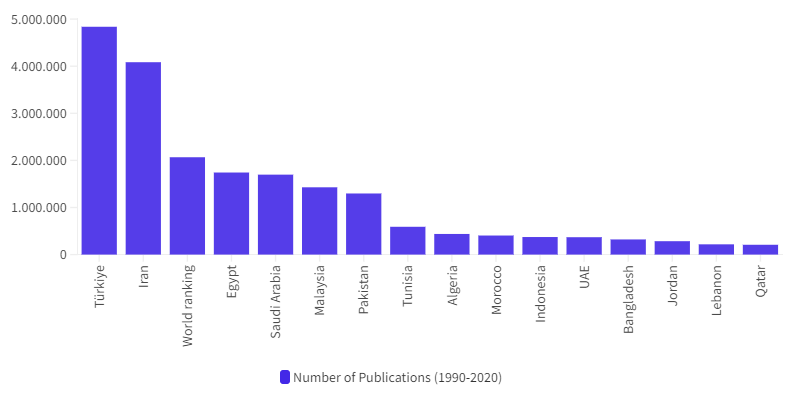
Figure 1. Distribution of Publications in the Web of Science Database in Member Countries of the OIC between 1990 and 2020
Source: Oldac, 2022
According to this figure, Türkiye and Iran are significantly ahead of other Muslim countries and are above the world average. They are followed by Egypt, Saudi Arabia, Malaysia, and Pakistan. The contributions of Muslim countries to global science relative to their populations were lower until the 2010s, but there has been an increase since then.
The contributions of Muslim countries to global science relative to their populations were lower until the 2010s, but there has been an increase since then.
We have previously noted that the number of publications from Islamic countries surpassed the world average from 2009 onwards, and there has been an increase in research outputs since the 2010s. There have also been some changes in this period. Until 2014, Türkiye was at the forefront of scientific productivity, but Iran took the lead after that year. As of 2018, the research productivity of the top ten member countries of the Organization of Islamic Cooperation (OIC) is shown in Graph 2 below. The graph provides both the position of countries among OIC countries and their position in global research activity. In terms of global research activity, the United States (17.30) and China (15.18) rank first and second, respectively. Among OIC countries, Iran (1.52) and Türkiye (1.15) are at the forefront.
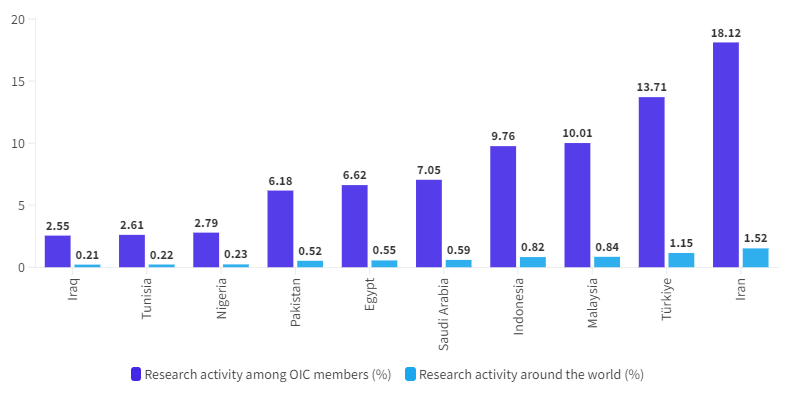
Figure 2. Research Activity among OIC Members (2018)
Source: Haq and Tanveer, 2020
According to Haq and Tanveer (2020) and Oldac (2022), there have been changes in publication trends in Islamic countries in recent years. Since 2014, Iran has taken the first place, while Türkiye is in the second place. Moreover, it can be observed that Saudi Arabia, Egypt, and Pakistan have been on the rise during these years and have surpassed Malaysia. However, countries’ positions in publication activity differ when these rankings are considered in terms of population. In this context, although Malaysia’s position in the ranking seems to have decreased, the production system in this country should not be ignored. When rankings are based on the journal percentiles, larger countries with broader scientific systems (such as Türkiye, Iran, and Pakistan) are ranked lower. In contrast, smaller countries (such as Qatar, the UAE, and Lebanon) or emerging countries (such as Indonesia and Bangladesh) are ranked higher in this ranking.
Some R&D Indicators in Islamic Countries
According to Hamid (2015), OIC countries allocate 0.5% of their GDP to R&D. The world average in this regard is 1.78%, while it is 3% for developed countries. According to Oldac’s study (2022), some R&D indicators in 15 OIC member countries that stand out according to their scientific publications in the WoS database in 2017-2018 are shown in Figure 3 and 4:
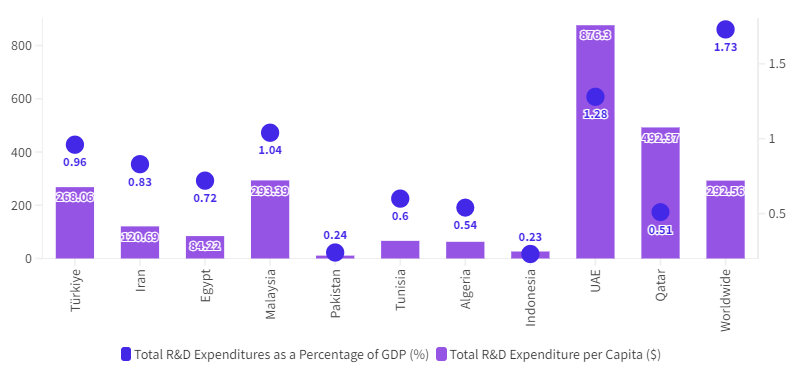
Figure 3. The ratio of R&D expenditures to GDP and the per capita total expenditure in some member countries of the OIC which stand out according to publications in the WoS
Source: Oldac, 2022
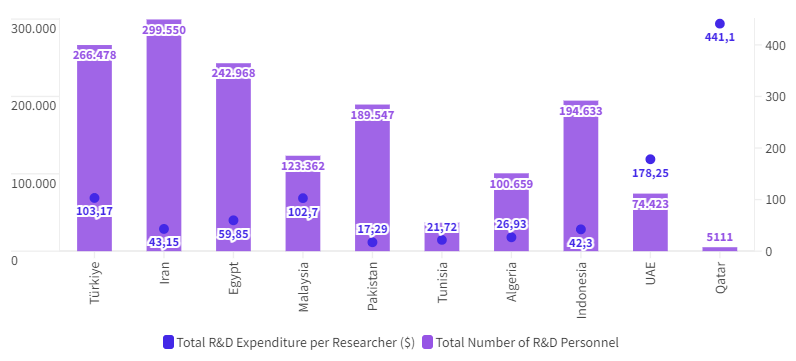
Figure 4. Indicator of R&D expenditures per researcher in some member countries of the OIC which stand out according to publications in the WoS
Source: Oldac, 2022
When Figures 3 and 4 are analyzed, the UAE and Malaysia are above 1%, while Türkiye is close to this ratio. In terms of total R&D expenditures per capita, the UAE and Qatar stand out as the countries with the highest amounts, prominently ranking at the top. Following these countries, Malaysia and Türkiye have ratios close to the world average. Regarding the total number of R&D personnel, Iran, Türkiye, and Egypt are at the forefront. These results indicate that quantitative factors are not automatically converted into publications or R&D outputs.
The share of OIC countries in global patent applications is 1.8%. In this regard, China, the United States, and Japan are in the lead in the world. Among OIC countries, Iran, Indonesia, Türkiye, Malaysia, and Saudi Arabia share the top positions. These five countries account for 71% of patent applications in OIC countries (SESRIC, 2023).
Conclusion
Political, economic, social, technological, legal, and environmental changes worldwide deeply affect higher education. Developments in higher education make it necessary to approach higher education with a strategic perspective and make structural and administrative changes with this perspective. It is important to respond quickly to the changes that will occur and meet the expectations of higher education in today’s world (Erdoğmuş, 2019). In this sense, positioning higher education and knowledge production as significant factors in economic and social development is necessary.
Universities and knowledge production play a significant role in the economic and social development of countries. Out of more than 200 countries worldwide, 57 or 28.5% are members of the Organization of Islamic Cooperation (OIC). OIC countries have a population ratio that can have a global impact. After the G20 countries, OIC countries have the largest population in the world institutionally, corresponding to 24.56% of the world’s total population. However, the total gross national income of OIC countries has not reached a level that can be sufficiently effective globally. The total gross national incomes of OIC countries correspond to 35.29% of the European Union (EU), 49.24% of China, and 32.23% of the United States institutionally. In other words, it is only about 1.65 times that of Germany and approximately 1.33 times that of Japan. The economic size of OIC countries corresponds to only 7.81% of the world economy, which clearly demonstrates that they are not influential enough globally (Yıldırım & Yeşilata, 2020).
Abdus Salam from Pakistan won the Nobel Prize in Physics, Ahmed Zewail from Egypt and Aziz Sancar from Türkiye won the Nobel Prize in Chemistry. Additionally, there are numerous researchers and scientists living and working in the United States and other countries. It is a fact that a significant portion of productive and prominent researchers and scientists reside outside Muslim countries. The three Nobel Prize laureates in science have lived and worked in the United Kingdom and the United States (Najam, 2015). In this context, it is essential to establish a contemporary infrastructure, well-educated scientists, a comprehensive research monitoring system, allocation of research and development funds, and practical research policies by removing cultural, political, and security barriers to foster innovative and productive research in Muslim countries (Rizvi, 2005).
When evaluating the contributions of Islamic countries to global science, it is important to note that the publications and indexed journals examined primarily focus on English and European languages, and publications in the languages used by OIC countries may not be represented enough. Furthermore, when referring to the Muslim world, it is important not to limit it only to Islamic countries. The best example of this is India, which has a larger Muslim population than many other countries. Therefore, it is beneficial to consider these factors when assessing the publishing productivity of Islamic countries. Despite these constraints and the relatively recent increase in scientific production, it is clear that there is a need for an improvement in scientific output and performance in Islamic countries, as well as the creation of the necessary environment and resources to support it.
Islamic countries should focus on enhancing quality, capacity, and efficiency in areas such as research, knowledge production, and acquiring professional knowledge and skills in higher education. On the other hand, it is essential for higher education institutions not to lose sight of their goals and priorities, such as providing answers to human existence and the search for meaning and providing philosophical and intellectual knowledge. Islamic countries and higher education institutions should strive to follow mainstream developments in higher education and knowledge production globally while simultaneously seeking to develop original approaches and methods.
References
Erdoğmuş, N. (2023). Giriş: Türkiye’de yükseköğretimde son yüz yılda yaşanan değişim ve gelişmeler. N. Erdoğmuş (Ed.) In Türkiye’nin yüzyılı yükseköğretim. Istanbul: Nokta Publishing.
Erdoğmuş, N. (2019). Geleceğin Türkiye’sinde yükseköğretim. Istanbul: İLKE Publishing.
Haq, I. U., & Tanveer, M. (2020). Status of research productivity and higher education in the members of Organization of Islamic Cooperation (OIC). Library Philosophy and Practice (e-journal), 3845.
Najam, A. (2015). Science, society & the university: 5 propositions. Guessoum, N. & Osama, A. (Eds). In Science at the universities of the Muslim world. Muslim World Science Initiative, Islamabad.
Oldac, Y. I. (2022). Global science and the Muslim world: overview of Muslim-majority country contributions to global science. Scientometrics, 127(11), 6231-6255.
Sarwar, R., Hassan, SU (2015). A bibliometric assessment of scientific productivity and international collaboration of the Islamic world in science and technology (S&T) areas. Scientometrics, 105, 1059–1077.
SESRIC (2023). OIC Economic Outlook 2023: The Rise of the Digital Economy and Bridging the Digital Divide. Retrieved from https://www.sesric.org/publications-detail.php?id=580
Yıldırım, R. ve Yeşilata, B. (2020). İslam işbirliği teşkilatı ülkelerinde yükseköğretime dayalı insan kaynaklarının analizi ve planlanması. Yükseköğretim ve Bilim Dergisi, 10(3), 474-487.