























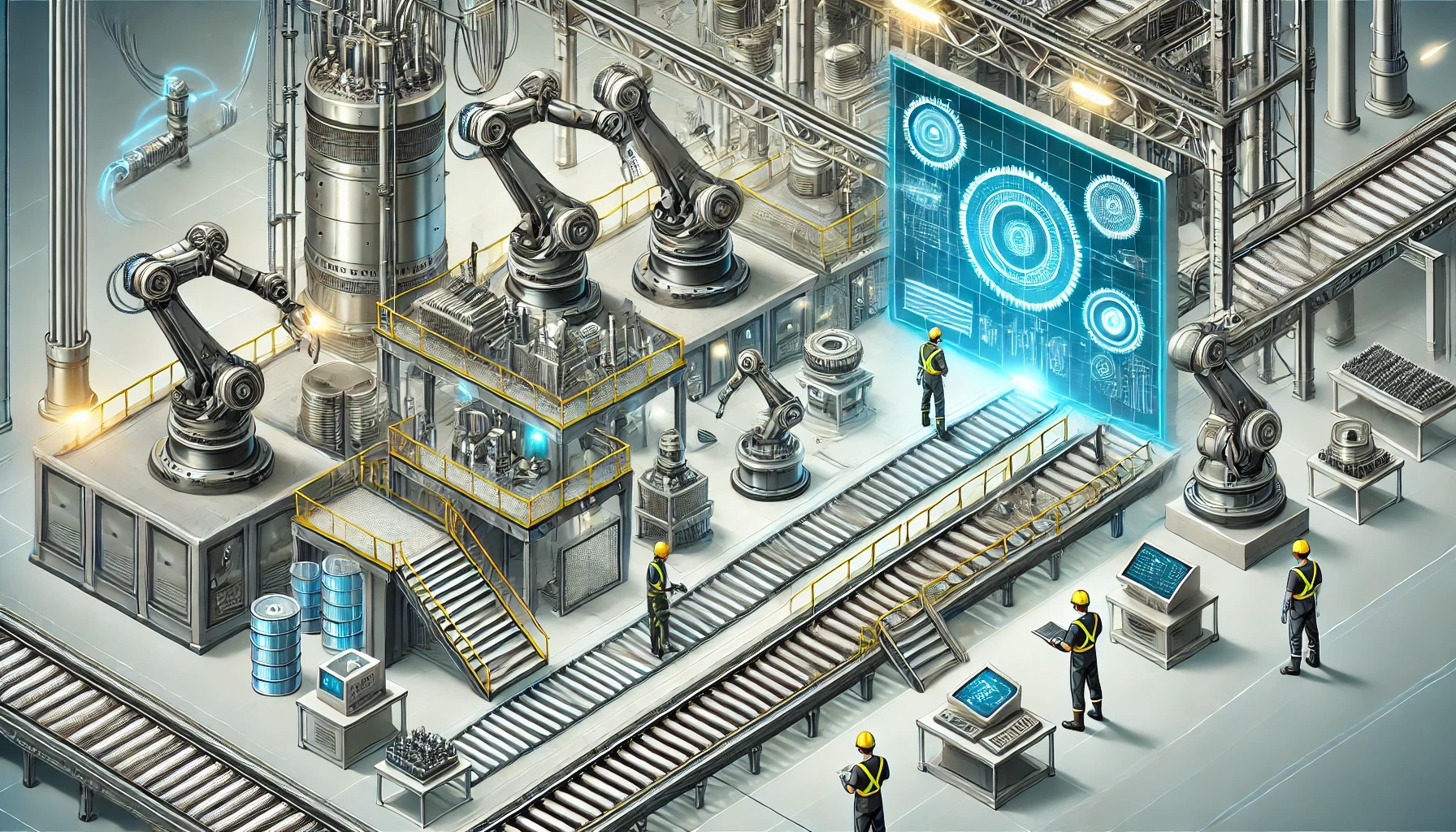
One of the most significant turning points in the modern world is the Industrial Revolution, which accelerated scientific and technical advancements. Capitalism, which has been renewing itself for centuries and maintaining its continuity through technical developments, is currently undergoing a new technical revolution. The name of this new technical revolution is Industry 4.0, or in other words, the Fourth Industrial Revolution.
The Industrial Revolutions, which profoundly transformed social structures, originated and developed in Western societies. Each revolution has led to extraordinary advancements in different fields. Even though these revolutions were not directly experienced in Islamic countries, it is important to analyze the efforts in Industry 4.0 to ensure that these countries do not fall far behind current developments. This article examines the concept of Industry 4.0, its development process, components, and some applications in Islamic countries. In this context, we will analyze the national Industry 4.0 strategy reports shared by Türkiye, Malaysia, and Saudi Arabia.
The Concept of Industry 4.0
The Chairman of the World Economic Forum, Klaus Schwab, considered one of the pioneers in this field, defined Industry 4.0 as the “industrial revolution” of this century, built on the digital revolution (Schwab, 2017, p. 16). On the other hand, Brynjolfsson and McAfee (2015) defined it as the second machine age.
The author of The Long Tail, Chris Anderson, described this process as the digitization of goods and services (Anderson, 2012, p. 29). Jeremy Rifkin, author of The Third Industrial Revolution (2014), referred to it as the “zero marginal cost society.” According to Rifkin, the cost of information is decreasing thanks to the contributions of the sharing economy and open-source knowledge.
Historical Process
The Industrial Revolution can be considered in four separate phases. The first phase is the technical developments between 1750 and 1880, especially in the textile industry and railroads. The second phase is the technical advances in electricity, steel, oil, and automotive fields between 1870 and 1970. The third phase was the change and transformation in the field of computers, communication technologies, and the Internet between 1970 and 2013. The fourth phase, which is still being discussed, represents scientific and technical advancements whose effects are expected to be felt in the coming decades. It is experienced in digitalization, social networks, artificial intelligence, 3D printers, autonomous vehicles, renewable energy, and big data.
Industry 4.0 was first introduced to the public at a fair in Germany in 2011. For this reason, Germany is considered one of the leading countries in this field. Germany aims to substitute the labor force it requires with smart technologies. Another pioneering country in this area is Japan. Japan expressed its desire to create a smart society with the concept of Society 5.0. Because Japan is a rapidly aging country and aims to use technology as a solution to the problem of an aging population. While the U.S. aims to use Industry 4.0 technologies to bring back manufacturing production, which it has lost to Asia, China is determined to retain its most significant strength: manufacturing within its borders.
The Components of Industry 4.0
The Fourth Industrial Revolution consists of many components. Blockchain, big data, artificial intelligence, the Internet of Things, autonomous vehicles, 3D printers, virtual reality, renewable energy, and digitalization are among the key components. With blockchain technology, digital account books are created, and digital objects are transferred securely. The Internet of Things connects devices. Skills related to the human mind are automated and digitized with artificial intelligence. With 3D printing, manufacturing industry production can be done at home or in small workshops. With big data, data is rapidly structured and used as a tool to create value. The automotive industry is being transformed by autonomous vehicles. It is rapidly moving away from fossil fuels by using renewable energy sources.
Türkiye’s National Industry 4.0 Strategy Report
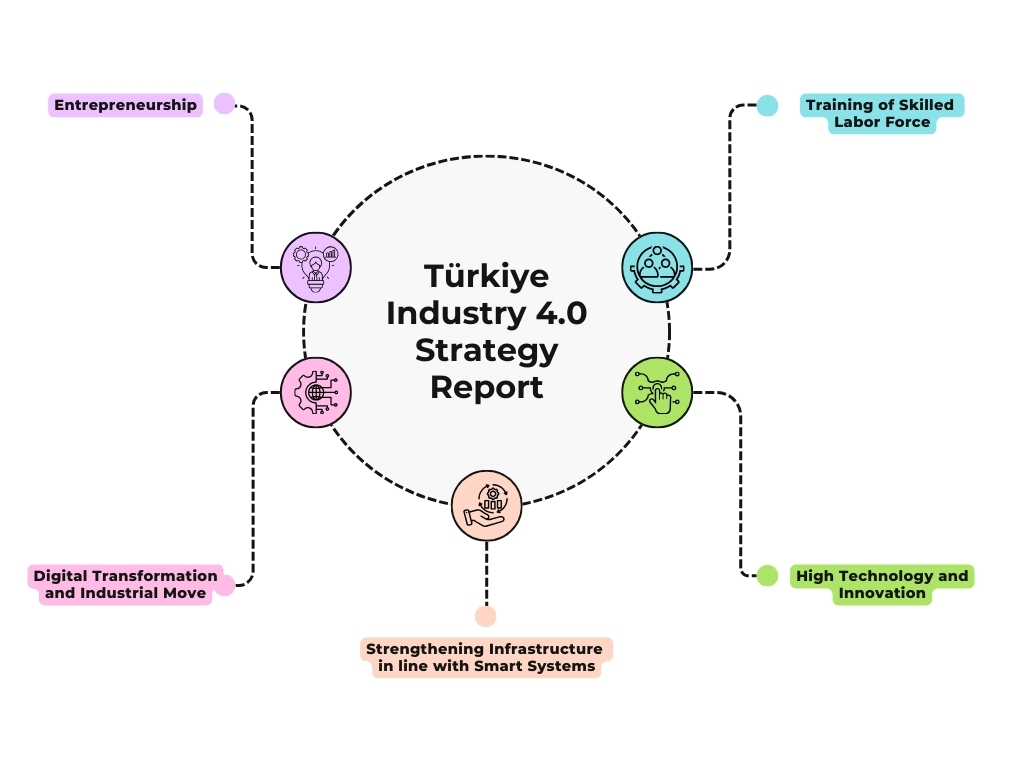
In 2019, the Ministry of Industry and Technology announced a national strategy report called “National Technology Move”. The report aims to counter the concentration of strategic technologies in the hands of certain countries and to become a country that can produce critical technologies with its capabilities. Hence, strategic goals such as building the future, digitalization, achieving technological independence, increasing the level of global competition, and becoming one of the top 10 economies in the world were included. The report is shaped by the concepts of national, domestic, and indigenous, and six main sub-targets have been identified. The graph below shows these objectives:
Graph 1. Republic of Türkiye National Industry 4.0 Strategy Report
Source: Balcı, 2022, p. 80 (re-visualized by The Platform team)
In this context, high technology and innovation must be ensured. Digital transformation of the country’s industry must be realized. Necessary qualified human resources should be trained and educated on new smart technologies. The startup ecosystem should be encouraged and supported. The necessary infrastructure for digitalization and smart systems must be strengthened. In line with these goals, we observe that Türkiye wants to catch up with the new technical revolution and take the necessary steps. It also wants to gain technological independence and become a regional and global power, which is very important for our country, the Turkic countries, and all Islamic countries.
Malaysia’s National Industry 4.0 Strategy Report
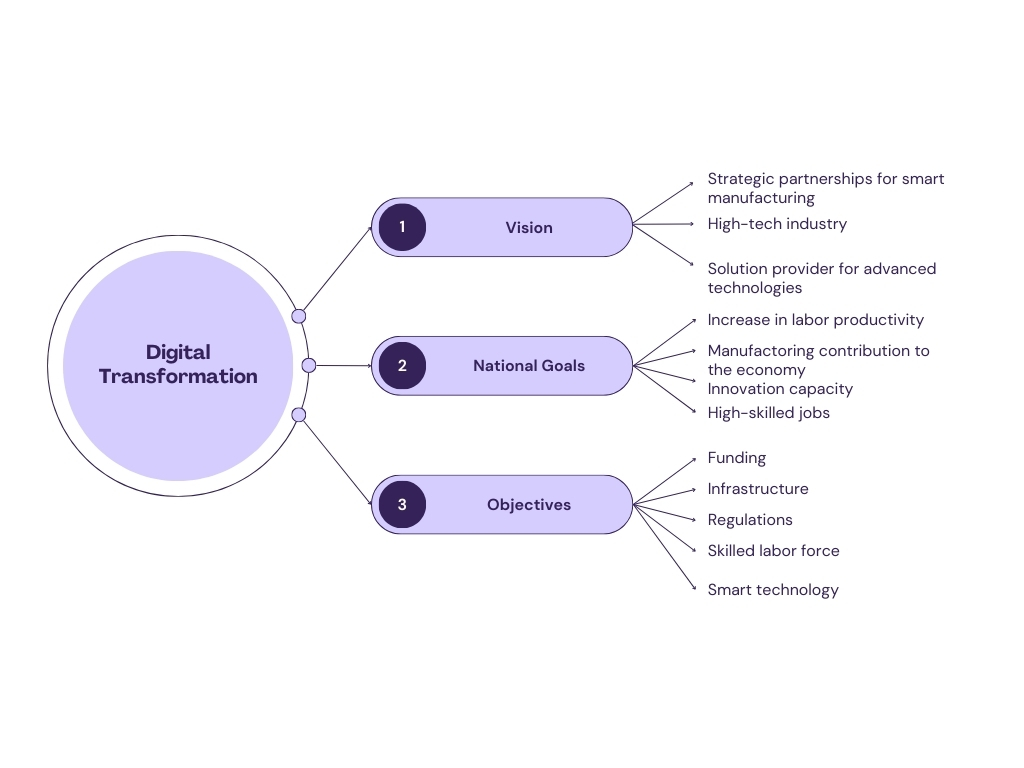
In 2018, the Ministry of International Trade and Industry published Malaysia’s National Industry 4.0 Strategy Report under the name “Industry4WRD”. In the report, the vision, national goals, and the elements that will play a role in achieving these goals are specified. The figure below shows the vision, national goals, and objectives:
Graph 2. Malaysia National Industry 4.0 Strategy Report
Source: Compiled by the author from the report, visualized by The Platform team.
When evaluating the vision of Malaysia’s National Industry 4.0 Strategy Report, it becomes clear that in the next 10 years, the manufacturing sector will be high-tech based, a solution provider will be developed for technology, and strategic partnerships for smart manufacturing and services are desired to be established in Asia Pacific. The national goals in the report are to encourage transformation through increased labor productivity, contribution of production to the economy, innovation capacity, and high-skilled jobs. For the stated vision and goals to be successful, it is necessary to establish a fund that will contribute to digital transformation, provide the necessary infrastructure, make legal regulations, train a skilled labor force, and ensure accessibility to smart technologies. We see that Malaysia supports SMEs, especially in the manufacturing and services sectors, to use industry 4.0 technologies and to ensure digital transformation in the sector.
Saudi Arabia’s National Industry 4.0 Strategy Report
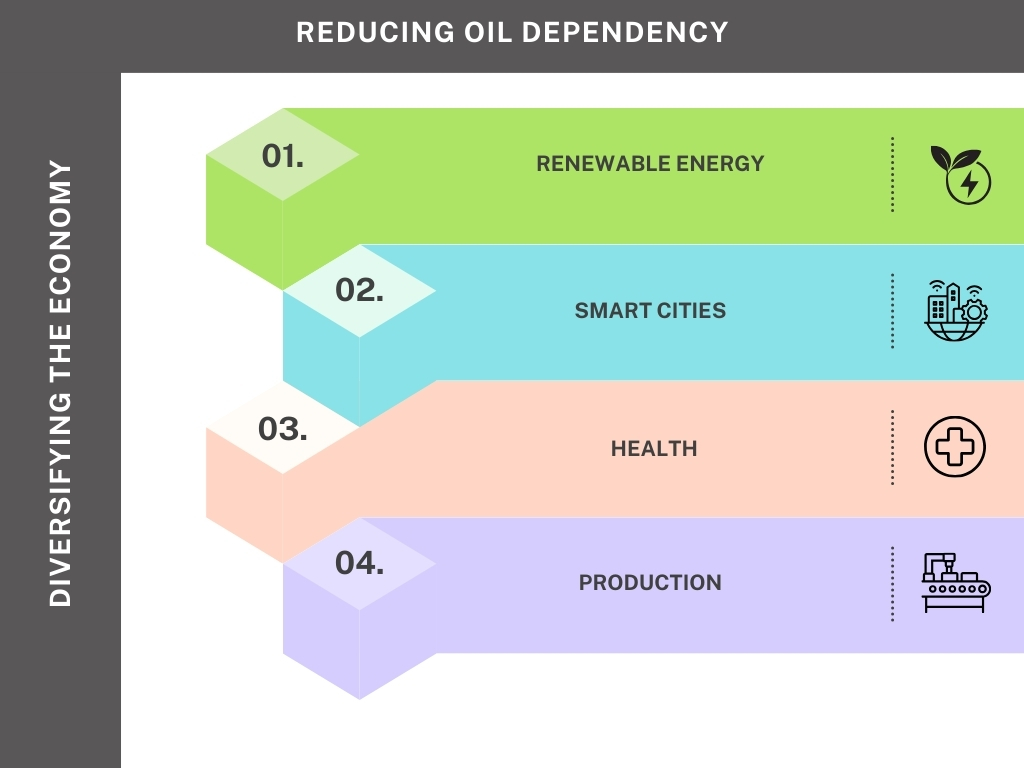
With the report published by Saudi Arabia under the name “Vision2030”, National Industry 4.0 strategy targets were announced. The report states that the primary goal is to reduce the country’s dependence on oil and diversify the economy. The priority areas for economic diversification and the fields where Industry 4.0 technologies will be used are visualized in the graph below:
Graph 3. Saudi Arabia National Industry 4.0 Strategy Report
Source: Compiled by the author from the report, visualized by The Platform team.
According to the national Industry 4.0 strategy report, Saudi Arabia aims to reduce oil dependence and increase investment in renewable energy sources. In addition, it expects to achieve the 2030 vision by creating smart cities, expanding tourism, and investing in production and health. Considering Saudi Arabia’s 2030 goals, it is evident that the country aims to replace the declining global use of fossil fuels with renewable energy and aspires to become an energy country in the future. It is also expected to diversify the country’s economy not only with energy but also with tourism, manufacturing, and health.
Conclusion and Evaluation
New scientific and technical advancements are intensifying the global competition in this field, and many countries are creating strategy reports in line with their own goals and needs. The Republic of Türkiye has declared to the whole world that it will exist in this field with its National Technology Move. It is particularly gaining significant momentum in autonomous vehicles (air, land, and sea). In addition to the UAV-UAV industry, serious investments are also being made in renewable energy and electric vehicles. Indeed, one of the important achievements of Industry 4.0 is to create high-added value. Smart technologies and a qualified labor force should be used together to create high-added value. For this reason, the transformation of the industry and the training of skilled labor force should be among the priority targets.
As one of the significant Islamic countries, Malaysia is not indifferent to the recent technological revolution and aims to establish an industry based on high technology. First, it is desired that digitalization be achieved with the industrial move. In this context, it is aimed to achieve these goals by establishing strategic partnerships in the Asia Pacific. The training of qualified human resources is also an important goal for Malaysia. Thus, it is necessary to establish a fund, address infrastructure needs, utilize smart technologies in production, and make the necessary legal arrangements.
When it comes to Saudi Arabia, oil comes to mind. The country’s economy is based on fossil fuels. However, reduction in the use of fossil fuels has been a topic of discussion for years. In this context, Saudi Arabia has sought to diversify its economy by investing in new technologies and maintaining its influence in energy. For this reason, significant investments have been made in renewable energy, and diversification efforts in the energy sector have been undertaken.
The situation in countries that are considered pioneers in this field can be examined with some examples. For years, Germany has been trying to meet its labor force needs with immigrants. However, the social adaptation of immigrants has not been successful over the years. Germany aimed to meet its ongoing labor force need with smart technologies and aimed to be the leader in world trade. In fact, it both aimed for success in global competition and did not want to experience new problems in social adaptation. Japan is one of the countries with the largest elderly population in the world. It is aimed to use smart technologies as an auxiliary tool both in the field of social services and smart city applications for the needs of the elderly population.
After the 1950s, manufacturing production shifted from the West to the East. Especially in China, due to low labor costs, the country has become a manufacturing production center. On the other hand, the U.S. wants to bring manufacturing back to the West by using smart technologies in production. China, on the other hand, does not want to lose its position as a manufacturing center and is trying to both protect production and continue the transfer of smart technology by offering incentives. In the new era, competition and hostility will emerge between the U.S. and China not only in the military field but also in the commercial and production fields.
As a result, countries’ social, economic, and demographic characteristics have shaped national Industry 4.0 strategy reports. While new technical advances have created new powers, they have also destroyed old powers. According to Schumpeter’s (2016) theory of creative destruction, technological revolutions create innovations on the one hand and destroy the old order on the other. It is clear that closely monitoring Industry 4.0 technologies is essential for a stronger presence in the future.
***
References
Anderson, C. (2012). Makers: The new industrial revolution. Crown Business.
Balcı, B. (2022). Endüstri 4.0 emeğin niteliğini nasıl değiştirmektedir: Türkiye’de Endüstri 4.0 teknolojilerinin uygulandığı işletmelerde nitel bir araştırma. (Doctoral Dissertation). Kırklareli University Institute of Social Sciences.
Brynjolfsson, E., & McAfee, A. (2014). The second machine age: Work, progress, and prosperity in a time of brilliant technologies. WW Norton & Company.
Kurzweil, R. (2016). İnsanlık 2.0: Tekilliğe doğru biyolojisini aşan insan (M. Şengel, Trans.). Alfa Publications.
Mandel, E. (1991). Kapitalist gelişmenin uzun dalgaları. Yazın Publishing.
Ministry of International Trade and Industry (2018). Industry4WRD. National Policy on Industry 4.0. ISBN: 978-967-13593-6-5
Rifkin, J. (2015). Nesnelerin interneti ve işbirliği çağı (L. Göktem, Trans.). Optimist Publications.
Ministry of Industry and Technology (2019). 2023 Industry and Technology Strategy [Industry 4.0 Strategy Report]. T.C. Ministry of Industry and Technology. Retrieved from https://www.sanayi.gov.tr/
Schwab, K. (2017). Dördüncü sanayi devrimi (Z. Dicleli, Trans.). Optimist Publications.
Schumpeter, J. (2016). Capitalism, socializm and democracy. Routledge.
The Embassy of the Kingdom of Saudi Arabia. Vision 2030. Retrieved from https://www.saudiembassy.net/vision-2030