


Modernisation and secularisation in the last century have affected the provision of religious education in schools all over the world. Both Islamic and Christian religious education institutions have been unfavourably affected by this situation. While Christian religious education continues in church schools and their foundations, Muslim communities living in Europe and America have sought solutions within the Islamic schools affiliated with mosques and non-governmental organisations.
In the face of the modern schools that emerged with modernisation, madrasas providing Islamic education could not survive and most of them were closed down. Those that were open were not in demand as much as before. As a result of this situation, a new question has emerged that Muslim societies need to answer; “How to provide Islamic religious education in modern schools?” Muslims living in Europe and America are trying to answer this question with the integrated education programmes they have developed. In this article, Islamic education programmes, which are a response to this question, will be examined in context of the pre-school age group.
IQRA’ Foundation Preschool Education Programme in America
IQRA’ Foundation was established in 1981 in Chicago, USA to develop educational programmes and materials for Islamic schools. The founders of the foundation are Dr Abdullah Ghazi and his wife Dr Tasneema Ghazi. Tasneema Ghazi is also an academic with a PhD in curriculum development in education. IQRA’ Foundation provides educational programmes and teaching materials including Islamic education at pre-school, primary and secondary levels. The educational programmes and textbooks produced by the Foundation are preferred by Islamic schools in the USA, Europe and South Asia.
In addition to curriculum development, IQRA’ Foundation also carries out academic research on teaching methodology for Islamic education in combination with secular education. As a result of these researches, the foundation has developed “unified curricula”, which attempts to synthesise classical Islamic madrasa education with modern pedagogy and address all levels of education from kindergarten to senior high school. In addition to the curricula, the foundation also publishes textbooks, exercise books, teacher support books and student support books. The Foundation’s educational programmes and its 150 educational materials are used as a resource in Islamic schools, especially in North America and other English-speaking countries around the globe (Uzun, 2016).
The “Islamic Experiences” learning area of the Foundation’s pre-school curriculum is one of the first examples of a curriculum in this field and has been widely used by Islamic schools in America, Europe and South Asia for nearly forty years. The Foundation’s “Islamic Experiences” learning area is organised under four headings: Qur’anic Studies, Life of the Prophet Muhammad, Fiqh and Worship, and Islamic History. It is seen that this branch distribution is maintained in the same way in the Foundation’s primary and secondary education programmes. Therefore, the “Islamic Experiences” learning area of the IQRA’ preschool programme constitutes the first step of a 12-year religious education process.
When the general objectives of the programme were analysed, it was found that there was an almost equal distribution among the learning areas, with the affective area being predominant. On the other hand, when we look at the objectives of the Islamic Experiences learning area, it has been determined that 92% of the objectives are related to the cognitive field. It would be appropriate to re-evaluate this situation in the light of current data in terms of the contribution of a knowledge-oriented religious education to children’s religious development in the early period. Current research in this field states that religious education that prioritises the affective domain before the cognitive domain in the early period contributes more to the religious development of children in the long term (Uzun, 2022).
When the curriculum was analysed in terms of content, it was found that the it did not include the teaching of reading the Qur’an. The reason for this is that the same lessons are also included in the primary school level and all related branches (Arabic, English, Qur’an). In addition, the programme includes topics such as revelation, heaven, hell, angels, which are difficult for pre-schoolers to make sense of and may be frightening for some sensitive children. In terms of the appropriateness of these subjects for a certain age group, the programme should be revised in line with current data.
In addition, it is seen that the programme makes a special effort to integrate religious education with other branches. For example, while teaching science to children, it is seen that the perspective of creation by God is emphasised and an understanding of science that gives an Islamic perspective is aimed to be established.
Tarbiyah Foundation of America Preschool Education Programme
Prof. Dr Dawud Tawhidi, The founder of the Terbiye Project, (1950-2010), is an American-born Muslim educator. Immediately after converting to Islam in 1972, Tawhidi studied Arabic at Leigh and Pennsylvania Universities. In 1980, he completed his Usulu al-Dīn studies at Al-Azhar University in Cairo and began teaching in Muslim schools in Philadelphia. After completing his master’s degree in Islamic Studies at the University of Michigan in 1983 and PhD in 1985, Tawhidi worked as a lecturer at the university. Tevhidi’s research interests are as follows: Model of Islamic Philosophy of Education, Early Islamic Educational Institutions, Semantic Structure of the Qur’an, and Worldview of the Qur’an.
Dawud Tawhidi has made a major contribution to the shaping of Islamic education in North America, and his most important work in the field of religious education is the Terbiye Project. The Foundation has published an 80-page framework educational programme, “Tarbiyah Overview”, which explains the basic philosophy of the project. The Terbiye Project is a values education programme developed within the framework of the concept of Tawheed, which is followed by Muslim schools in the USA, Indonesia and Malaysia, especially the Crescent Academy schools founded by Dawud Tawheed in the USA.
The American Tarbiya Project is a curriculum framework that considers it necessary to take into account Islamic knowledge and the Islamic perspective at all levels and in all subjects when formulating the curriculum. The purpose of the Tarbiyah Project is to determine the principles of applying Islamic knowledge to the education system or curriculum. The programme ultimately aims to develop a God-centred, comprehensive perspective based on a universal outlook. The most fundamental goal of the programme is to bring the human nature to perfection. The Education Programme argues that learning is a transformative process rather than a purely informative process.
The Terbiye Project proposes an educational programme based on the Integrated Learning Model (IILM) developed by Dawud Tawhidi. This programme proposal offers a holistic model of Islamic education based on the principles of tawheed and decency, which incorporates the answers to the fundamental questions of education such as “What should we teach?” and “How should we educate?”.
The framework programme, which aims to help determine the content that is critical to the Terbiye Project is based on seven main themes that emerge from a God-centred perspective. These themes are: God-consciousness, noble character, useful knowledge, healthy living, human relationships, faith-based action and public service.
The project divides an academic year into three semesters, and in each semester it chooses two or three core subject areas. For example, if the subject of the first month of the first term is Spiritual Literacy (God Consciousness-Tawhit), teachers at all levels and in all branches are obliged to address this subject in their lessons and social activities and to synthesise the subjects in their curricula with the subject of Tawhit.
The draft curriculum developed by the Terbiye Foundation is crucial in guiding how Islamic education can be integrated into the modern education programme at all levels and in all branches.[1]
UK Islamic Shaksiyah Foundation Preschool Education Programme
The Islamic Shahsiyet Foundation in the UK was founded by Muslim mothers who did not want to entrust their children to secular state schools (Ahmed, Sabir, 2019, p.119). Shahsiyet Foundation Schools aim to educate children as a whole in physical, intellectual, emotional and spiritual aspects.
The foundation’s schools do not have Islamic Religion classes and teachers as a separate subject (Ahmed, Sabir, 2019 p. 120). Instead, in primary schools, class teachers lead circle times, which begin with the recitation of the Qur’an and end with prayer, usually with a curriculum-determined topic that has a relevance to Islam (Ahmed, Sabir, 2019 p. 120). The aim of the circle time is to provide children with an Islamic perspective and critical thinking skills, where questioning is encouraged. The aim of the circle time is to introduce Islam to children by connecting it with their daily life experiences. For Muslim children living in a non-Muslim society, circle time is also considered to be a safe space to understand and discuss how non-Muslims view Muslims’ worship and lifestyle and where they differ from Muslims (Ahmed, Sabir, 2019, p. 121).
The daily circle time conversations provide the basis for the religious education curriculum of Şahsiyet Schools. The religious education programme, which is referred to as the circle curriculum, includes the topics of memorisation, tarbiyah, talim and tedip in Şahsiyet Foundation Kindergartens. Memorisation covers the memorisation of short suras, hadiths and prayers at the preschool level. What is meant by the concept of discipline is to conceptualise the connection between children’s daily life experiences and Islamic teachings. While basic knowledge about the Islamic faith and teachings is given under the title of talim (instruction), information about the children themselves, their relationship with Allah and their awareness of servitude is given under the title of tedip (treatment) (Ahmed, Sabir, 2019, pp. 120-122).
The Foundation has a kindergarten in London called Tıfli Daycare, which gives education to children between the ages of 3-5. The basic activities included in the daily programme of the Foundation’s Kindergarten are as follows;
– Morning Prayer, Hadith Reading and Memorisation
– Circle Hour (includes Aqeedah, Worship, Sunnah, Adab and Morals)
– Teaching Arabic Reading and Writing
– Qur’an Reading and Memorisation
– Islamic Children’s Songs and Music Education
Apart from these, the activities that are included on a daily basis are story reading and telling, drama, art, lego and building games, sand and water activities, garden games, technology and media, which are also used in other preschools.
The education programme of the Islamic Shahsiyet Foundation is important as an opportunity to set an example of how Islamic religious education can be delivered without a separate Islamic religion course, synthesised with the curriculum and made a part of the institutional culture.
USA Noor Kids Character Development Programme
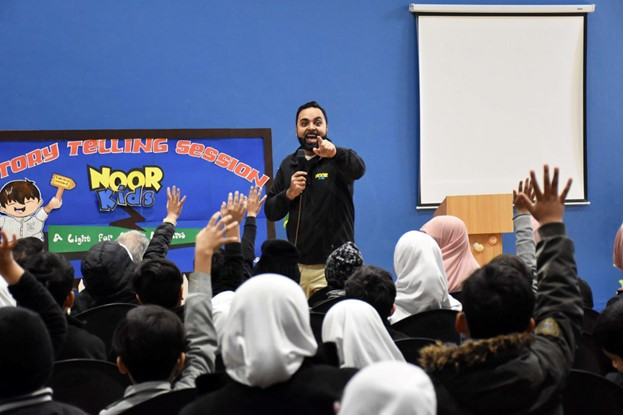
In addition to these programmes, there is an example of an Islamic education programme developed in the USA called Noor Kids, which is developed for use in home-schools and schools and has an online education infrastructure. Noor Kids is an educational institution that creates programmes and produces digital and printed resources in the field of early childhood Islamic religious education. It was founded in 2016 in the USA and receives educational counselling from Harvard University (Aaser, n.d., p. 2).
The “Noor Kids Character Building Programme” was developed as a result of research conducted at Harvard, Berkeley and San Francisco State Universities. The programme is used by 25,000 families from 25 countries. Families participating in the programme receive two educational storybooks prepared for children aged 4-9 per month. Besides, the programme includes weekly online children’s sermons prepared for children. In the children’s sermons, the topic of the week is explained through stories, art activities and a humorous style. Children collect the badges in the storybooks in their Global Muslim Citizen Passports given to them by the programme. In addition, animated films, professionally drawn and dubbed, related to the theme are produced for children and shared with the participants of the programme (Aaser, n.d., p.3). There are 36 themes in the programme covering character, citizenship, and faith. Each month, documents related to a theme (two storybooks, an animated film, and a weekly online children’s sermon) are sent to the children participating in the programme. In addition to the home-school programme, Noor Kids also provides consultancy to Islamic schools on curriculum, materials, and teacher training.
The main characters of the storybooks, Emin, Shirin, Amira and Assad, are four Muslim children attending a public school in a non-Muslim society. The characters of the cartoon film are represented by animal figures in order to be at an equal distance to children of different ethnic backgrounds. Each storybook contains two stories. In the stories, sample events and problems that children may encounter in their daily lives are included, and questions are asked to encourage the development of critical thinking skills to solve problems (Aaser, n.d., p. 5).
Conclusion and Assessment
Muslims living in the last century have developed different approaches and educational programmes to find a place for Islamic education in modern schools. IQRA’ Foundation, Tarbiyah Foundation, Islamic Shakhsiyah Foundation and Noor Kids are just a few examples of these programmes that are reviewed in this analysis. The efforts of Muslim societies to create a space for Islamic education in modern societies and the resulting educational programmes and materials are of great importance as an example for institutions in similar pursuits.
The IQRA’ Foundation Programme can be considered as a version of the Imam Hatip Schools that exist in Türkiye, which also provide education at pre-school and primary school levels. The Islamic Shakhsiyah Foundation is an example of how religious education can be provided at an early age without religious education classes and teachers. The Taribyah Foundation sets a precedent on how to prepare a whole school curriculum from an Islamic perspective, while the Noor Kids Programme is a good example of online Islamic education.
References
Aaser, A., (t.y.) The noor kids akhlaq building program: Program for communities and Islamic schools. Brooklyn: Noor Kids Publication.
Ahmet, F. & Sabir, T., (2019). Developing shakhsiyah Islamiyah personalised character education for British Muslims, E. Bakarm(Ed.), In Rethinhinking madrasah education in a globalised world (s. 118-134). UK: Routledge.
Tauhidi, D. (2001). The tarbiyah project: A holistic vision of Islamic education. Retrieved February 6, 2023 from https://www.yumpu.com/en/document/read/15570725/tarbiyah-project-iit-
Uzun, S. (2016). Okul öncesi dönem din eğitimi (İslam dini) programlarının karşılaştırmalı değerlendirilmesi Türkiye ve Amerika örnekleri. (Unpublished master’s thesis). Istanbul University Institute of Social Sciences, İstanbul.
Uzun, S. (2018). İslam eğitiminde program geliştirmede yeni bir eetodoloji: Amerika terbiye projesi örneği. H. N. Aslanoğlu, S. Özil (Haz.) In International congress on Islamic education 2018 Proceedings Book (p. 555-567). Istanbul: YEKDER Publications.
Uzun, S. (2022). Okul öncesi din eğitiminde program geliştirme süreçlerinde ilke ve yaklaşımlar. (Unpublished doctoral dissertation). Marmara University Institute of Social Sciences, İstanbul.
[1] For detailed information on the Terbiye project, see the author’s paper titled “A New Methodology in Programme Development in Islamic Education: The Case of the American Terbiye Project” in the Proceedings of the International Islamic Education Congress 2018.