




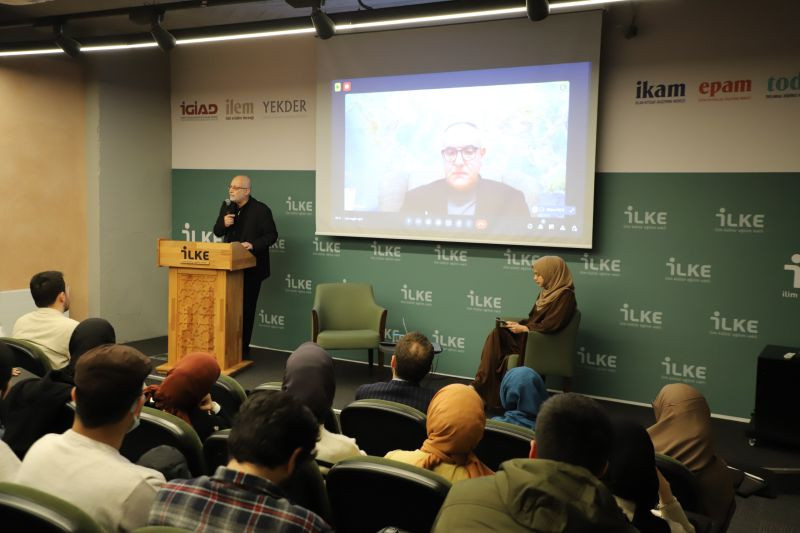
Mutaz Qafisheh: My talk will be divided into two parts. First, I will talk about the genocide case that South Africa brought against Israel to the International Court of Justice. The second part will be dedicated to the impact of the Gaza war and the decision of the International Court of Justice on the international discourse and international law in general. The decision of the International Court of Justice that was delivered on January 26 regarding the genocide that is taking place in Gaza right now is historical. Because it is the first time in history that such type of genocide is taking place in an unprecedented way. Until now, we have about 100,000 Palestinian martyrs, about 30,000 who were murdered by the Israeli forces, and more than 70,000 Palestinians who were injured by Israeli forces, which is about 5% of the entire population of the Gaza Strip.
In addition to the destruction of more than 80% of the buildings in Gaza, the destruction of deliberately targeted hospitals. And, as I speak now, the Israeli forces are invading the Nassar hospital in Khan Yunis. It is probably the first time since the Second World War that hospitals are directly targeted by military forces, of course, all along with the destruction of schools, universities, municipalities, courts, bar associations, and all facets of life. If we take, for example, the five cases of genocide that have been pleaded before the International Court of Justice, this would probably be the highest number of casualties and mass destruction in comparison to the other cases, such as Bosnia, Croatia, or Myanmar cases. But this decision is a historical one because it is the first time that Israel has been brought to the International Court of Justice and charged with genocide. Nobody would have imagined, when the Genocide Convention was crafted in 1948, that Israel, for which the Genocide Convention was drafted after the Holocaust, would be charged with committing the holocaust for or against other people.
In regards to the case, nobody expected that the court would decide this significant majority against them; 16 judges said that the genocide in Gaza was plausible. That means that there are serious indications that genocide is taking place in Gaza. However, we were not expecting that this high number of judges would decide that there is genocide because of the compulsion of the court. Actually, the composition of the court was not promising because we have judges from the United States, Germany, Slovakia, India, Australia, Australia, and Uganda, and most of these countries’ policies are pro-Israel. But I think it was overwhelming for the judges to decide that there is genocide in Gaza because the facts speak for themselves. So, I also think this judgment will have a far-reaching impact and result in other aspects of international law, including international criminal law. I expect, and I hope that the prosecutor of the International Criminal Court, Karim Khan, will take action soon to bring charges against the officials who are committing the crime of genocide, which is the crime of the crimes. This genocide was committed by Israeli officials who declared publicly that they were going to erase Gaza and commit actions that are genocidal by character in addition to the intention that was declared publicly by the Israeli Minister of Defense, Israeli Prime Minister, and a number of other cabinet ministers. But of course, I know some people were disappointed by the judgment because the Court did not declare a ceasefire. I know that there are different opinions in this respect. Still, I think the essence of the court order is to apply or to enforce a ceasefire in Gaza because the court ordered the cessation of genocidal acts, the opening of the crossings for Gaza for humanitarian aid, and stopping all incitement for genocide.
Some people were hoping that the court would order the ceasefire directly, but given the composition of the court, that would have been a bit difficult, as indicated by the German judge in the court that the court would not decide on other general international law issues, including the issue of self-defense, ceasefire, self-determination and the application of international humanitarian law. Yet the order is very clear and imposes obligations on Israel. Also, what we call in international law erga omnes obligations, which require that all states take actions to stop genocide in Gaza, based on the genocide convention. There are 153 states that are members of the Genocide Convention, and all of them have so-called erga omnes obligations to stop genocide, challenge Israel, and take action against the Israeli genocidal acts in Gaza. On the 19th of February, the Court will conduct a hearing from February 19 to February 26 regarding the legality of the Israeli occupation. Fifty-two states and three international organizations will be speaking at the court.
On the other hand, the other aspect is the impact of this decision on international law generally. International law is quite significant for us as Palestinians and indeed for all those who are living under oppression. International law is the tool for us to claim and continue claiming our rights. I think giving up on international law or not calling for the implementation and enforcement of international law will be a gift for those who abuse international law. International law is the tool for the Palestinians to address the illegality of the Israeli settlements, the Israeli annexation of East Jerusalem, and the Israeli confiscation of Palestinian land and water resources. Also, the right of return for Palestinian refugees is based on international law, and the International Criminal Court, in particular, is the tool by which the Palestinians can claim that the court has the duty to investigate and punish those who are committing crimes in Palestine.
The International Law Before and After October 7
I think international law before October 7 is different from international law after October 7. What happened after October 7 showed very clearly the international or Western hypocrisy in dealing with international law and how they approach international law. In the case of Ukraine and the case of Palestine, those who crafted international law, particularly international human rights law and international humanitarian law, are the very violators of international law. Because they are not only not trying to prevent, but they are even complicit and are supporting Israel in violating international law. Germany, for example, punishes anyone, especially after October and November, who calls for a ceasefire, so if you are calling for peace and a ceasefire, you will be charged by the German police. What hypocrisy would be more than that? International law was undergoing a historical transformation even before October 7; we could see that certain powers in the world were trying to find a more just international order and law that would be enforceable.
We could see that in Ukraine and China, so-called BRICS countries are trying to find an alternative to the international security order created after the Second World War, whereby the Western colonizers are dominating the international order and including international law. In the coming years, we will witness a certain transformation of the international order. Western countries are aware of this fact and know that Western civilization, especially American hegemony, is declining, and they are trying to stop this fact from happening. But I think what happened on October 7 will accelerate that process of the decline of the Western hegemony and colonization of international law towards more just international law and international order.
Of course, it’s a difficult moment for the Palestinians and Gaza, but that might contribute to putting more pressure on international organizations, including the United Nations, to recognize the state of Palestine, recognize the rights of Palestinians, to end the Israeli occupation, and probably the next decision of the International Court of Justice regarding the illegality of Israeli occupation. They might impose certain obligations on all states in the world to contribute to putting an end to the Israeli occupation by actions, for example, imposing certain sanctions, including diplomatic sanctions and commercial boycotts, to grant Palestine full membership in the United Nations to recognize the right of the Palestinians to self-determination, including the right of Palestinian refugees and the liberation of Palestine from the Israeli colonization not only in words but also in practice.
The impact of October 7 and the decision of the ICJ will be felt in the international legal order in general. Gaza will be the stone upon which international law will be tested and be clearer toward a more just international order. I think international law is changing, and international justice and other actors will contribute to the new international order, including many of the countries in the South of the world.
Symbols of the Struggle for Existence: South Africa and Palestine
Sami Al Arian: The question of “Why South Africa?” is very important because South Africa has been a symbol of the South African struggle for existence for decades and culminated in the 1980s until Nelson Mandela was freed in 1990 and then elected president in 1994. This is very important because South Africa is the symbol of an oppressive imperialist mentality. So, for South Africa to bring this to the attention of the world is very significant. Indeed, no other country was willing to do it, including Muslim countries. Fifty-seven countries have 5 million soldiers, 5500 airplanes, 22,000 men, and thousands of artillery. And all these countries with all these facilities couldn’t bring one bottle of water to Palestine unless Israel said yes. However, we have one country that brought this to the International Court of Justice. Now, a lot of people don’t know what that means, but it is indeed very important because, for the first time, Israel is brought under scrutiny. South Africa presented an impeccable case with an 84-page report and wrote the charges against them in a way that makes it very difficult to deny what happened. A lot of people say this is a political case as well as a legal case, and therefore, because many of the countries on that court were supportive of the Israeli genocide, that they’re the people who are representing these countries would probably try to sway or not be forthcoming or no role in a way that would be in favor of the Palestinians here.
The Details of the Trial at the International Court of Justice
14 out of the 15 judges in the Court accepted the South African case. South Africa asked for nine demands, while Israel asked to dismiss the case because there was no direct dispute between South Africa and Israel. The court rejected all of Israel’s demands and accepted the demands of South Africa. But we have to remember that South Africa did not ask for a ceasefire. A ceasefire is a term used between states, and what’s happening in Gaza is not between states since Hamas is not the state. Israel is trying to achieve what it couldn’t achieve back in 1948, which is the complete expulsion of Palestinians from Palestine. The Court of Justice came with these six rulings, which effectively declared that Israel has to keep records of all the things that are taking place in Gaza; it cannot incite against Palestinians; it must open all doors to help the Palestinians and get all the aid needed to the Palestinians, and the last one, it also has to present a report of what’s taking place. Now, what was Israel’s response? Totally ignored it. So, the political implications are significant because those who help Israel commit genocide are as guilty as the one who commits genocide according to the Genocide Convention, which means the United States is also implicated.
Let me conclude by saying there are many important implications of this. First of all, this is the first time that Israel is facing the court, an international body that is going to say it is guilty of genocide. Unfortunately, the wheel of justice is very slow, so it will probably take two years before they determine that. But in that ruling, it says that there are plausible cases of genocide that by itself puts it into the light that it is committing genocide. Secondly, those who help Israel to commit are themselves implicated. Third, anyone who will prevent genocide is justified. It cannot be said, as the US or the UK says, “You cannot have Israeli shipping because that would lead to disruption of international trade,” because anyone trying to prevent the genocide is justified by international law. Fourth, for example, if Türkiye, as a powerful and regional country, was waiting for someone to help and saying that we don’t want to move alone, it could go and help the Gazans. They cannot necessarily stop the genocide, but at least give them the aid, medicine, food, water, and electricity that they deserve, and they can do that on by international law. Because that ruling says that all aid must reach the Palestinians, and no one can, meaning Israel, prevent that aid. So, it will be armed by international law. However, what is missing here is the political will because the US as a state basically controls the international order that it created; everybody is afraid of the US. And I say if countries are afraid, it is then the people who have to move and force their governments to do the right thing.
Editor’s Note
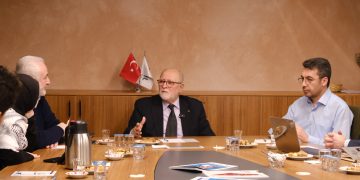
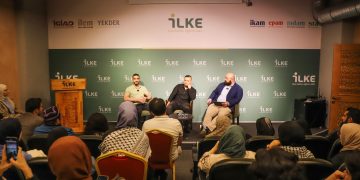
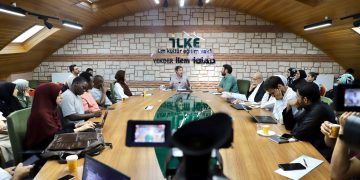
The seminar titled “Israel on Trial at the International Court of Justice: Legal and Political Implications”, organised by İLKE Foundation on 15 February 2024 and delivered by Mutaz Qafisheh and Sami al-Arian, was edited by Elif Sağır and Safiya Faroukh for Platform readers.