



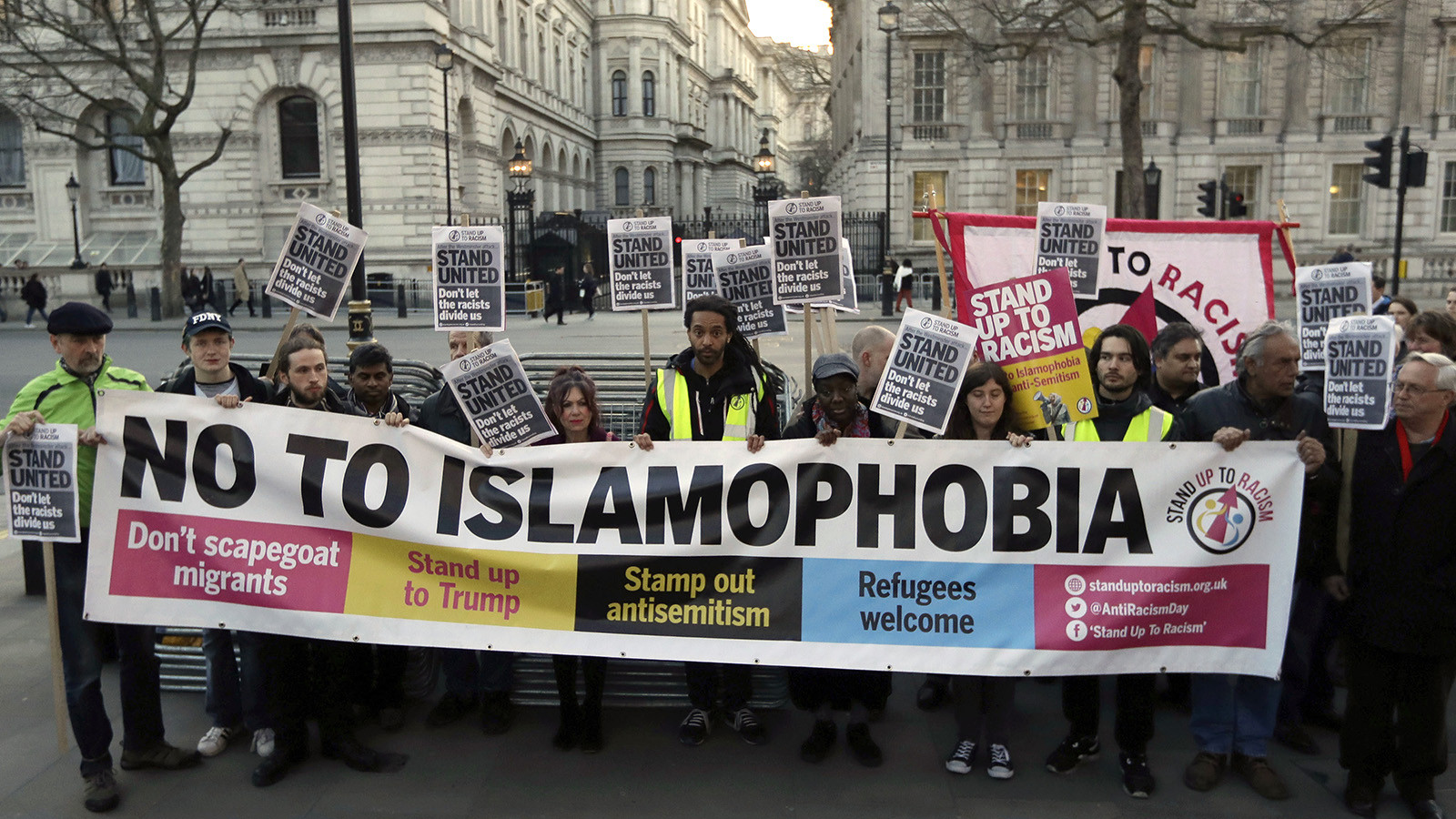
Islamophobia in Kosova -despite being a Muslim-majority country- marginalizes Muslim identity through narratives that portray Islam as foreign and incompatible with national identity. This extends to education and employment, where practices like wearing the hijab face discrimination, highlighting ongoing struggles for acceptance and the need for greater recognition of religious expression.
Islamophobia is often examined in Western societies where Muslims are a minority, with countries like France, Germany, and the United States receiving significant attention. However, its presence in Muslim-majority societies remains understudied, as highlighted in the book Islamophobia in Muslim Majority Societies (Bayraklı & Hafez, 2019). While the book explores various cases, it omits Kosova – a striking example of a Muslim-majority country grappling with Islamophobia. Due to Kosova’s geographical positioning within continental Europe and its constant desire to fully integrate into the Euro-Atlantic alliance, one would assume that Kosova would be the subject of more research within the field, especially considering its proximity to whiteness. However, despite these factors, Kosova remains largely overlooked in academic and political discussions.
Kosova, an Albanian-majority state in the Western Balkans, was part of the Ottoman Empire for nearly five centuries, during which many Albanians converted to Islam. Following the Empire’s decline, European colonial powers redrew Balkan borders in 1912, severing Kosova from Albania and placing it under Serbian rule. This colonial partition subjected Kosova’s Albanians to systemic repression and forced assimilation. In the 1990s, Kosova endured a Serbian-led genocide, marking a critical chapter in its ongoing fight against oppression and for self-determination. Today, as the European country with the highest Muslim population at 93% (Kosova Agency of Statistics, 2024), Kosova faces both explicit and implicit Islamophobia, shaped by Eurocentric narratives that frame Islam as antithetical to European identity.
Islamophobia in Kosova across Education, Employment, and Society
Islamophobia in Kosova takes various forms, each serving to marginalize and even erase Muslim identity. One common manifestation is the portrayal of Islam as foreign to Albanian identity, as if Islam were an imposition rather than an integral part of the region’s history for centuries. This claim ignores the deep historical presence of Islam in Kosova and seeks to present Albanian national identity as inherently secular or Christian. A striking example of this is the “Deçan Movement,” which openly calls for Albanians to renounce Islam, framing it as anti-human and incompatible with national values (Lëvizja e Deçanit, Facebook). The movement’s leaders use social media to propagate the idea that the Islamic faith is a direct threat to Albanian identity, reinforcing the false notion that Islam is inherently foreign.
Due to Kosova’s geographical positioning within continental Europe and its constant desire to fully integrate into the Euro-Atlantic alliance, one would assume that Kosova would be the subject of more research within the field; however, despite these factors, Kosova remains largely overlooked in academic and political discussions.
A key mechanism of Islamophobia in Kosova is the conflation of religiosity with extremism—an idea rooted in Eurocentric secular frameworks that consider visible expressions of Islamic faith as inherently destabilizing. This logic positions practicing Muslims, particularly those who wear religious attire, as threats to modernity. By constructing Islam as an obstacle to progress, this discourse pressures Muslims to suppress their religious identity to be accepted as “European” or “civilized.” The implication is that full participation in society requires conforming to a secularized, Westernized ontological framework, where religious identity, particularly Islam, is viewed as incompatible with modern, acceptable notions of self and society.
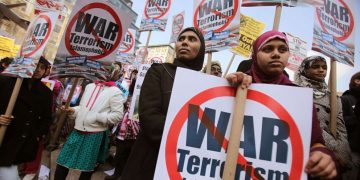
The restriction of hijab-wearing students from attending school highlights the impact of this secularized ontological framework, which demands conformity to Western norms at the expense of religious expression. In September 2023, several cases emerged in which girls wearing the hijab were barred from schools in Gjakovë, Shtimë, and Pejë (Karemani & Luboteni, 2024). Officials justified these exclusions with secular dress codes despite constitutional protections for religious freedom. These policies regulate Muslim identity, perpetuating the idea that visible expressions of Islam undermine national belonging. However, student protests challenge this narrative, affirming that religious expression is integral to Kosova’s society, not a deviation from it.
Hijab-wearing women, often perceived as oppressed, face systemic discrimination in professional settings, where their choice of dress is seen as a barrier to participation in society.
The marginalization of Muslim women extends beyond the classroom and into the workplace. Hijab-wearing women, often perceived as oppressed, face systemic discrimination in professional settings, where their choice of dress is seen as a barrier to participation in society. A landmark case in 2022 saw Kosova’s Court of Appeals ruling in favor of Indira Mujaj, a hijab-wearing police officer who had been suspended from duty (Ferizaj, 2023, p. 381). While her victory underscored the rule of law, it also highlighted the ongoing struggles Muslim women face to integrate into the workforce fully. Additionally, government institutions have shown hesitation in accommodating Muslim practices. In Kamenicë, an official email announcing reduced working hours for fasting employees during Ramadan was swiftly retracted following public backlash (Karemani & Luboteni, 2024). The municipality went so far as to deny having sent the email, sending a clear message that acknowledging Muslim needs is politically inconvenient.
Islamophobia also manifests in efforts to downplay or erase Muslim identity from national narratives. Historical figures who were openly Muslim are often secularized in popular discourse, with their Islamic faith minimized to fit a narrative that excludes Islam from the national story. The most notable example of this is Albanian national hero Adem Jashari, who was martyred during the liberation struggle against Serbia in 1998. Jashari was both Albanian and Muslim, yet certain commentators deliberately obscure or diminish his religious identity, attempting to strip him of his Muslimness. For example, the well-known journalist Milaim Zeka made a controversial statement on an online talk show, expressing concern over what he described as “dishonorable” efforts to portray Adem Jashari as if he belonged to the “religious Muslim sect.” He then attempted to refute this portrayal by claiming that Jashari regularly consumed beer and raki during holidays (Kojshia Show, 2020). This argument is both logically flawed – alcohol consumption does not exclude one from being Muslim – and historically inaccurate, as it is well-documented that Jashari observed Ramadan (Bota Sot, 2021) and came from a devout family, with his father having been educated as an imam (Gazeta Selam, 2021).
Albanianism and the Marginalization of Muslim Identity in Kosova
In Kosova, one subtle but powerful way Islamophobia is spread is through Albanianism, the idea that national identity supersedes all other forms of belonging. Though often framed as a unifying force, it marginalizes religious identities, particularly Islam. The notion that “we are Albanians first” is not a neutral statement but a colonial imposition, pressuring Albanian Muslims to suppress or erase their religious identity in favor of a secular national ideal. Albanianism selectively aligns national identity with European secularism and distances it from Islam, while Christian identity is embraced as part of the national character. Kosova’s prime minister, Albin Kurti, exemplified this subtle Islamophobic rhetoric when he stated in a January 2025 New York Times article, “For us, religions came and went, but we are still here. For Albanians, in terms of identity, religion has never been of primary importance” (Higgins & Mejdini, 2025). This rhetoric reflects how Albanianism shapes the boundaries of acceptable identity, privileging a Europeanized, secular (de-Islamicized) conception of Albanianism.
The notion that “we are Albanians first” is not a neutral statement but a colonial imposition, pressuring Albanian Muslims to suppress or erase their religious identity in favor of a secular national ideal.
In conclusion, Islamophobia in Kosova manifests through various mechanisms that marginalize Muslim identity, framing Islam as incompatible with modernity and European values. This is evident in the exclusion of hijab-wearing students from schools, the discrimination faced by Muslim women in the workplace, and the broader societal pressures to suppress religious identity. These practices reflect a deeper cultural narrative that equates secularism with national belonging and creates obstacles for Muslims in asserting their religious identity within Kosova’s social and political sphere.
***
Editor’s Note: Although the name of the country is commonly referred to as “Kosovo” in Serbian and English, decolonial Albanians advocate for the Albanian spelling with an “a” at the end, i.e., “Kosova” as a reflection of political and cultural identity.
***
Bibliography
Bayraklı, E., & Hafez, F. (Eds.). (2019). Islamophobia in Muslim majority societies. New York: Routledge.
Bekim Jashari: Po, Adem Jashari e Hamëz Jashari kanë mbajtur Ramazan. (2021, April 23). Bota Sot. https://www.botasot.info/aktuale-lajme/1567571/bekim-jashari-po-adem-jashari-e-hamez-jashari-kane-mbajtur-ramazan/
Ferizaj, A. (2023). Islamophobia in Kosova: National report 2022. In E. Bayraklı & F. Hafez (Eds.), European Islamophobia report 2022 (pp. 365–386). Vienna: Leopold Weiss Institute.
Gazeta Selam. (2021, April 14). Baba i Adem Jasharit ishte Hoxh e thotë Bekim Jashari [Video]. Facebook. https://www.facebook.com/watch?ref=search&v=223260796263958
Karemani, S., & Luboteni, J. (2024). Islamophobia in Kosova: National report 2023. In E. Bayraklı & F. Hafez (Eds.), European Islamophobia report 2023. Vienna: Leopold Weiss Institute.
Kojshia Show. (2020, July 26). Milaim Zeka: O hoxhollar mos e përzini Adem Jashari me fe! Ja pse [Video]. YouTube. https://www.youtube.com/watch?v=ulMja8MGaRA
Higgins, A., & Mejdini, F. (2025, January 4). A move toward Christianity stirs in a Muslim land. The New York Times. https://www.nytimes.com/2025/01/04/world/europe/Kosova-albanians-christianity-islam.html#:~:text=Kosova’s%20ethnic%20Albanian%20prime%20minister,was%20never%20of%20first%20importance.%E2%80%9D
Lëvizja e Deçanit. (n.d.). Lëvizja e Deçanit [Facebook page]. Facebook. https://www.facebook.com/profile.php?id=61557071351973