








İLKE Vakfı
Platform
No Result
View All Result
  • PLATFORM
  • HABERLER
    İLKE Agenda: Muzzammil Ayyub Thakur ile Keşmir’in “Filistinleştirilmesi”

    İLKE Agenda: Muzzammil Ayyub Thakur ile Keşmir’in “Filistinleştirilmesi”

    İLKE Agenda: Muzzammil Ayyub Thakur ile Keşmir’in “Filistinleştirilmesi”

    The Platform Talks: Kinda Hawasli ile 8 Aralık Sonrası Suriye

    İLKE Agenda: Muzzammil Ayyub Thakur ile Keşmir’in “Filistinleştirilmesi”

    The Platform Talks: Azzam Tamimi ile 7 Ekim Sonrası Filistin

    İLKE Agenda: Muzzammil Ayyub Thakur ile Keşmir’in “Filistinleştirilmesi”

    İLKE Agenda: Gazze Soykırımı Günlerinde Aktivizm ve İslamofobi

    Filistin Sempozyumu: Filistin ve Küresel İlişkilerin Geleceği

    Filistin Sempozyumu: Filistin ve Küresel İlişkilerin Geleceği

    Filistin Sempozyumu: Filistin ve Küresel İlişkilerin Geleceği

    Müslüman Dünyada Çağdaş Düşünce Konferansı’nda buluşuyoruz!

    Filistin Sempozyumu: Filistin ve Küresel İlişkilerin Geleceği

    Müslüman Dünyada Çağdaş Düşünce Konferansı

    Filistin Sempozyumu: Filistin ve Küresel İlişkilerin Geleceği

    Dr. Jonathan Brown “İslam’ın Siyahiliğe ve Köleliğe Yaklaşımı” adlı seminer gerçekleştirdi.

  • ANALİZLER
    • All
    • Düşünce
    • Eğitim
    • Ekonomi
    • Enerji ve Çevre
    • Göç
    • Medya, Kültür ve Sanat
    • Temel Hak ve Özgürlükler
    • Toplumsal Meseleler
    The Gravity of What Took Place at Al-Aqsa Mosque During Ramadan 2026

    Ramazan 2026’da Mescid-i Aksa’da Yaşananların Ciddiyeti

    AFP/GETTY IMAGES

    FLA-JNIM İş Birliği ve Mali’de Değişen Güvenlik Dinamikleri

    Sosyal Medyada İslamcı-Muhafazakâr Kamusallığın Dönüşümü Üzerine

    Sosyal Medyada İslamcı-Muhafazakâr Kamusallığın Dönüşümü Üzerine

    Bangladeş’te 2026 Seçimleri Sonrası Siyasi Tartışmalar

    Bangladeş’te 2026 Seçimleri Sonrası Siyasi Tartışmalar

    Filistin’de Çocuk Olmak: 5 Nisan Filistinli Çocuklar Günü

    Filistin’de Çocuk Olmak: 5 Nisan Filistinli Çocuklar Günü

    Security, Fragility, and the Search for a New Equilibrium in the Gulf Following the Iranian Attacks

    İran Saldırıları Sonrası Körfez’de Güvenlik, Kırılganlık ve Yeni Denge Arayışı

  • SÖYLEŞİLER
    The Decolonization of Knowledge: Interview with Professor Souleymane Bachir Diagne

    Bilginin Dekolonizasyonu: Profesör Souleymane Bachir Diagne ile Röportaj

    A Possible New Breath in Regional Balances: The Alliance of Türkiye, Pakistan, Egypt, and Saudi Arabia

    Bölgesel Dengelerde Olası Yeni Bir Soluk: Türkiye, Pakistan, Mısır ve Suudi Arabistan İttifakı

    Digital Ummah and Muslim Identity: Dr. Sahar Khamis Interview

    Dijital Ümmet ve Müslüman Kimliği: Dr. Sahar Khamis ile Röportaj

    From the Ballot Box to the Street: The Rising Social Wave in Tanzania After the Election

    Sandıktan Sokağa: Tanzanya’da Seçim Sonrası Yükselen Toplumsal Dalga

    Müslüman Nüfusa Karşı Güvenlikleştirme

    Müslüman Nüfusa Karşı Güvenlikleştirme

    Gurbet Hikayeleri

    Gurbet Hikayeleri

    Göçü Yönetmek: Dr. Mehmet Köse’yle Söyleşi

    Göçü Yönetmek: Dr. Mehmet Köse’yle Söyleşi

    İstanbul’daki Uluslararası Öğrencilerle Söyleşi

    İstanbul’daki Uluslararası Öğrencilerle Söyleşi

    Zaytuna College Lisansüstü Eğitim Dekanı Maşuk Yamaç’la Söyleşi

    Zaytuna College Lisansüstü Eğitim Dekanı Maşuk Yamaç’la Söyleşi

  • DÜNYADAN SESLER
    Voices from the Muslim World | Sari Hanafi (with Turkish subtitles)

    Voices from the Muslim World | Sari Hanafi (with Turkish subtitles)

    Voices from the Muslim World | Ovamir Anjum

    Voices from the Muslim World | Ovamir Anjum

    VOICES FROM THE MUSLIM WORLD | DR. YASIR QADHI

    VOICES FROM THE MUSLIM WORLD | DR. YASIR QADHI

    VOICES FROM THE MUSLIM WORLD | DR. ADEEL MALIK

    VOICES FROM THE MUSLIM WORLD | DR. ADEEL MALIK

  • SAYILAR
  • VERİTABANI
    • All
    • Hareketler
    • Kurumlar
    • Şahsiyetler
    Pak-Türk Maarif

    Pak-Türk Maarif

    İslam Vakfı

    İslam Vakfı

    Avrupa Fetva ve Araştırma Konseyi

    Avrupa Fetva ve Araştırma Konseyi

    Tokyo Camii ve Diyanet Türk Kültür Merkezi

    Tokyo Camii ve Diyanet Türk Kültür Merkezi

  • PLATFORM
  • HABERLER
    İLKE Agenda: Muzzammil Ayyub Thakur ile Keşmir’in “Filistinleştirilmesi”

    İLKE Agenda: Muzzammil Ayyub Thakur ile Keşmir’in “Filistinleştirilmesi”

    İLKE Agenda: Muzzammil Ayyub Thakur ile Keşmir’in “Filistinleştirilmesi”

    The Platform Talks: Kinda Hawasli ile 8 Aralık Sonrası Suriye

    İLKE Agenda: Muzzammil Ayyub Thakur ile Keşmir’in “Filistinleştirilmesi”

    The Platform Talks: Azzam Tamimi ile 7 Ekim Sonrası Filistin

    İLKE Agenda: Muzzammil Ayyub Thakur ile Keşmir’in “Filistinleştirilmesi”

    İLKE Agenda: Gazze Soykırımı Günlerinde Aktivizm ve İslamofobi

    Filistin Sempozyumu: Filistin ve Küresel İlişkilerin Geleceği

    Filistin Sempozyumu: Filistin ve Küresel İlişkilerin Geleceği

    Filistin Sempozyumu: Filistin ve Küresel İlişkilerin Geleceği

    Müslüman Dünyada Çağdaş Düşünce Konferansı’nda buluşuyoruz!

    Filistin Sempozyumu: Filistin ve Küresel İlişkilerin Geleceği

    Müslüman Dünyada Çağdaş Düşünce Konferansı

    Filistin Sempozyumu: Filistin ve Küresel İlişkilerin Geleceği

    Dr. Jonathan Brown “İslam’ın Siyahiliğe ve Köleliğe Yaklaşımı” adlı seminer gerçekleştirdi.

  • ANALİZLER
    • All
    • Düşünce
    • Eğitim
    • Ekonomi
    • Enerji ve Çevre
    • Göç
    • Medya, Kültür ve Sanat
    • Temel Hak ve Özgürlükler
    • Toplumsal Meseleler
    The Gravity of What Took Place at Al-Aqsa Mosque During Ramadan 2026

    Ramazan 2026’da Mescid-i Aksa’da Yaşananların Ciddiyeti

    AFP/GETTY IMAGES

    FLA-JNIM İş Birliği ve Mali’de Değişen Güvenlik Dinamikleri

    Sosyal Medyada İslamcı-Muhafazakâr Kamusallığın Dönüşümü Üzerine

    Sosyal Medyada İslamcı-Muhafazakâr Kamusallığın Dönüşümü Üzerine

    Bangladeş’te 2026 Seçimleri Sonrası Siyasi Tartışmalar

    Bangladeş’te 2026 Seçimleri Sonrası Siyasi Tartışmalar

    Filistin’de Çocuk Olmak: 5 Nisan Filistinli Çocuklar Günü

    Filistin’de Çocuk Olmak: 5 Nisan Filistinli Çocuklar Günü

    Security, Fragility, and the Search for a New Equilibrium in the Gulf Following the Iranian Attacks

    İran Saldırıları Sonrası Körfez’de Güvenlik, Kırılganlık ve Yeni Denge Arayışı

  • SÖYLEŞİLER
    The Decolonization of Knowledge: Interview with Professor Souleymane Bachir Diagne

    Bilginin Dekolonizasyonu: Profesör Souleymane Bachir Diagne ile Röportaj

    A Possible New Breath in Regional Balances: The Alliance of Türkiye, Pakistan, Egypt, and Saudi Arabia

    Bölgesel Dengelerde Olası Yeni Bir Soluk: Türkiye, Pakistan, Mısır ve Suudi Arabistan İttifakı

    Digital Ummah and Muslim Identity: Dr. Sahar Khamis Interview

    Dijital Ümmet ve Müslüman Kimliği: Dr. Sahar Khamis ile Röportaj

    From the Ballot Box to the Street: The Rising Social Wave in Tanzania After the Election

    Sandıktan Sokağa: Tanzanya’da Seçim Sonrası Yükselen Toplumsal Dalga

    Müslüman Nüfusa Karşı Güvenlikleştirme

    Müslüman Nüfusa Karşı Güvenlikleştirme

    Gurbet Hikayeleri

    Gurbet Hikayeleri

    Göçü Yönetmek: Dr. Mehmet Köse’yle Söyleşi

    Göçü Yönetmek: Dr. Mehmet Köse’yle Söyleşi

    İstanbul’daki Uluslararası Öğrencilerle Söyleşi

    İstanbul’daki Uluslararası Öğrencilerle Söyleşi

    Zaytuna College Lisansüstü Eğitim Dekanı Maşuk Yamaç’la Söyleşi

    Zaytuna College Lisansüstü Eğitim Dekanı Maşuk Yamaç’la Söyleşi

  • DÜNYADAN SESLER
    Voices from the Muslim World | Sari Hanafi (with Turkish subtitles)

    Voices from the Muslim World | Sari Hanafi (with Turkish subtitles)

    Voices from the Muslim World | Ovamir Anjum

    Voices from the Muslim World | Ovamir Anjum

    VOICES FROM THE MUSLIM WORLD | DR. YASIR QADHI

    VOICES FROM THE MUSLIM WORLD | DR. YASIR QADHI

    VOICES FROM THE MUSLIM WORLD | DR. ADEEL MALIK

    VOICES FROM THE MUSLIM WORLD | DR. ADEEL MALIK

  • SAYILAR
  • VERİTABANI
    • All
    • Hareketler
    • Kurumlar
    • Şahsiyetler
    Pak-Türk Maarif

    Pak-Türk Maarif

    İslam Vakfı

    İslam Vakfı

    Avrupa Fetva ve Araştırma Konseyi

    Avrupa Fetva ve Araştırma Konseyi

    Tokyo Camii ve Diyanet Türk Kültür Merkezi

    Tokyo Camii ve Diyanet Türk Kültür Merkezi

No Result
View All Result
Platform
No Result
View All Result
Home Analyses

Remigration Patterns of Muslim Diasporas in the West: The Case of French Muslims

Salim Refas by Salim Refas
7 Kasım 2025
in Analyses, Migration
0
Remigration Patterns of Muslim Diasporas in the West: The Case of French Muslims
0
SHARES
1
VIEWS
Share on FacebookShare on Twitter

The 4.7 to 5.1 million French Muslims, according to our estimates (Refas, 2021), have recently developed new migration behaviors that have not been studied in the literature. We observe three patterns mainly: a selective migration to high-income countries (including booming migration flows to GCC countries), a rapidly expanding migration to Türkiye and Malaysia, and a resurgence of migration to former colonies that had previously experienced a consistent reduction in migration flows from France since the 1980s. Overall, more than 140,000 people migrate to Muslim-majority countries from France every year today, and that flow of permanent or temporary migrants offers a wide range of economic potentials that ought to be studied further. The drivers of migration decisions are the main focus of our research.

Going back to history first, note that in the 1970s and 1980s, large cohorts of Muslims from post-independence African countries and Türkiye left their native lands to live in the West. At the time, the typical push and pull factors of labor migration were their main motivation for leaving their homeland, family, and native culture by ferryboat and immersing themselves in a completely foreign environment. In the case of France, this wave of labor migrants was predominantly coming from former North African and Sub-Saharan colonies (e.g., Algeria, Morocco, Tunisia, Senegal, Cameroon and Mali) with dominant or large Muslim populations. A few years later, thanks to progressive immigration laws, the families of these labor migrants also immigrated under the “regroupement familial,” a right recognized under French law in 1978, and thanks to the birthright (“droit du sol”) which grants French nationality to whoever is born in France since the 16th century, they gave birth to millions of second-generation Muslim migrants who predominantly settled for good in France.

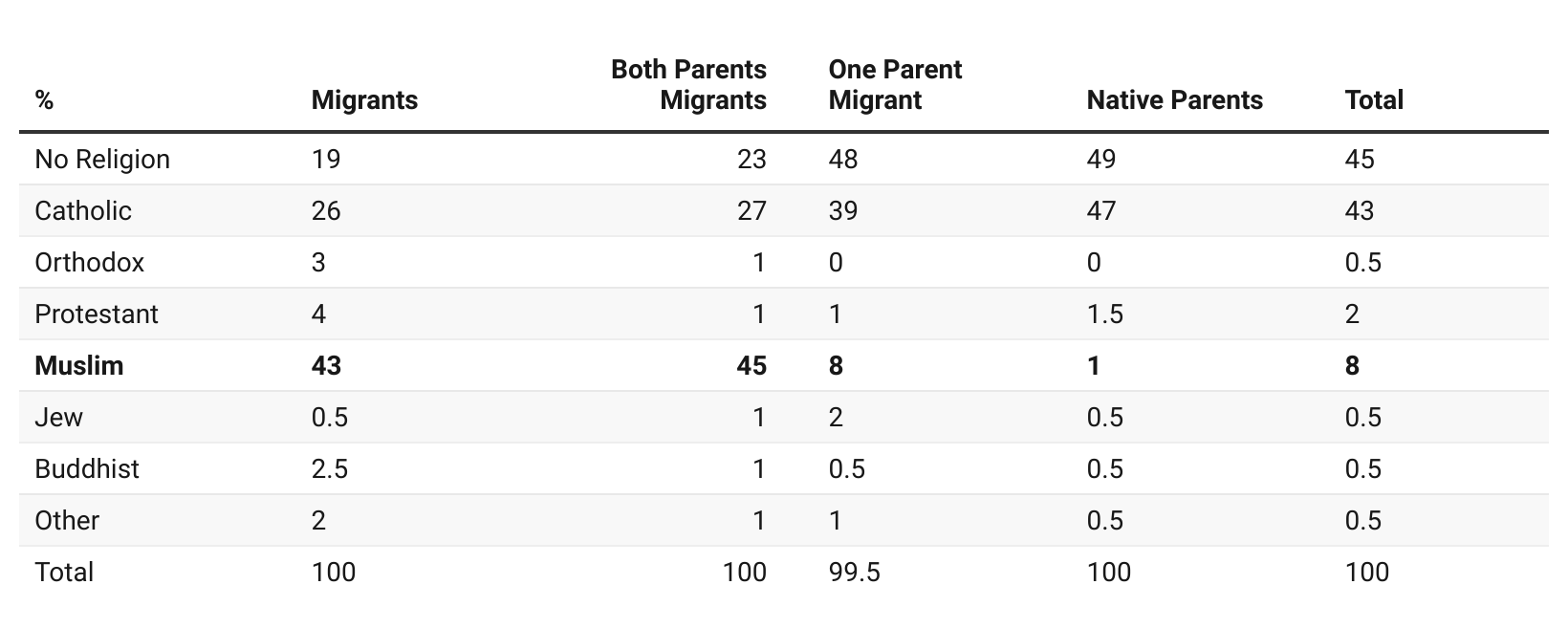
Using recent demographic evidence, we estimate that 45 years later, the Muslim immigrants of first, second, or third generation in France range today between 4.7 to 5.1 million (see Table 1). Due to a range of economic and social factors, we observe a growing trend of migration amongst this population, back to the home country of their parents (return migrations) or, interestingly, to third countries (transnational migrations). We also observe other migration patterns, such as temporary migrations or migration strategies involving two or three countries simultaneously (hybrid migrations).
salim_refas

Table 1. Self-declared religious affiliations of migrants and descendants of migrants in France

Source: Trajectoires et Origines 2008, INED

To understand these migration flows, we need to focus on three questions mainly: how these populations have changed over time, in particular in terms of preferences and economic or social behavior (demand-side), how France has changed since the 1970s, and accordingly, if there are new push factors inducing the migration decisions, and how destination countries including homeland of their parents have changed since then and offer new pull factors dragging migration flows.

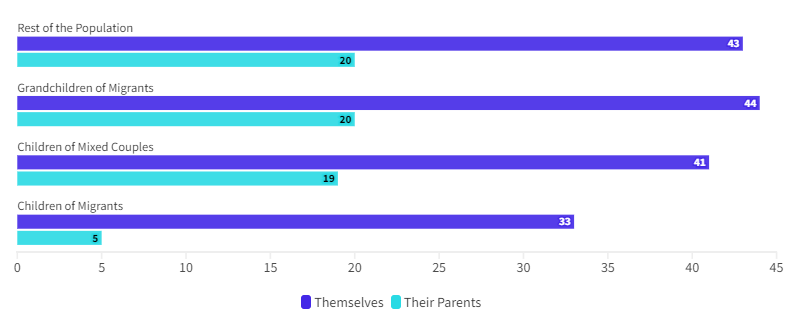
In a nutshell, if we focus on the population of Muslim migrants in France first, we observe that the predominantly blue-collar population that first immigrated to France has put a lot of emphasis on education as a social promotion mechanism, and their progeny is now well-educated and well-inserted in the various social strata of the country (see Figure 1). 33% of the descendants of migrant couples have now graduated with a higher-study degree compared to 5% of their parents (Beauchemin & Simon, 2023). Among second-generation migrants, the proportion is now 44%, i.e., even higher than the rest of the population (43%). 
salim_refas2

Figure 1. Progression of Higher-Study Graduation Rate Across Generations in France

Source: Trajectoires et Origines 2, INED-INSEE, 2019-2020 (TeO2)

Despite the social recognition and improvements, these populations feel increasingly discriminated against. In 2019-2020, 26% of Maghreb immigrants reported having suffered unequal treatment or discrimination in the last five years (Beauchemin & Simon, 2023). Interestingly, the same data reveals that discrimination linked to origins has, however, decreased due in part to a shift towards religious motive: 11% of people declaring themselves to be religious Muslim women report religious discrimination, compared to 5% ten years ago. Other social issues specific to the context in France affect the migration decisions of these populations. According to the OECD (2022), for example, 34% of the population in France was at risk of depression in 2021, up from less than 10% in 2019, due to a range of factors, including loneliness during the COVID-19 pandemic.

Despite the social recognition and improvements, these populations feel increasingly discriminated against.

On the other hand, the world has changed since the 1970s, and new opportunities for migration have emerged for this population, predominantly French and well-qualified. Classical migration theory predicts that the typical pull factor for a worker is the labor price differential (real or expected) offered for the same profession in destination countries. GCC countries, or other OECD countries, offer such opportunities and, therefore, drag migration flows in line with traditional migration models. However, field observations and structured interviews also indicate that for an increasing number of migrants, despite negative labor price differentials, migration from the West back to the homeland of their parents or to other Muslim countries such as Turkey is a desired option.

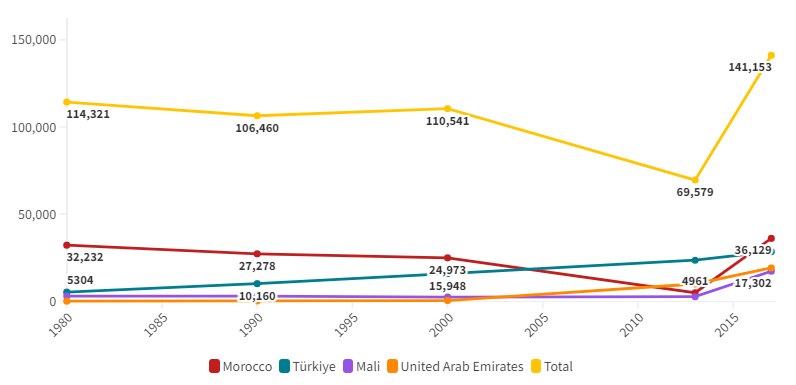
Figure 2 below shows that the total number of migrants from France to Muslim-majority countries has slowly decreased over the period 1980-2013, with a major dip since 2000. But after that, the number of migrants boomed and doubled between 2013 and 2017 for the 16 main destinations of French migrants within Muslim-majority countries. This would strengthen the assumption that due to increased Islamophobia in France and increased religiosity among French Muslims, French Muslims are increasingly looking forward to relocating, generating transnational migration flows that remain to be studied in detail.

The tabulation of recent migration data helps identify some growing trends:

  1. The massive growth of migration to GCC countries and Malaysia (UAE, Kuwait, Oman, Bahrain, Qatar) with growth from 8 times (Malaysia) to more than 100 times (UAE, Bahrein) in the annual outflow of migrants from France between 1980 and 2017;
  2. The return to annual volumes is slightly higher than in 1980 for former colonies such as Morocco, Tunisia, or Chad, with the noticeable exception of Algeria, which shows a major reduction in the number of migrants in recent years;
  3. The massive growth of Turkey as a destination for French migrants, with 28,507 migrants to Turkey in 2017, i.e., more than 5 times the 1980 number;
  4. The significant growth in the number of migrants to Morocco since 2013 could be interpreted as a growth in return migrations or a growth in new migrants, especially among retired French citizens and industrial employees.
salim3

Figure 2. Total Migration to Muslim Majority Countries and Top 4 2017 Migration Destinations from France, 1980-2017

Source: World Bank

It is worth noting that data limitations do not enable us at this stage to distinguish between Muslim and non-Muslim migrants in the data presented, a caveat that an ongoing statistical exercise is trying to correct.

Overall, the economic implications of the migration trends remain relevant for Muslim populations in France and Europe. In 2017 alone, more than 140,000 French citizens or residents have migrated to 16 Muslim-majority countries that we identify as main destination countries. This figure was up from about 70,000 in 2013. The economic implications of that massive outflow of migrants can be studied from the perspective of the recipient or origin country. Countries such as Morocco, Jordan, and Turkey have developed over the years support programs to facilitate investments and return from their expatriated citizens, but the full economic impact of these investments, in particular the spillover effects on the rest of the economy, are yet to be fully understood.

A simplified evaluation of the economic potential of the remigrations of Muslim diasporas in the West to Muslim-majority countries could be attempted by looking at the average savings of these populations and the related investment capacity. For example, Arrondel and Coffinet (2019) report a median wealth of €113,300 per household in France. The 4.7 – 5.1 million Muslims in France (assuming an average of 2.9 persons by household as reported by INSEE) could have an accumulated wealth of €183 to €203 billion in 2019. If the transnational remigration assumption is confirmed for the majority of the 141,153 annual migrants from France to the Muslim-majority countries reported, the potential repatriation of the savings of these migrants to their new country of residence could reach €5.5 billion on an annual basis (€1.4 billion and €1.1 billion for Morocco and Türkiye alone). Other economic implications include transfer or knowledge through direct investment, entrepreneurship or corporate and academic channels. In 2014, Philippe Legrain published Immigrants: Your Country Needs Them, an excellent book about immigration, showing why Western countries should welcome migrants (Legrain, 2014). Ten years later, we probably now need such a book to discuss why transnational migrants are highly needed in Muslim-majority nations. 

References

Arrondel, L., & Coffinet, J. (2019). Le patrimoine et l’endettement des ménages français en 2015. Revue de l’OFCE, (1), 49–75.

Beauchemin, C., Ichou, M. & Simon, P. (2023). Trajectoires et Origines 2019-2020 (TeO2): présentation d’une enquête sur la diversité des populations en France. Population, 78, 11–28. https://doi.org/10.3917/popu.2301.0011

Legrain, P. (2014). Immigrants: Your country needs them. Princeton University Press.

Refas, S. (2022). Transnational economic behavior of Muslim diasporas in the West: The case of French Muslims. Journal of Islamic Economics, 2(1), 24–46.

Source: Reuters

Tags: French MuslimsMigrationMuslim DiasporasRemigration
Previous Post

Batı’daki Müslüman Diasporaların Tersine Göç Örüntüleri: Fransız Müslümanlar Örneği

Next Post

Müslüman Halklar, Göç ve Sinema

Next Post
Muslims, Migration and Cinema

Müslüman Halklar, Göç ve Sinema

Bir yanıt yazın Yanıtı iptal et

E-posta adresiniz yayınlanmayacak. Gerekli alanlar * ile işaretlenmişlerdir

  • A Possible New Breath in Regional Balances: The Alliance of Türkiye, Pakistan, Egypt, and Saudi Arabia

    Bölgesel Dengelerde Olası Yeni Bir Soluk: Türkiye, Pakistan, Mısır ve Suudi Arabistan İttifakı

    0 shares
    Share 0 Tweet 0
  • Nakşibendi-Hakkani Tarikatı

    0 shares
    Share 0 Tweet 0
  • Bilime Yön Verenler: Nobel Ödüllü Müslüman Bilim İnsanları

    0 shares
    Share 0 Tweet 0
  • Fuad Sezgin

    0 shares
    Share 0 Tweet 0
  • Sosyal Medyada İslamcı-Muhafazakâr Kamusallığın Dönüşümü Üzerine

    0 shares
    Share 0 Tweet 0
  • The Gravity of What Took Place at Al-Aqsa Mosque During Ramadan 2026

    Ramazan 2026’da Mescid-i Aksa’da Yaşananların Ciddiyeti

    0 shares
    Share 0 Tweet 0
  • The Gravity of What Took Place at Al-Aqsa Mosque During Ramadan 2026

    0 shares
    Share 0 Tweet 0
  • FLA-JNIM Cooperation and Shifting Security Dynamics in Mali

    0 shares
    Share 0 Tweet 0
  • FLA-JNIM İş Birliği ve Mali’de Değişen Güvenlik Dinamikleri

    0 shares
    Share 0 Tweet 0
  • The Current State of Indonesia’s Luxury Industry and the Landscape of Independent Handcrafted Watchmaking

    0 shares
    Share 0 Tweet 0

Platform: Müslüman Dünyanın Gündemi, Müslüman toplumların fikrî, siyasi, sosyal, ekonomik ve kültürel gündemlerini takip ve tahlil edip Müslüman dünyaya dair güncel ve özgün perspektifler sunmayı amaçlayan bir yayın organı olarak İLKE İlim Kültür Eğitim Vakfı bünyesinde kurulmuştur.

  • SAYILAR
  • ANALİZLER
  • HABERLER
  • SÖYLEŞİLER
  • DÜNYADAN SESLER
  • platform@ilke.org.tr
  • (0216) 310 43 18
  • Aziz Mahmut Hüdayi Mah. Türbe Kapısı Sk. No: 13 Üsküdar, İstanbul

2025 @ PLATFORM bir İLKE Vakfı kuruluşudur. Tüm hakları saklıdır. 

No Result
View All Result
  • Home
  • Analizler
  • Haberler
  • Söyleşiler
  • Dünyadan Sesler