










In the literature of urban sociology and urbanism, the transformation of space is generally analyzed through regimes of capital accumulation and neoliberal policies. Lefebvre (1991) and Harvey (1982), for instance, employ the concept of “creative destruction” to explain the role of the production and destruction of space within capitalist processes. Harvey’s “spatial fix” theory (1982) also addresses this process as the continuous reconstruction of space to overcome the crises of capital. However, when viewed through the lens of settler colonialism, this transformation cannot be explained only by capital accumulation, economic rent-seeking, or the “reorganization” of space. Therefore, the destructive and ideological motivation behind urban destruction in settler-colonial contexts necessitates looking at the issue from another dimension. The colonizer’s motivation to dispossess the indigenous people and erase their memory provides a field for discussion through memory and space, providing a basis for rethinking urban space and displacement. Indeed, the urban destruction seen here goes beyond the neoliberal economic model and market dynamics, manifesting itself as a form of “spacio-cide.”
Spacio-cide is introduced by Hanafi as an alternative, or an additional dimension, to the concept of “genocide” (2009). Hanafi argues that the term genocide is insufficient in some respects when defining the Israeli-Palestinian conflict because Israel’s primary target is the “space” itself: to destroy the very basis of the Palestinians’ existence as a political subject, namely their land (2009, pp. 107-109). It refers to a form of violence that illustrates how space and urban memory are turned into a battlefield. The aim here is to target the space where they sustain their social, cultural, and political existence (2009, p. 113). For Hanafi (2009), if the space is rendered uninhabitable and dysfunctional, the people in that space are also “eliminated”. This is the sole purpose of the settler-colonial project. Therefore, the motivation of settler colonialism is not only to take ownership of the land but to erase the urban memory of that land, its spatial integrity, and its connection to local identity.
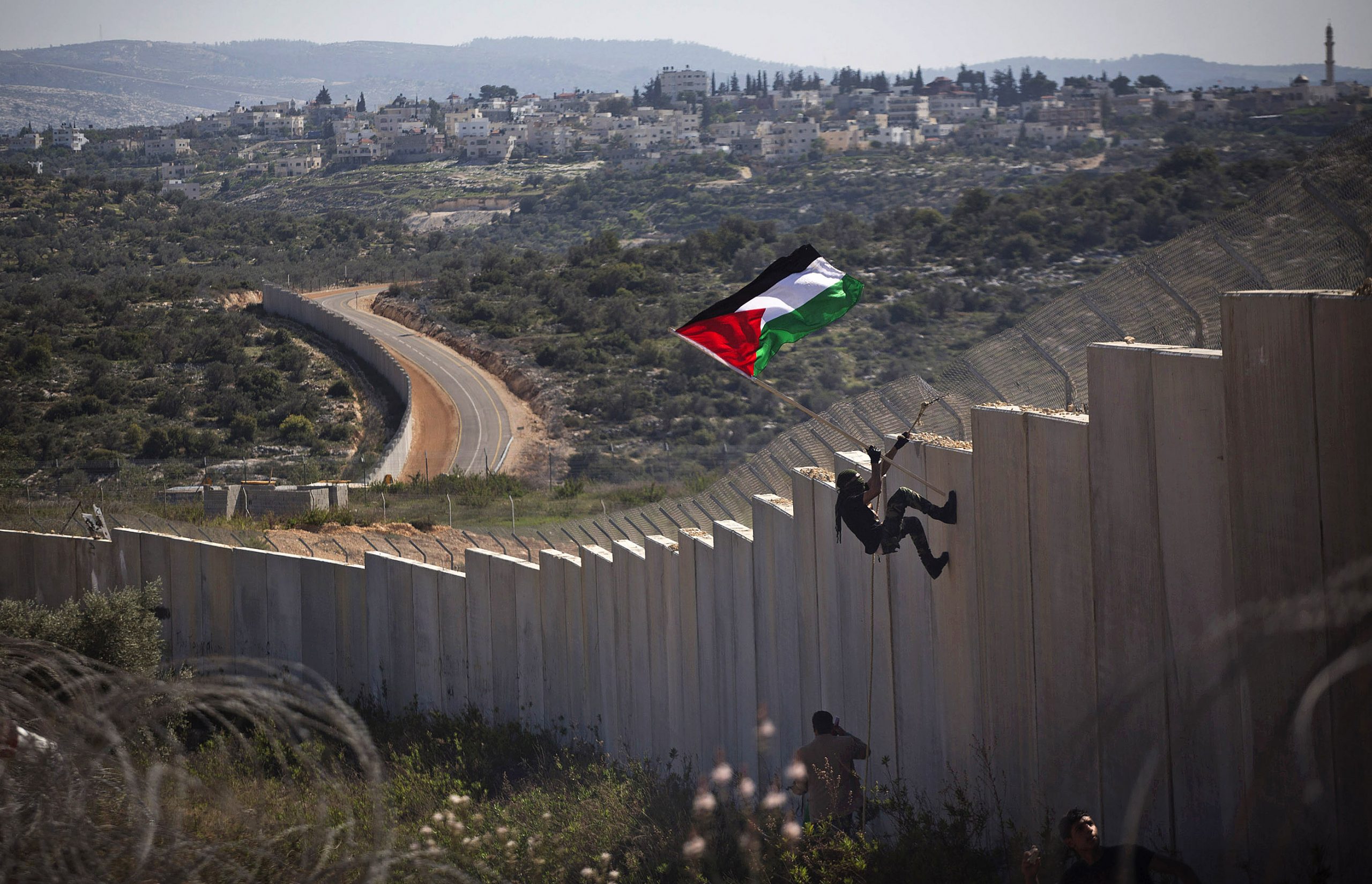
Palestine is defined as the “laboratory” of this theory. One of the main objectives of spacio-cide, for Hanafi (2009), is to render the Palestinian people invisible by confining them to a fragmented geography where they cannot function as subjects of international law. Indeed, as a manifestation of spacio-cide, the West Bank has been transformed into “archipelagos” divided into disconnected fragments. The concept, therefore, has become not just “destruction” but also a “mode of governance” (2012). Accordingly, through colonization, Palestinian lands are gradually taken over by Jewish settlements. Israeli settlements and roads reserved exclusively for settlers are established, transforming Palestinian cities into closed cells that cannot reach each other. Walls, checkpoints, and roads reserved exclusively for Jewish settlers restrict the movement of Palestinians. These “archipelagos” aim to make the establishment of a Palestinian state physically impossible by destroying the integrity of the space (Hanafi, 2012, pp. 196-198).
Similarly, the Separation Wall is seen as a physical barrier and, at the same time, the most concrete manifestation of symbolic violence (Piquard, 2007). The Wall constructs a hierarchy that is “inside and safe” for settlers, and “outside and dangerous/invisible” for Palestinians. On the other hand, contrary to Foucault’s (1978) concept of “biopolitics”, Hanafi argues that a “spatial-politics” operates in Palestine. Accordingly, spacio-cide is not only a military attack, but also a regime of dispossession carried out through “civilian”-looking tools such as planning laws, archaeological excavations, and environmental regulations (2012, p.196). Indeed, spacio-cide is a covert and insidious process that gradually renders the space “dysfunctional” and ultimately severs the indigenous population from the land through the construction of settlements, the imposition of movement restrictions, and the establishment of checkpoints.
Collective Memory, Displacement, and Destruction
The removal of space, which functions as the carrier of memory, erases the past and identity of that community. This leads to “identity erosion,” rootless the community. Urban destruction (urbicide) in the Balkans was fueled by a hatred for the city’s ‘cosmopolitan spirit,’ blowing up houses and buildings and destroying cities. In Palestine, however, spacio-cide is a multi-layered project of annihilation that paralyzes the geography, infrastructure, and economic veins (econo-cide) to clear the land of its indigenous populationmake way for the settler-colonizer (Ersoy Ceylan, 2024).
Spatial policies and displacement reveal that urban planning or restructuring is as much a political and ideological process as it is an economic one. Urban destruction, therefore, cannot be limited to the physical elimination of buildings and infrastructure. Processes of destruction also lead to the severing of social bonds established through space, daily life practices, and collective memory. The destruction or inaccessibility of these spaces erodes the sense of belonging to the city and the spatial memories of individuals and communities. The phenomenon of displacement is considered alongside the processes of urban transformation, gentrification, and spatial segregation implemented under the guise of urban planning or redevelopment. These processes are political interventions shaped through state policies, capital, legal regulations, and ideological orientations. The “reorganization” of space through destruction and displacement functions as a practice of power that determines who can remain in the city and who will be excluded.
In the context of settler colonialism, displacement and destruction are carried out systematically and continuously. In settler-colonial projects, space is an object that must be constantly controlled, transformed, and redefined for “new settlers.” Therefore, urban destruction and displacement in the context of settler colonialism should be understood as a comprehensive strategy of power that aims to reproduce space not only physically but also socially and symbolically. For example, during the Second Intifada, Israel’s occupation project aimed to subject the Palestinian population to a process of “demographic transfer” or, as one Israeli minister called it, “voluntary transfer,” by transforming Palestinian territories from topos to atopia (space to placelessness). Israel prepares the ground for this type of population “transfer.” House demolitions are another tactic used to encourage this “transfer” through spacio-cide (Hanafi, 2012).
The destruction of space does not occur only through military means; actors such as urban planners, real estate experts, and settlers also become part of the spatial annihilation process. Spacio-cide ultimately results in the emergence of dispossessed and deterritorialized masses. Forcing people to abandon the spaces that make their existence possible or where their existence is rooted aims to erase collective memory. Space has a soul, and social relations reproduce this space throughout history. Since 1948, the Palestinian geography has been reproduced for Jewish settlers. While the suppression and erasure of Palestinian memory are targeted on one hand, a new Jewish collective memory is attempted to be constructed on the other. The destruction of Palestinian villages, their erasure from maps, the Hebraization of Arabic place names, and the imposition of new national narratives on these spaces are the fundamental tools of this regime (Ersoy Ceylan, 2024, pp. 80-82).
Reclaiming Space as a Form of Resistance
Spatial forms of resistance developed against the settler-colonialist’s practice of spacio-cide hold an important place in Palestinian resistance history as a kind of struggle to “reclaim the space.” The essence of this struggle is “taking back the space from the colonizer, or space-making.” This process means protecting collective memory, reproducing it, and carrying it into the future through space. In the Palestinian context, the city is both an area that the colonial power tries to destroy and a “memory space” where resistance persists with determination. This resistance developed against colonial spacio-cide becomes visible through objects, bodily practices, and oral narratives.
The most powerful examples of this resistance are literature, oral traditions, and storytelling practices. Following the 1948 Nakba, exiled Palestinians tried to keep alive the cities and villages they were displaced from through narratives; they passed on the streets, houses, olive groves, and daily life practices from generation to generation. These narratives represent the protection, reproduction, and transmission of collective memory through space to the future. At the same time, they function as political actions that keep alive the right of return and spatial belonging. Villages erased from the map continue to exist in social memory through these narratives; thus, even if physically destroyed, space is rebuilt with symbols as a part of the resistance. For Palestinians, this represents not just remembering the past but a way of re-declaring ownership over the space. Indeed, the preservation of house keys by Palestinians living in exile is one of the most powerful symbols of the message “one day we will return.”
For Palestinians still living in Gaza and the West Bank, reclaiming the city, staying in space despite destruction, and fighting to reproduce it is another vital part of this resistance. Palestinians who repeatedly rebuild their homes destroyed by Israeli bombs or bulldozers display a conscious counter-practice against spatial annihilation. Here, houses are not just physical structures; they are vital nodes where memory, identity, and continuity intersect with resistance. Therefore, rebuilding a destroyed house means re-establishing the historical ties that were meant to be severed.
Reclaiming the city can be understood through the persistent maintenance of spatial existence. Although space is an area that the colonial power tries to control and rewrite, it is constantly reproduced through the daily life practices of Palestinians. At this point, collective memory is an active political action that “unites the pieces” in the geography “fragmented” by colonial violence. Palestinian archives, ranging from literature to oral history, encompass an important part of this memory. By trying to keep the villages and cities erased from the map alive through words and attempting to reconstruct them, it offers an alternative space that “prevents the absolute success of spacio-cide.” Thus, while space is a site of destruction for the colonizer, it becomes an active subject of resistance for the resister as a home where memory is preserved, and identity is reproduced every day, maintaining the bond with the space with the hope of returning one day, even if they do not live there.
References
Hanafi, S. (2009). Spacio-cide: Colonial politics, invisibility and reiterability in Palestinian territory. Contemporary Arab Affairs, 2(1), 106–121. https://doi.org/10.1080/17550910802622641
Hanafi, S. (2012). Explaining spacio-cide in the Palestinian territory: Colonization, separation, and state of exception. Current Sociology, 61(2), 190–205. https://doi.org/10.1177/0011392112456505
Harvey, D. (1982). The limits to capital. Basil Blackwell. (Harvey’nin “Spatial Fix” ve yaratıcı yıkım teorisi bağlamında metin içi atıf için).
Ersoy Ceylan, T. (2024). Belleği silmek: Bir yıkım aracı olarak mekân-kırım. Mimar.ist, (80), 20-23.
Foucault, M. (1980). Power/knowledge: Selected interviews and other writings 1972–1977 (C. Gordon, Ed. & Trans.). New York: Pantheon Books.
Lefebvre, H. (1991). The production of space (D. Nicholson-Smith, Çev.). Blackwell.
Piquard, B. (2007). The politics of the West Bank wall: Symbolic violence and spaciocide. S. Doucet (Ed.), The politics of making içinde (ss. 11-24). Routledge.
The views expressed in the articles belong to the authors and may not reflect the editorial policy of the Platform: Current Muslim Affairs.