


İLKE Vakfı
Platform
No Result
View All Result
  • PLATFORM
  • HABERLER
    İLKE Agenda: Muzzammil Ayyub Thakur ile Keşmir’in “Filistinleştirilmesi”

    İLKE Agenda: Muzzammil Ayyub Thakur ile Keşmir’in “Filistinleştirilmesi”

    İLKE Agenda: Muzzammil Ayyub Thakur ile Keşmir’in “Filistinleştirilmesi”

    The Platform Talks: Kinda Hawasli ile 8 Aralık Sonrası Suriye

    İLKE Agenda: Muzzammil Ayyub Thakur ile Keşmir’in “Filistinleştirilmesi”

    The Platform Talks: Azzam Tamimi ile 7 Ekim Sonrası Filistin

    İLKE Agenda: Muzzammil Ayyub Thakur ile Keşmir’in “Filistinleştirilmesi”

    İLKE Agenda: Gazze Soykırımı Günlerinde Aktivizm ve İslamofobi

    Filistin Sempozyumu: Filistin ve Küresel İlişkilerin Geleceği

    Filistin Sempozyumu: Filistin ve Küresel İlişkilerin Geleceği

    Filistin Sempozyumu: Filistin ve Küresel İlişkilerin Geleceği

    Müslüman Dünyada Çağdaş Düşünce Konferansı’nda buluşuyoruz!

    Filistin Sempozyumu: Filistin ve Küresel İlişkilerin Geleceği

    Müslüman Dünyada Çağdaş Düşünce Konferansı

    Filistin Sempozyumu: Filistin ve Küresel İlişkilerin Geleceği

    Dr. Jonathan Brown “İslam’ın Siyahiliğe ve Köleliğe Yaklaşımı” adlı seminer gerçekleştirdi.

  • ANALİZLER
    • All
    • Düşünce
    • Eğitim
    • Ekonomi
    • Enerji ve Çevre
    • Göç
    • Medya, Kültür ve Sanat
    • Temel Hak ve Özgürlükler
    • Toplumsal Meseleler
    The Gravity of What Took Place at Al-Aqsa Mosque During Ramadan 2026

    Ramazan 2026’da Mescid-i Aksa’da Yaşananların Ciddiyeti

    AFP/GETTY IMAGES

    FLA-JNIM İş Birliği ve Mali’de Değişen Güvenlik Dinamikleri

    Sosyal Medyada İslamcı-Muhafazakâr Kamusallığın Dönüşümü Üzerine

    Sosyal Medyada İslamcı-Muhafazakâr Kamusallığın Dönüşümü Üzerine

    Bangladeş’te 2026 Seçimleri Sonrası Siyasi Tartışmalar

    Bangladeş’te 2026 Seçimleri Sonrası Siyasi Tartışmalar

    Filistin’de Çocuk Olmak: 5 Nisan Filistinli Çocuklar Günü

    Filistin’de Çocuk Olmak: 5 Nisan Filistinli Çocuklar Günü

    Security, Fragility, and the Search for a New Equilibrium in the Gulf Following the Iranian Attacks

    İran Saldırıları Sonrası Körfez’de Güvenlik, Kırılganlık ve Yeni Denge Arayışı

  • SÖYLEŞİLER
    The Decolonization of Knowledge: Interview with Professor Souleymane Bachir Diagne

    Bilginin Dekolonizasyonu: Profesör Souleymane Bachir Diagne ile Röportaj

    A Possible New Breath in Regional Balances: The Alliance of Türkiye, Pakistan, Egypt, and Saudi Arabia

    Bölgesel Dengelerde Olası Yeni Bir Soluk: Türkiye, Pakistan, Mısır ve Suudi Arabistan İttifakı

    Digital Ummah and Muslim Identity: Dr. Sahar Khamis Interview

    Dijital Ümmet ve Müslüman Kimliği: Dr. Sahar Khamis ile Röportaj

    From the Ballot Box to the Street: The Rising Social Wave in Tanzania After the Election

    Sandıktan Sokağa: Tanzanya’da Seçim Sonrası Yükselen Toplumsal Dalga

    Müslüman Nüfusa Karşı Güvenlikleştirme

    Müslüman Nüfusa Karşı Güvenlikleştirme

    Gurbet Hikayeleri

    Gurbet Hikayeleri

    Göçü Yönetmek: Dr. Mehmet Köse’yle Söyleşi

    Göçü Yönetmek: Dr. Mehmet Köse’yle Söyleşi

    İstanbul’daki Uluslararası Öğrencilerle Söyleşi

    İstanbul’daki Uluslararası Öğrencilerle Söyleşi

    Zaytuna College Lisansüstü Eğitim Dekanı Maşuk Yamaç’la Söyleşi

    Zaytuna College Lisansüstü Eğitim Dekanı Maşuk Yamaç’la Söyleşi

  • DÜNYADAN SESLER
    Voices from the Muslim World | Sari Hanafi (with Turkish subtitles)

    Voices from the Muslim World | Sari Hanafi (with Turkish subtitles)

    Voices from the Muslim World | Ovamir Anjum

    Voices from the Muslim World | Ovamir Anjum

    VOICES FROM THE MUSLIM WORLD | DR. YASIR QADHI

    VOICES FROM THE MUSLIM WORLD | DR. YASIR QADHI

    VOICES FROM THE MUSLIM WORLD | DR. ADEEL MALIK

    VOICES FROM THE MUSLIM WORLD | DR. ADEEL MALIK

  • SAYILAR
  • VERİTABANI
    • All
    • Hareketler
    • Kurumlar
    • Şahsiyetler
    Pak-Türk Maarif

    Pak-Türk Maarif

    İslam Vakfı

    İslam Vakfı

    Avrupa Fetva ve Araştırma Konseyi

    Avrupa Fetva ve Araştırma Konseyi

    Tokyo Camii ve Diyanet Türk Kültür Merkezi

    Tokyo Camii ve Diyanet Türk Kültür Merkezi

  • PLATFORM
  • HABERLER
    İLKE Agenda: Muzzammil Ayyub Thakur ile Keşmir’in “Filistinleştirilmesi”

    İLKE Agenda: Muzzammil Ayyub Thakur ile Keşmir’in “Filistinleştirilmesi”

    İLKE Agenda: Muzzammil Ayyub Thakur ile Keşmir’in “Filistinleştirilmesi”

    The Platform Talks: Kinda Hawasli ile 8 Aralık Sonrası Suriye

    İLKE Agenda: Muzzammil Ayyub Thakur ile Keşmir’in “Filistinleştirilmesi”

    The Platform Talks: Azzam Tamimi ile 7 Ekim Sonrası Filistin

    İLKE Agenda: Muzzammil Ayyub Thakur ile Keşmir’in “Filistinleştirilmesi”

    İLKE Agenda: Gazze Soykırımı Günlerinde Aktivizm ve İslamofobi

    Filistin Sempozyumu: Filistin ve Küresel İlişkilerin Geleceği

    Filistin Sempozyumu: Filistin ve Küresel İlişkilerin Geleceği

    Filistin Sempozyumu: Filistin ve Küresel İlişkilerin Geleceği

    Müslüman Dünyada Çağdaş Düşünce Konferansı’nda buluşuyoruz!

    Filistin Sempozyumu: Filistin ve Küresel İlişkilerin Geleceği

    Müslüman Dünyada Çağdaş Düşünce Konferansı

    Filistin Sempozyumu: Filistin ve Küresel İlişkilerin Geleceği

    Dr. Jonathan Brown “İslam’ın Siyahiliğe ve Köleliğe Yaklaşımı” adlı seminer gerçekleştirdi.

  • ANALİZLER
    • All
    • Düşünce
    • Eğitim
    • Ekonomi
    • Enerji ve Çevre
    • Göç
    • Medya, Kültür ve Sanat
    • Temel Hak ve Özgürlükler
    • Toplumsal Meseleler
    The Gravity of What Took Place at Al-Aqsa Mosque During Ramadan 2026

    Ramazan 2026’da Mescid-i Aksa’da Yaşananların Ciddiyeti

    AFP/GETTY IMAGES

    FLA-JNIM İş Birliği ve Mali’de Değişen Güvenlik Dinamikleri

    Sosyal Medyada İslamcı-Muhafazakâr Kamusallığın Dönüşümü Üzerine

    Sosyal Medyada İslamcı-Muhafazakâr Kamusallığın Dönüşümü Üzerine

    Bangladeş’te 2026 Seçimleri Sonrası Siyasi Tartışmalar

    Bangladeş’te 2026 Seçimleri Sonrası Siyasi Tartışmalar

    Filistin’de Çocuk Olmak: 5 Nisan Filistinli Çocuklar Günü

    Filistin’de Çocuk Olmak: 5 Nisan Filistinli Çocuklar Günü

    Security, Fragility, and the Search for a New Equilibrium in the Gulf Following the Iranian Attacks

    İran Saldırıları Sonrası Körfez’de Güvenlik, Kırılganlık ve Yeni Denge Arayışı

  • SÖYLEŞİLER
    The Decolonization of Knowledge: Interview with Professor Souleymane Bachir Diagne

    Bilginin Dekolonizasyonu: Profesör Souleymane Bachir Diagne ile Röportaj

    A Possible New Breath in Regional Balances: The Alliance of Türkiye, Pakistan, Egypt, and Saudi Arabia

    Bölgesel Dengelerde Olası Yeni Bir Soluk: Türkiye, Pakistan, Mısır ve Suudi Arabistan İttifakı

    Digital Ummah and Muslim Identity: Dr. Sahar Khamis Interview

    Dijital Ümmet ve Müslüman Kimliği: Dr. Sahar Khamis ile Röportaj

    From the Ballot Box to the Street: The Rising Social Wave in Tanzania After the Election

    Sandıktan Sokağa: Tanzanya’da Seçim Sonrası Yükselen Toplumsal Dalga

    Müslüman Nüfusa Karşı Güvenlikleştirme

    Müslüman Nüfusa Karşı Güvenlikleştirme

    Gurbet Hikayeleri

    Gurbet Hikayeleri

    Göçü Yönetmek: Dr. Mehmet Köse’yle Söyleşi

    Göçü Yönetmek: Dr. Mehmet Köse’yle Söyleşi

    İstanbul’daki Uluslararası Öğrencilerle Söyleşi

    İstanbul’daki Uluslararası Öğrencilerle Söyleşi

    Zaytuna College Lisansüstü Eğitim Dekanı Maşuk Yamaç’la Söyleşi

    Zaytuna College Lisansüstü Eğitim Dekanı Maşuk Yamaç’la Söyleşi

  • DÜNYADAN SESLER
    Voices from the Muslim World | Sari Hanafi (with Turkish subtitles)

    Voices from the Muslim World | Sari Hanafi (with Turkish subtitles)

    Voices from the Muslim World | Ovamir Anjum

    Voices from the Muslim World | Ovamir Anjum

    VOICES FROM THE MUSLIM WORLD | DR. YASIR QADHI

    VOICES FROM THE MUSLIM WORLD | DR. YASIR QADHI

    VOICES FROM THE MUSLIM WORLD | DR. ADEEL MALIK

    VOICES FROM THE MUSLIM WORLD | DR. ADEEL MALIK

  • SAYILAR
  • VERİTABANI
    • All
    • Hareketler
    • Kurumlar
    • Şahsiyetler
    Pak-Türk Maarif

    Pak-Türk Maarif

    İslam Vakfı

    İslam Vakfı

    Avrupa Fetva ve Araştırma Konseyi

    Avrupa Fetva ve Araştırma Konseyi

    Tokyo Camii ve Diyanet Türk Kültür Merkezi

    Tokyo Camii ve Diyanet Türk Kültür Merkezi

No Result
View All Result
Platform
No Result
View All Result
Home Analyses

Symbols of Resistance: Social Media as a Space of Ritual

Elif Sağır by Elif Sağır
7 Kasım 2025
in Analyses, Culture, Arts and Media
0
Symbols of Resistance: Social Media as a Space of Ritual
0
SHARES
1
VIEWS
Share on FacebookShare on Twitter

Rituals are not only a preserve of “primitive” societies; their influence has transformed throughout history. While it is possible to talk about sacred or spiritual rituals, secular or even virtual rituals have also emerged in the modern era. Furthermore, each and every popular revolution and resistance has brought out its own rituals, yet what distinguishes contemporary movements is the intersection of social media, ritual, and collective identity. In this article, I will analyze how the videos of the al-Qassam Brigades, the military wing of HAMAS, and Abu Obeida, the spokesman for the brigades, released periodically reproduce social media as a space of resistance and create an atmosphere of ritual in the Durkheimian sense. I will also include tweets and images from the videos released to emphasize the “totemic” nature of the created space both in those videos and on social media.

Although Durkheim examines Australian Aborigines and the totemic religions of “primitive” societies in his work, The Elementary Forms of Religious Life, he instrumentalizes the rituals and totems as a means of understanding the human psyche and society. The relationship between symbols and community is mutual; that is to say, while society always generates forms of rituals and totems for social cohesion, “social life is only possible thanks to a vast symbolism” (213), Durkheim argues. The feelings are “spontaneously” transmitted to the symbol that represents it (222). The emotions evoked by the symbol engender a common feeling or experience that leads to a sense of belonging and collective conscience. The rituals, therefore, create a space in defined symbolic boundaries where the symbols and feelings are perpetuated constitutively. Consisting of repetitive practices in a particular time and space with an assembled group, the rituals “release new energies that transform” (222) each member of the group. Nevertheless, even though Durkheim puts emphasis on bodily engagement and sacred symbols, intellectuals such as Erving Goffman and Randall Collins have examined micro-level human interactions such as greetings as everyday rituals. Contributing to the discussion, James W. Carey examined how new forms of communication, i.e., the telegraph at that time, created new ritual acts, which paved the way for modern media rituals.

2021 was a milestone for social media activism in the long history of resistance in Palestine against the Israeli occupation, and the Al-Aqsa flood created another wave of media interest in the Palestinian case.

2021 was a milestone for social media activism in the long history of resistance in Palestine against the Israeli occupation, and the Al-Aqsa flood created another wave of media interest in the Palestinian case. While in 2021, individual Palestinians such as Mohammad and Muna al-Kurd siblings came forward, leading to worldwide protests as well as awareness through social media with the hashtag #SaveSheikhJarrah, events unfolding after October 7 put the video releases by al-Qassam Brigades and Abu Obeida forward, reproducing social media as a space of symbols related to Palestinian resistance. The videos are first published on Telegram channels -until the censorship by Telegram in November- every day, after a message that indicates that new videos are coming and that they have launched attacks in specific locations. The videos of Abu Obeida, on the other hand, are published every four to five days. In this sense, the periodic and repetitive release of these videos almost pre-conditions the followers of the case to engage with these videos daily or weekly and creates a heightened emotional state of expectation. For example, one Twitter user mentions how the elderly person in the image waits for Abu Obeida’s videos every day and, most importantly, “listens to [Abu Obeida] while standing,” which reflects the heightened feelings of presumably awe and expectation. The second, on the other hand, shows in a joking manner that the break in the ritualized act of continuous video releases by HAMAS causes another feeling, this time: anxiety.

@ سعد السعيدي, Twitter (https://x.com/salsaeedi/status/1720921320706257284) 
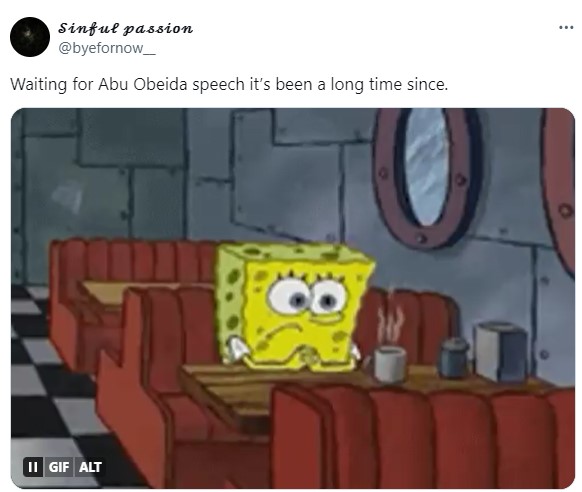
Resim 2

“Ebu Ubeyde’nin konuşmasını bekliyorum, son videodan bu yana uzun zaman oldu.” @dearrmarya, Twitter (https://twitter.com/dearrmarya/status/1744432564994015404) 

Social media creates a space in which users on social media platforms can share the same emotions and empathize with one another, transcending the limits of proximity or virtuality.
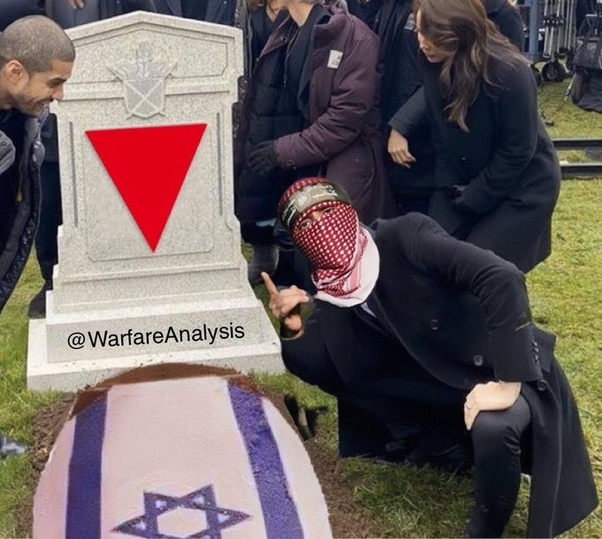
The videos are transferred to bigger social media platforms such as Facebook and, most importantly, Twitter after they are released on Telegram. Therefore, as Durkheim questions, “Repeated everywhere and in every form, how could that image not fail to stand out in the mind with exceptionally sharp relief?” (222), these videos become representatives of the ongoing atrocities. Although the videos are in Arabic and, therefore, fail to generate effect and emotions in the ritualistic space of social media, they are quickly translated into different languages, which restores engagement and creates a social cohesion between those who follow the incidents closely. The moment the videos are released, users create different posts, either praising the acts or condemning them but also turning them into memes, mocking images, as shown in Figure 3. In this sense, besides its use of sharing events, social media creates a space in which users on social media platforms can share the same emotions and empathize with one another, transcending the limits of proximity or virtuality.

Resim 3

I/P Conflict Memes, Quora (https://ipconflictmemes.quora.com/ti-135195543) 

For the uninformed or foreign viewer, this image may not be symbolic, but when we analyze the image, these two elements, the red arrow on the tombstone and the man in red head covering, hint at the idea that the symbols are not mere artifices, but instead, they are integral to the representations (Durkheim, 233) and originate outside us. That is to say, when the al-Qassam Brigades release a video, there are certain repetitive elements that distinguish them from the rest of the war videos and create a constitutive relation with the viewer, the red arrows used for pointing the Israeli soldiers or tanks as targets: 
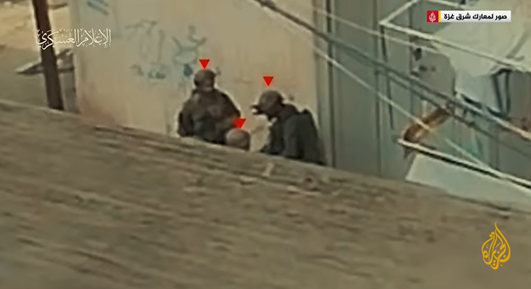
Resim 4

AlJazeera Arapça قناة الجزيرة, Youtube (https://www.youtube.com/watch?v=7K3Tg4asQhQ) 

But at the same time, for some, these red arrows signify the red triangular shape of the Palestinian flag. Moreover, people put the red arrow shape (🔻) next to their Twitter names. Thus, while creating a collective engagement with the released videos and the ongoing war in Gaza, the symbol also contributes to the collective identity shaped by another symbol, the flag. 

On the other hand, wearing a camouflage soldier uniform and a red keffiyeh, Abu Obeida has become the symbol of Palestinian resistance since the 7th of October. Even though keffiyeh is a traditional attire worn in Middle Eastern and Kurdish regions, wearing it in a way that covers the whole face, as worn by the spokesman, has become another symbolic movement that has become inscribed in the symbol itself. Hence, it has also become something durable that is alive not only on social media but also in protests all around the world. Each recorded voice message is shared with the same image, Abu Obeida raising his finger in a threatening manner and the same attire (Figure 5), and this image is being hung as a poster in different countries to display support for HAMAS or becomes a feature in memes as shown in the previous figures.
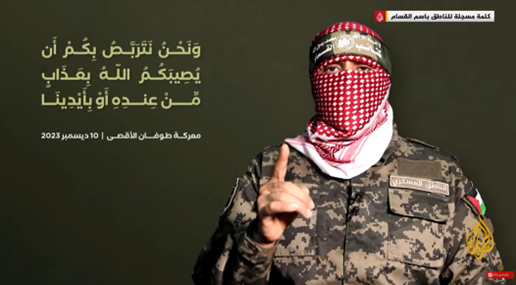
Resim 5

AlJazeera Arapça قناة الجزيرة

The videos released by the al-Qassam Brigades serve as symbols that create ritualistic spaces on these platforms thanks to the repetitive elements highlighted in them, such as red arrows and Abu Obeida in red keffiyeh. 

Therefore, the repeated images and symbols in those videos are utilized in a way that recalls emotions in relation to the resistance even after the videos end. They become durable elements of social life since they are simple and well-defined as well as repeated everywhere on social media.

In conclusion, rituals have transcended the confines of “primitive” societies, and the modern era has witnessed the emergence of virtual rituals on social media platforms. The videos released by the al-Qassam Brigades serve as symbols that create ritualistic spaces on these platforms thanks to the repetitive elements highlighted in them, such as red arrows and Abu Obeida in red keffiyeh. The instant translation of videos into different languages and the reproduction of these videos into memes and other social media posts contribute to a shared experience that transcends physical boundaries. The analysis of these videos, therefore, reveals that these symbolic images not only reflect the Palestinian social resistance but also actively shape the collective consciousness, fostering a sense of identity among those engaged with these contents.

Kaynakça

Durkheim, Émile. “Religion and Ritual.” In Emile Durkheim: Selected Writings, eds by A. Giddens. Cambridge: Cambridge University Press, pp. 219–222

Durkheim, Émile. 1912. The Elementary Forms of Religious Life. New York: Free Press

“الجزيرة تبث صورا حصلت عليها لمعارك كتائب القسام والجيش الإسرائيلي شرق غزة.” YouTube, uploaded by AlJazeera Arabic, 11 Dec. 2023. https://www.youtube.com/watch?v=7K3Tg4asQhQ 

I/P Conflict Memes. [Image]. Quora, 12 Dec. 2023. https://ipconflictmemes.quora.com/ti-135195543 

سعد السعيدي [salsaeedi] “ينتظر أبو عبيدة كل يوم ولا يستمع إليه إلا واقفاً…” Twitter, 5 November 2023. https://twitter.com/salsaeedi/status/1720921320706257284 

🔻[dearrmarya]. “Waiting for Abu Obeida speech it’s been a long time since.” Twitter, 8 January 2024. https://twitter.com/dearrmarya/status/1744432564994015404 

Cover source: Getty Images

Tags: GazaSocial Media
Previous Post

Direniş ve Semboller: Bir Ritüel Alanı Olarak Sosyal Medya

Next Post

Dijital Davet: Endonezya’da Tebliğin Yeni Medya Aracılığıyla Dönüşümü

Next Post
Dijital Davet: Endonezya’da Tebliğin Yeni Medya Aracılığıyla Dönüşümü

Dijital Davet: Endonezya'da Tebliğin Yeni Medya Aracılığıyla Dönüşümü

Bir yanıt yazın Yanıtı iptal et

E-posta adresiniz yayınlanmayacak. Gerekli alanlar * ile işaretlenmişlerdir

  • A Possible New Breath in Regional Balances: The Alliance of Türkiye, Pakistan, Egypt, and Saudi Arabia

    Bölgesel Dengelerde Olası Yeni Bir Soluk: Türkiye, Pakistan, Mısır ve Suudi Arabistan İttifakı

    0 shares
    Share 0 Tweet 0
  • Bilime Yön Verenler: Nobel Ödüllü Müslüman Bilim İnsanları

    0 shares
    Share 0 Tweet 0
  • Nakşibendi-Hakkani Tarikatı

    0 shares
    Share 0 Tweet 0
  • Fuad Sezgin

    0 shares
    Share 0 Tweet 0
  • Sosyal Medyada İslamcı-Muhafazakâr Kamusallığın Dönüşümü Üzerine

    0 shares
    Share 0 Tweet 0
  • The Gravity of What Took Place at Al-Aqsa Mosque During Ramadan 2026

    Ramazan 2026’da Mescid-i Aksa’da Yaşananların Ciddiyeti

    0 shares
    Share 0 Tweet 0
  • The Gravity of What Took Place at Al-Aqsa Mosque During Ramadan 2026

    0 shares
    Share 0 Tweet 0
  • FLA-JNIM Cooperation and Shifting Security Dynamics in Mali

    0 shares
    Share 0 Tweet 0
  • FLA-JNIM İş Birliği ve Mali’de Değişen Güvenlik Dinamikleri

    0 shares
    Share 0 Tweet 0
  • The Current State of Indonesia’s Luxury Industry and the Landscape of Independent Handcrafted Watchmaking

    0 shares
    Share 0 Tweet 0

Platform: Müslüman Dünyanın Gündemi, Müslüman toplumların fikrî, siyasi, sosyal, ekonomik ve kültürel gündemlerini takip ve tahlil edip Müslüman dünyaya dair güncel ve özgün perspektifler sunmayı amaçlayan bir yayın organı olarak İLKE İlim Kültür Eğitim Vakfı bünyesinde kurulmuştur.

  • SAYILAR
  • ANALİZLER
  • HABERLER
  • SÖYLEŞİLER
  • DÜNYADAN SESLER
  • platform@ilke.org.tr
  • (0216) 310 43 18
  • Aziz Mahmut Hüdayi Mah. Türbe Kapısı Sk. No: 13 Üsküdar, İstanbul

2025 @ PLATFORM bir İLKE Vakfı kuruluşudur. Tüm hakları saklıdır. 

No Result
View All Result
  • Home
  • Analizler
  • Haberler
  • Söyleşiler
  • Dünyadan Sesler