

























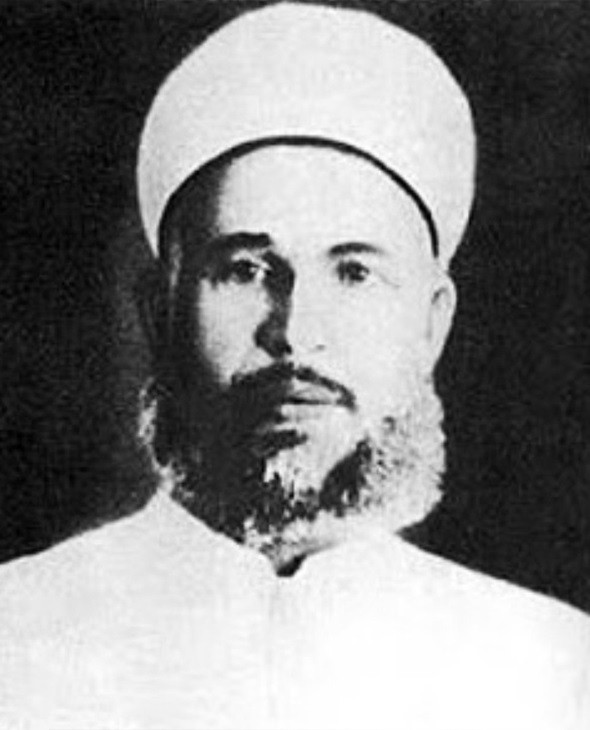
The most striking similarity among revolutionaries throughout history is their unyielding support for unconditional and unrestricted rights and freedom. Such was the case with Al-Qassam: a teacher, preacher, fighter, sheikh (venerable man), activist, revolutionary, and martyr who always sought freedom, aimed to destroy colonialism, and extended his desire for liberation beyond the borders of his homeland.
Izz ad-Din Abd al-Qadar ibn Mustafa ibn Yusuf ibn Muhammad al-Qassam was born in 1882 in the village of Jableh, incorporated into the Latakia Governorate in Syria, into a conservative family that prioritized Islamic jurisprudence (fiqh) and sciences. He learned the basics of reading, writing, arithmetic, and Islamic sciences. When he was 14, his father sent him to the esteemed school of Al-Azhar. He spent nearly eight years in Egypt, where he became acquainted with the reformist school advocating resistance against Western colonialism. He studied under figures like Imam Muhammed Abdhu and Sheikh Jamal al-Din al-Afghani, adopting the spirit of anti-British colonial resistance and defending his homeland. He witnessed the revolutionary enthusiasm in the Egyptian Arab street spread by figures like Ahmed Urabi and Mustafa Kamil. Then, the Al-Azhar-educated Imam returned to Jableh as a sheikh and preacher, embarking on a long revolutionary journey that extended to the present day.
Izz ad-Din al-Qassam despised the feudal system in Jableh, which, at that time, imposed taxes on farmers and denied them their rights. As an imam and teacher, he began spreading awareness among the people, intending to address the injustice imposed by the feudal system. Some of the lords in Jableh felt threatened and attempted to exile him to Izmir, prompting the young man to leave for the city of the Caliphate, Istanbul. He learned about educational systems there but soon returned to Jableh and established his school in 1913. He introduced a modern system for teaching children during the day and adults at night, teaching Hadith and Tafsir (exegesis of Qur’an) in the Ibrahim ibn Adham Mosque and delivering Friday sermons at the Mansouri Mosque.
Izz ad-Din al-Qassam as a Revolutionary Figure
When discussing Izz ad-Din al-Qassam, historians and critics differ in their accounts of his upbringing, identity, and the beginning of his revolutionary journey. Despite the multitude of descriptions, varying reasons, and speculations on what made him the “Sheikh of the Revolution and Resistance,” there is a consensus that he was an exceptional revolutionary Arab figure.
To understand “al-Qassam” today, we must delve into the revolutionary personality of al-Qassam. However, reviewing the revolutionary journey of the sheikh is not just an attempt to narrate historical events, but also a desire to understand the character of the Syrian sheikh who has become a symbol and a cause for resistance and Palestinian liberation.
To understand “al-Qassam” today, we must delve into the revolutionary personality of al-Qassam.
When we say that land and nationality were never motivations behind the sheikh’s call for freedom, we should also refer to Izz ad-Din al-Qassam’s attempt to fend off the Italian attack on Tripoli, Libya. Upon hearing this news, he participated in protests condemning Italian occupation, urging men to defend Muslim Arab lands. He mobilized men for combat and collected donations from the people, coordinating with the Turkish government to transfer volunteers via the port of Iskenderun to Tripoli. However, the ship did not arrive, and some accounts state that he later used the collected funds to build an orphanage, while others suggest that he infiltrated Libya to meet Sheikh Omar al-Mukhtar, providing him with the money he collected to fund his fight against colonialism.
After World War I and the Sykes-Picot Agreement, which divided the region between French and British colonizers in 1920, French colonial fleets occupied Latakia and the Syrian coast. Izz ad-Din al-Qassam did not hesitate to fight against the colonizers, selling his house to buy 24 rifles to resist the French. At that time, he mobilized revolutionaries, cultivating the spirit of resistance among farmers and common people to throw out the occupiers through his influential speeches and clever military tactics. Some areas in Syria became centers for executing raids against the occupiers, and he was the first to raise arms against the French, challenging them and refusing any attempts at reconciliation. He began training men in the mountains to bear arms and confront the enemy. When al-Qassam and his men increased their force, the French occupiers attempted to offer him power and wealth, but he rejected it. So, the French occupiers issued a death sentence in absentia against him and some of his companions, and offered a reward for anyone who could find him. Hence, the sheikh found no solution but to leave Syria with six of his companions for Palestine, marking a crucial point in his life.
Izz ad-Din al-Qassam in Haifa
At the beginning of 1911, when Palestine was under British mandate, Sheikh al-Qassam sought refuge in Haifa. He had several reasons to choose Haifa, including its status as a cultural center with a socially diverse environment. Additionally, Haifa was a hub for the poor men who lived in the tents since their villages had been seized. Moreover, Haifa was a British navy base. Therefore, can we argue that Izz ad-Din al-Qassam went to Palestine specifically to confront British occupation and, later, the Zionist project?
We do not know what exactly was going on in the sheikh’s mind regarding future intentions when he arrived in Palestine. However, we know that he would not hesitate or waver in forcing out the invaders or occupiers from the land, be it in Libya, Syria, or Palestine. We know that he was committed to resisting and confronting oppressors. After settling in Haifa, Izz ad-Din al-Qassam became a preacher at the Istiqlal Mosque, which still stands in occupied Haifa to this day. The sheikh worked as a preacher in the mosque until the day of his martyrdom.
Izz ad-Din al-Qassam and the Istiqlal (Independence) Mosque
It was not surprising that the sheikh was the first to predict the establishment of the Zionist state on Palestinian land. After the British executed a Palestinian, he declared in one of his speeches, “Zionism wants to slaughter you as they slaughtered the Red Indians in America.” Because Sheikh Izz al-Din al-Qassam was not just a religious figure or preacher, nor was he merely an armed man. He was also a revolutionary thinker with a keen mind that allowed him to perceive and analyze events, plan in advance, and decide to confront the Zionist project. He started calling from the minbars (pulpits) to confront the British occupier. The pioneers of the Istiqlal Mosque were mostly farmers and common people, but Sheikh al-Qassam was known for his powerful speeches. It was said that he could turn an ordinary man into a true fighter. The sheikh openly declared that jihad is the foundation, and it is obligatory for every Muslim to bear arms against the enemy.
The sheikh’s popularity increased, and he developed further relationships with different social classes, revolutionaries, and even some politicians in Palestine. People trusted him and would come from different places to attend his speeches because his religious standing drew people closer to him. Although the sheikh had political experience with the Young Men’s Muslim Association and Hizb al-Istiqlal (Independence Party), his relationship with the people was special. He did not like engaging in political activities, believing that politics should only serve jihad.
The beginning of al-Qassam’s military activities and specialized training started with various operations in the confrontations between Muslims and Jews around the Western Wall. Later, in 1925, al-Qassam established what became known as the Qassamites or, as he termed them, “al-Jihadiya.” He himself supervised the Jihadiya with military leadership and an exceptional mobilization system. The nucleus of this secret organization was rooted in the concept of pure jihadist Islam. Al-Qassam believed that jihad was a mandatory duty for every Muslim under colonization, emphasizing that weaponry took precedence over adorning mosques, even if it was the Al-Aqsa Mosque. The Jihadiya remained secretive until al-Qassam declared his revolution in 1935 with his famous slogan from the minbar of the Istiqlal Mosque: “It is a jihad. Either victory or martyrdom.” Although most of al-Qassam’s followers were farmers and people with limited education, they were pioneers of the Istiqlal Mosque. Trained and guided by al-Qassam, they later emerged as highly skilled fighters. Al-Qassam did not exclude anyone from jihad, believing it would bring them reform. At the same time, he contributed to their moral and intellectual improvement.
When discussing al-Qassam as a leader, historians describe al-Qassam as a “social influencer” in modern terms. He had strong and close relationships with families, politicians, and intellectuals in Palestine. Although he understood the societal structure and had personal connections, he always remained closer to common people or farmers. He always refrained from joining any political party, emphasizing that his priority was jihad and the liberation of the land.
The Sheikh and the Seeds of the Great Palestinian Revolution
The Buraq / Western Wall disturbances, or known as the Buraq Revolution on August 14, 1929, are considered the first spark of what later became the Great Palestinian Revolution. It was the first confrontation faced by Sheikh al-Qassam and his men. In the succeeding years, Sheikh al-Qassam and his Qassamite group continued to carry out operations against the British army and Zionist gangs. They maintained complete secrecy during their operations and successfully prevented the British from identifying them. Sheikh al-Qassam himself declared his revolution against the enemy for the liberation of the land in October 1935, delivering his final sermon at the Istiqlal Mosque in Haifa. He declared, “O people, I educated you about your religious matters until each of you became knowledgeable. I also informed you about the matters of your homeland, reminding you that jihad is obligatory upon you. Bear witness, O Allah, that I conveyed the message. Muslims, to jihad; Muslims, to jihad.”
Why did Izz ad-Din al-Qassam not die?
Even though it has been eighty years since Izz ad-Din al-Qassam was, his name remains one of the most frequently heard when discussing Palestine or the history of resistance. When we say “resistance,” especially in Arabic, what comes to mind is the actions of men like those of martyr Izz ad-Din al-Qassam. The sheikh added a profound and functional meaning to the term, making the phrase “men of resistance” synonymous with armed men defending their land. And this raises an important question: How can a deceased man reunite a nation, connect them at heart, and create a shared goal of liberating Palestine, in particular, and liberating the whole Ummah, in general, for generations and individuals who never met him or set foot in his land? How can words spoken on a mosque minbar in Haifa over eighty years ago become part of the official discourse for people resisting in Gaza and shared by Generation Z in a TikTok video? Is it the sincerity in his words or his shahada (martyrdom) that keeps those words alive?
I cannot say for sure, but I do know that pages are not enough to discuss al-Qassam, nor are words sufficient to summarize his influential life and character. When we say that we need a profound study of his life, it must be to walk in his footsteps to achieve what he sought: freedom of the land and people.