



İLKE Vakfı
Platform
No Result
View All Result
  • PLATFORM
  • HABERLER
    İLKE Agenda: Muzzammil Ayyub Thakur ile Keşmir’in “Filistinleştirilmesi”

    İLKE Agenda: Muzzammil Ayyub Thakur ile Keşmir’in “Filistinleştirilmesi”

    İLKE Agenda: Muzzammil Ayyub Thakur ile Keşmir’in “Filistinleştirilmesi”

    The Platform Talks: Kinda Hawasli ile 8 Aralık Sonrası Suriye

    İLKE Agenda: Muzzammil Ayyub Thakur ile Keşmir’in “Filistinleştirilmesi”

    The Platform Talks: Azzam Tamimi ile 7 Ekim Sonrası Filistin

    İLKE Agenda: Muzzammil Ayyub Thakur ile Keşmir’in “Filistinleştirilmesi”

    İLKE Agenda: Gazze Soykırımı Günlerinde Aktivizm ve İslamofobi

    Filistin Sempozyumu: Filistin ve Küresel İlişkilerin Geleceği

    Filistin Sempozyumu: Filistin ve Küresel İlişkilerin Geleceği

    Filistin Sempozyumu: Filistin ve Küresel İlişkilerin Geleceği

    Müslüman Dünyada Çağdaş Düşünce Konferansı’nda buluşuyoruz!

    Filistin Sempozyumu: Filistin ve Küresel İlişkilerin Geleceği

    Müslüman Dünyada Çağdaş Düşünce Konferansı

    Filistin Sempozyumu: Filistin ve Küresel İlişkilerin Geleceği

    Dr. Jonathan Brown “İslam’ın Siyahiliğe ve Köleliğe Yaklaşımı” adlı seminer gerçekleştirdi.

  • ANALİZLER
    • All
    • Düşünce
    • Eğitim
    • Ekonomi
    • Enerji ve Çevre
    • Göç
    • Medya, Kültür ve Sanat
    • Temel Hak ve Özgürlükler
    • Toplumsal Meseleler
    The Gravity of What Took Place at Al-Aqsa Mosque During Ramadan 2026

    Ramazan 2026’da Mescid-i Aksa’da Yaşananların Ciddiyeti

    AFP/GETTY IMAGES

    FLA-JNIM İş Birliği ve Mali’de Değişen Güvenlik Dinamikleri

    Sosyal Medyada İslamcı-Muhafazakâr Kamusallığın Dönüşümü Üzerine

    Sosyal Medyada İslamcı-Muhafazakâr Kamusallığın Dönüşümü Üzerine

    Bangladeş’te 2026 Seçimleri Sonrası Siyasi Tartışmalar

    Bangladeş’te 2026 Seçimleri Sonrası Siyasi Tartışmalar

    Filistin’de Çocuk Olmak: 5 Nisan Filistinli Çocuklar Günü

    Filistin’de Çocuk Olmak: 5 Nisan Filistinli Çocuklar Günü

    Security, Fragility, and the Search for a New Equilibrium in the Gulf Following the Iranian Attacks

    İran Saldırıları Sonrası Körfez’de Güvenlik, Kırılganlık ve Yeni Denge Arayışı

  • SÖYLEŞİLER
    The Decolonization of Knowledge: Interview with Professor Souleymane Bachir Diagne

    Bilginin Dekolonizasyonu: Profesör Souleymane Bachir Diagne ile Röportaj

    A Possible New Breath in Regional Balances: The Alliance of Türkiye, Pakistan, Egypt, and Saudi Arabia

    Bölgesel Dengelerde Olası Yeni Bir Soluk: Türkiye, Pakistan, Mısır ve Suudi Arabistan İttifakı

    Digital Ummah and Muslim Identity: Dr. Sahar Khamis Interview

    Dijital Ümmet ve Müslüman Kimliği: Dr. Sahar Khamis ile Röportaj

    From the Ballot Box to the Street: The Rising Social Wave in Tanzania After the Election

    Sandıktan Sokağa: Tanzanya’da Seçim Sonrası Yükselen Toplumsal Dalga

    Müslüman Nüfusa Karşı Güvenlikleştirme

    Müslüman Nüfusa Karşı Güvenlikleştirme

    Gurbet Hikayeleri

    Gurbet Hikayeleri

    Göçü Yönetmek: Dr. Mehmet Köse’yle Söyleşi

    Göçü Yönetmek: Dr. Mehmet Köse’yle Söyleşi

    İstanbul’daki Uluslararası Öğrencilerle Söyleşi

    İstanbul’daki Uluslararası Öğrencilerle Söyleşi

    Zaytuna College Lisansüstü Eğitim Dekanı Maşuk Yamaç’la Söyleşi

    Zaytuna College Lisansüstü Eğitim Dekanı Maşuk Yamaç’la Söyleşi

  • DÜNYADAN SESLER
    Voices from the Muslim World | Sari Hanafi (with Turkish subtitles)

    Voices from the Muslim World | Sari Hanafi (with Turkish subtitles)

    Voices from the Muslim World | Ovamir Anjum

    Voices from the Muslim World | Ovamir Anjum

    VOICES FROM THE MUSLIM WORLD | DR. YASIR QADHI

    VOICES FROM THE MUSLIM WORLD | DR. YASIR QADHI

    VOICES FROM THE MUSLIM WORLD | DR. ADEEL MALIK

    VOICES FROM THE MUSLIM WORLD | DR. ADEEL MALIK

  • SAYILAR
  • VERİTABANI
    • All
    • Hareketler
    • Kurumlar
    • Şahsiyetler
    Pak-Türk Maarif

    Pak-Türk Maarif

    İslam Vakfı

    İslam Vakfı

    Avrupa Fetva ve Araştırma Konseyi

    Avrupa Fetva ve Araştırma Konseyi

    Tokyo Camii ve Diyanet Türk Kültür Merkezi

    Tokyo Camii ve Diyanet Türk Kültür Merkezi

  • PLATFORM
  • HABERLER
    İLKE Agenda: Muzzammil Ayyub Thakur ile Keşmir’in “Filistinleştirilmesi”

    İLKE Agenda: Muzzammil Ayyub Thakur ile Keşmir’in “Filistinleştirilmesi”

    İLKE Agenda: Muzzammil Ayyub Thakur ile Keşmir’in “Filistinleştirilmesi”

    The Platform Talks: Kinda Hawasli ile 8 Aralık Sonrası Suriye

    İLKE Agenda: Muzzammil Ayyub Thakur ile Keşmir’in “Filistinleştirilmesi”

    The Platform Talks: Azzam Tamimi ile 7 Ekim Sonrası Filistin

    İLKE Agenda: Muzzammil Ayyub Thakur ile Keşmir’in “Filistinleştirilmesi”

    İLKE Agenda: Gazze Soykırımı Günlerinde Aktivizm ve İslamofobi

    Filistin Sempozyumu: Filistin ve Küresel İlişkilerin Geleceği

    Filistin Sempozyumu: Filistin ve Küresel İlişkilerin Geleceği

    Filistin Sempozyumu: Filistin ve Küresel İlişkilerin Geleceği

    Müslüman Dünyada Çağdaş Düşünce Konferansı’nda buluşuyoruz!

    Filistin Sempozyumu: Filistin ve Küresel İlişkilerin Geleceği

    Müslüman Dünyada Çağdaş Düşünce Konferansı

    Filistin Sempozyumu: Filistin ve Küresel İlişkilerin Geleceği

    Dr. Jonathan Brown “İslam’ın Siyahiliğe ve Köleliğe Yaklaşımı” adlı seminer gerçekleştirdi.

  • ANALİZLER
    • All
    • Düşünce
    • Eğitim
    • Ekonomi
    • Enerji ve Çevre
    • Göç
    • Medya, Kültür ve Sanat
    • Temel Hak ve Özgürlükler
    • Toplumsal Meseleler
    The Gravity of What Took Place at Al-Aqsa Mosque During Ramadan 2026

    Ramazan 2026’da Mescid-i Aksa’da Yaşananların Ciddiyeti

    AFP/GETTY IMAGES

    FLA-JNIM İş Birliği ve Mali’de Değişen Güvenlik Dinamikleri

    Sosyal Medyada İslamcı-Muhafazakâr Kamusallığın Dönüşümü Üzerine

    Sosyal Medyada İslamcı-Muhafazakâr Kamusallığın Dönüşümü Üzerine

    Bangladeş’te 2026 Seçimleri Sonrası Siyasi Tartışmalar

    Bangladeş’te 2026 Seçimleri Sonrası Siyasi Tartışmalar

    Filistin’de Çocuk Olmak: 5 Nisan Filistinli Çocuklar Günü

    Filistin’de Çocuk Olmak: 5 Nisan Filistinli Çocuklar Günü

    Security, Fragility, and the Search for a New Equilibrium in the Gulf Following the Iranian Attacks

    İran Saldırıları Sonrası Körfez’de Güvenlik, Kırılganlık ve Yeni Denge Arayışı

  • SÖYLEŞİLER
    The Decolonization of Knowledge: Interview with Professor Souleymane Bachir Diagne

    Bilginin Dekolonizasyonu: Profesör Souleymane Bachir Diagne ile Röportaj

    A Possible New Breath in Regional Balances: The Alliance of Türkiye, Pakistan, Egypt, and Saudi Arabia

    Bölgesel Dengelerde Olası Yeni Bir Soluk: Türkiye, Pakistan, Mısır ve Suudi Arabistan İttifakı

    Digital Ummah and Muslim Identity: Dr. Sahar Khamis Interview

    Dijital Ümmet ve Müslüman Kimliği: Dr. Sahar Khamis ile Röportaj

    From the Ballot Box to the Street: The Rising Social Wave in Tanzania After the Election

    Sandıktan Sokağa: Tanzanya’da Seçim Sonrası Yükselen Toplumsal Dalga

    Müslüman Nüfusa Karşı Güvenlikleştirme

    Müslüman Nüfusa Karşı Güvenlikleştirme

    Gurbet Hikayeleri

    Gurbet Hikayeleri

    Göçü Yönetmek: Dr. Mehmet Köse’yle Söyleşi

    Göçü Yönetmek: Dr. Mehmet Köse’yle Söyleşi

    İstanbul’daki Uluslararası Öğrencilerle Söyleşi

    İstanbul’daki Uluslararası Öğrencilerle Söyleşi

    Zaytuna College Lisansüstü Eğitim Dekanı Maşuk Yamaç’la Söyleşi

    Zaytuna College Lisansüstü Eğitim Dekanı Maşuk Yamaç’la Söyleşi

  • DÜNYADAN SESLER
    Voices from the Muslim World | Sari Hanafi (with Turkish subtitles)

    Voices from the Muslim World | Sari Hanafi (with Turkish subtitles)

    Voices from the Muslim World | Ovamir Anjum

    Voices from the Muslim World | Ovamir Anjum

    VOICES FROM THE MUSLIM WORLD | DR. YASIR QADHI

    VOICES FROM THE MUSLIM WORLD | DR. YASIR QADHI

    VOICES FROM THE MUSLIM WORLD | DR. ADEEL MALIK

    VOICES FROM THE MUSLIM WORLD | DR. ADEEL MALIK

  • SAYILAR
  • VERİTABANI
    • All
    • Hareketler
    • Kurumlar
    • Şahsiyetler
    Pak-Türk Maarif

    Pak-Türk Maarif

    İslam Vakfı

    İslam Vakfı

    Avrupa Fetva ve Araştırma Konseyi

    Avrupa Fetva ve Araştırma Konseyi

    Tokyo Camii ve Diyanet Türk Kültür Merkezi

    Tokyo Camii ve Diyanet Türk Kültür Merkezi

No Result
View All Result
Platform
No Result
View All Result
Home Analyses

The Gaza Strip: Occupation and Resistance in Light of Urban Planning

Eman İsmail by Eman İsmail
7 Kasım 2025
in Analyses, Fundamental Rights and Freedoms
0
The Gaza Strip: Occupation and Resistance in Light of Urban Planning
0
SHARES
3
VIEWS
Share on FacebookShare on Twitter

The rule over Palestine has transferred over time from one side to another as a result of wars and conflicts. In the last two centuries and after being ruled by the Ottoman Empire, the British colonization of Palestine started in 1917. In 1948, the state of Israel was formed over most of the Palestinian land, leaving Gaza and the West Bank to be ruled by Egypt and Jordan, respectively. However, this did not last long, as Gaza and the West Bank were occupied by Israel in 1967. In 1993, after the Oslo I Accord, the Gaza Strip was handed to the Palestinian Authority by the Israeli occupation government, knowing that the control of borders, exportation, and importation was still under the Israeli occupation government. As a result, urban planning in Palestine has been affected and shaped according to these political changes. This article discusses how the political situation has shaped the urban planning of the Gaza Strip and how these changes play roles in the current conflict.

The built environment has been transformed radically since the end of the nineteenth century. For example, land ownership changed from communal during the Ottoman Empire’s rule of the Gaza Strip to private ownership during the British colonization. The agriculture-based economy changed to a wage-based economy, resulting in changes in the architectural forms, construction methods, and the layout of towns and cities. In 1921, the British colonization authority in Palestine issued a town-planning ordinance, followed by an edited one in 1936. The later ordinance had a less centralized system that gave the planning decisions to the local government in each city or district. As a result, a transformation has happened from traditional buildings, such as courtyard houses, to western-style buildings, like multistory mixed-use buildings along wide roads, in addition to the application of modern planning with land use zoning. 

In 1948, as a result of the Nakba, the built environment in Palestine was affected hugely. Around 400 villages and towns were depopulated, and thousands of residents were forced to move to other parts inside and outside Palestine. Many of these refugees arrived in the Gaza Strip, which increased its indigenous population by 300%. The population radical and sudden increase in the Gaza Strip affected its urban and rural landscape and added new spatial forms, the refugee camps. Between 1948 and 1967, the responsibility for urban planning in the Gaza Strip was given to the Egyptian government based on the British 1936 mandate ordinance. Housing units and services in refugee camps were given to the UNRWA.

In 1948, as a result of the Nakba, the built environment in Palestine was affected hugely. Around 400 villages and towns were depopulated, and thousands of residents were forced to move to other parts inside and outside Palestine.

Eight refugee camps have been established in the Gaza Strip; they started with tents and transferred quickly to several solid units with narrow roads in between. These camps as well as the central parts of the main cities in the Gaza Strip represented, and still represent, the architecture of resistance due to both the high density of population and the urban fabric, which is difficult to access by anyone from outside. Therefore, in 1967, after the Israeli occupation of the Gaza Strip and the West Bank, urban planning in these areas was another occupation tool to put more control over Palestinians. In the Gaza Strip, the occupation forces tried to empty refugee camps by relocating some refugees to the West Bank. In addition, the Israeli occupation forces demolished many refugee houses to open a wider road network for military access and control. However, the population’s natural growth in these camps with the limited given area continuously restructures the urban fabric there. This results in seeing multi-story concrete buildings replacing the light structure houses in addition to narrow and ramified roads inside the refugee camps.  

The Israeli occupation forces demolished many refugee houses to open a wider road network for military access and control.

After 1967, Israeli settlements were also constructed in different locations in the Gaza Strip. Nearly 21 Israeli settlements were built on the Gaza Strip land between 1968 and 1985. The different locations of these settlements were chosen carefully by the Israeli occupation government to control the borders of the Gaza Strip and also to divide it into three zones: the North and Gaza City, the middle region, and the southern region. This division of the Gaza Strip by Israeli settlements continues to affect the Gaza Strip until today. The settlements were used as military bases as well, and it gave the Israeli occupation army easy access to all urban populated areas from different directions to cut the Palestinian cities and towns from each other. In addition, a new road network, which was accessible only by Israeli settlers, was created. This network, in addition to the settlements, minimizes the land area where Palestinians in the Gaza Strip can build in and inhabit. 

In 2005, the Israeli settlements in the Gaza Strip were evacuated as part of the Israeli disengagement from the Gaza Strip. However, that does not improve the situation since one year after the evacuation, a harsh blockade was imposed on the Gaza Strip, preventing the development of the evacuated areas. The blockade prevents building materials from entering the Gaza Strip which left these areas, settlements areas, to be either agricultural areas or open spaces. At the same time, lands inside the Gaza Strip near the eastern borders were taken as a buffer zone, which again limited the areas available for construction, agricultural, or industrial purposes. 
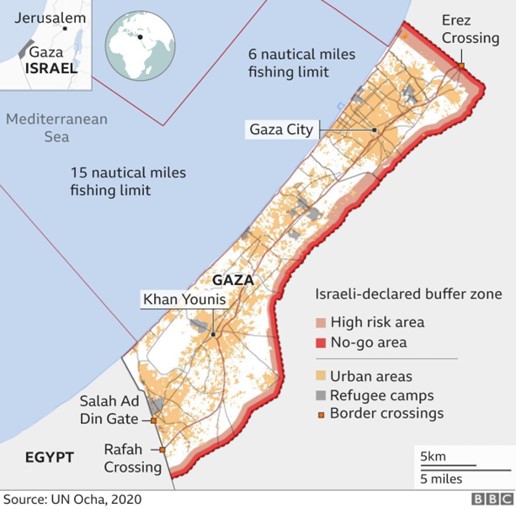
The Buffer Zone along the eastern border of the Gaza Strip (UN OCHA, 2020)

In summary, the current urban characteristics of the Gaza Strip have been shaped by two main powers: the power of resistance and the power of occupation. The power of resistance is represented by the contiguous architecture of both refugee camps and the old parts of all cities forming the Gaza Strip, in addition to the insistence on living and rebuilding better after each attack. The power of resistance can also be seen in the innovation in finding alternatives within the limited resources allowed to enter the Gaza Strip. On the other hand, the power of occupation is represented by the master plan of the Gaza Strip, which turned it into a dividable piece of land for easy control in addition to the control of all goods going in and out of the Gaza Strip. Both of these powers used architecture and urban planning, either intentionally or naturally, throughout the several attacks on the Gaza Strip. In 2014, when the Israeli tanks tried to invade Gaza, they could enter the city from the areas where there were settlements before. Still, they could not invade the center of the city without bombing the entire building fabric in that area. This is what explains the massive destruction we can see nowadays in the urban areas, specifically refugee camps like al-Shati and Jabalia refugee camps or the old part of the city like al-Shuja’iyya neighborhood. Therefore, we can conclude that the current destruction that we witness in the Gaza Strip has been exacerbated by segregation and colonial infrastructure in one of Earth’s most densely populated areas.

The current urban characteristics of the Gaza Strip have been shaped by two main powers: the power of resistance and the power of occupation.
Tags: GazaGaza StripOccupationResistanceUrban Planning
Previous Post

Gazze Şeridi: Kentsel Planlama Işığında İşgal ve Direniş

Next Post

Filistin Direniş Edebiyatının Doğduğu Okul: Ulusal Necah Okulu

Next Post
The Birthplace of Palestinian Resistance Literature: National an-Najah School

Filistin Direniş Edebiyatının Doğduğu Okul: Ulusal Necah Okulu

Bir yanıt yazın Yanıtı iptal et

E-posta adresiniz yayınlanmayacak. Gerekli alanlar * ile işaretlenmişlerdir

  • A Possible New Breath in Regional Balances: The Alliance of Türkiye, Pakistan, Egypt, and Saudi Arabia

    Bölgesel Dengelerde Olası Yeni Bir Soluk: Türkiye, Pakistan, Mısır ve Suudi Arabistan İttifakı

    0 shares
    Share 0 Tweet 0
  • Bilime Yön Verenler: Nobel Ödüllü Müslüman Bilim İnsanları

    0 shares
    Share 0 Tweet 0
  • Nakşibendi-Hakkani Tarikatı

    0 shares
    Share 0 Tweet 0
  • Fuad Sezgin

    0 shares
    Share 0 Tweet 0
  • Sosyal Medyada İslamcı-Muhafazakâr Kamusallığın Dönüşümü Üzerine

    0 shares
    Share 0 Tweet 0
  • The Gravity of What Took Place at Al-Aqsa Mosque During Ramadan 2026

    Ramazan 2026’da Mescid-i Aksa’da Yaşananların Ciddiyeti

    0 shares
    Share 0 Tweet 0
  • The Gravity of What Took Place at Al-Aqsa Mosque During Ramadan 2026

    0 shares
    Share 0 Tweet 0
  • FLA-JNIM Cooperation and Shifting Security Dynamics in Mali

    0 shares
    Share 0 Tweet 0
  • FLA-JNIM İş Birliği ve Mali’de Değişen Güvenlik Dinamikleri

    0 shares
    Share 0 Tweet 0
  • The Current State of Indonesia’s Luxury Industry and the Landscape of Independent Handcrafted Watchmaking

    0 shares
    Share 0 Tweet 0

Platform: Müslüman Dünyanın Gündemi, Müslüman toplumların fikrî, siyasi, sosyal, ekonomik ve kültürel gündemlerini takip ve tahlil edip Müslüman dünyaya dair güncel ve özgün perspektifler sunmayı amaçlayan bir yayın organı olarak İLKE İlim Kültür Eğitim Vakfı bünyesinde kurulmuştur.

  • SAYILAR
  • ANALİZLER
  • HABERLER
  • SÖYLEŞİLER
  • DÜNYADAN SESLER
  • platform@ilke.org.tr
  • (0216) 310 43 18
  • Aziz Mahmut Hüdayi Mah. Türbe Kapısı Sk. No: 13 Üsküdar, İstanbul

2025 @ PLATFORM bir İLKE Vakfı kuruluşudur. Tüm hakları saklıdır. 

No Result
View All Result
  • Home
  • Analizler
  • Haberler
  • Söyleşiler
  • Dünyadan Sesler