








İLKE Vakfı
Platform
  • Türkçe
No Result
View All Result
  • PLATFORM
  • NEWS
    Filistin Sempozyumu: Filistin ve Küresel İlişkilerin Geleceği

    Exploring Islam’s View on Slavery and Blackness: Seminar by Jonathan A.C. Brown

    The Conference on Contemporary Muslim Thought

    The Conference on Contemporary Muslim Thought

    Filistin Sempozyumu: Filistin ve Küresel İlişkilerin Geleceği

    Palestine Symposium: Palestine and the Future of Global Affairs

    İLKE Agenda: Muzzammil Ayyub Thakur ile Keşmir’in “Filistinleştirilmesi”

    The Platform Talks: Palestine after October 7 with Azzam Tamimi

    İLKE Agenda: Muzzammil Ayyub Thakur ile Keşmir’in “Filistinleştirilmesi”

    The Palestine Talks: Syria after December 8 with Kinda Hawasli

    İLKE Agenda: Muzzammil Ayyub Thakur ile Keşmir’in “Filistinleştirilmesi”

    İLKE Agenda: The “Palestinization” of Kashmir with Muzzammil Ayyub Thakur

    İLKE Agenda: Muzzammil Ayyub Thakur ile Keşmir’in “Filistinleştirilmesi”

    Khaled Beydoun: “Islamophobia is a modern manifestation of the crusades”

  • ANALYSIS
    • All
    • Culture, Arts and Media
    • Economy
    • Education
    • Energy and Environment
    • Fundamental Rights and Freedoms
    • Migration
    • Opinion
    • Social Issues
    Sharif Osman Hadi and the Politics of Insāf: Youth Mobilization and the Unfinished Revolution in Bangladesh

    Sharif Osman Hadi and the Politics of Insāf: Youth Mobilization and the Unfinished Revolution in Bangladesh

    What Does Ghannouchi’s Hunger Strike Say About Tunisian Politics?

    What Does Ghannouchi’s Hunger Strike Say About Tunisian Politics?

    The End of Gray Balances: Eastern Yemen, Saudi Security Imperatives, and Yemeni Unity

    The End of Gray Balances: Eastern Yemen, Saudi Security Imperatives, and Yemeni Unity

    8 Aralık 2024’ten Bugüne Suriye: Devrimin İlk Yılının Muhasebesi

    From December 8th, 2024, to the Present: An Assessment on the First Year of the Revolution in Syria

    7 Ekim Sonrası Gazze’de Çöken Sağlık Sistemi ve Yeryüzü Doktorları’nın Rolü

    The Collapse of the Healthcare System in Gaza After October 7 and the Role of Doctors Worldwide

    Possible Scenarios Regarding Iran’s Nuclear Negotiations

    Possible Scenarios Regarding Iran’s Nuclear Negotiations

  • INTERVIEWS
    From the Ballot Box to the Street: The Rising Social Wave in Tanzania After the Election

    From the Ballot Box to the Street: The Rising Social Wave in Tanzania After the Election

    Kafkasya’da Müslümanlar ve İslami Eğitim: TCDİB Kuzey Kafkasya Koordinatörü Selim Akburak ile Söyleşi

    Muslims and Islamic Education in the Caucasus: An Interview with Selim Burak North Caucasus Coordinator in Directorate of Religious Affairs

    Göçü Yönetmek: Dr. Mehmet Köse’yle Söyleşi

    Interview with Mehmet Köse

    Gurbet Hikayeleri

    Interview on Gurbet Hikayeleri

    İstanbul’daki Uluslararası Öğrencilerle Söyleşi

    Interview with International Students in Istanbul

    Gazze’den Bir Ses

    A Voice from Gaza: Sarah al-Najjar

    Filistinli Kadınları Anlamak: Yıldız Ramazanoğlu

    Understanding Palestinian Women: Interview with Yıldız Ramazanoğlu

    Filistinli Yönetmen Nevres Salih’le Söyleşi

    Interview with Palestinian Director Nawras Abu Saleh

    Çin’de Bir Hattat: Haji Noor Deen

    A Calligrapher in China: Haji Noor Deen

  • VOICES
    Anas Altikriti | Voices from the Muslim World | Türkçe Altyazılı

    Anas Altikriti | Voices from the Muslim World | Türkçe Altyazılı

    Basil Mustafa (Oxford) | Voices from the Muslim World | with Turkish subtitles

    Basil Mustafa (Oxford) | Voices from the Muslim World | with Turkish subtitles

    OMAR SULEIMAN | VOICES FROM THE MUSLIM WORLD

    OMAR SULEIMAN | VOICES FROM THE MUSLIM WORLD

    Paul Williams | Voices from the Muslim World

    Paul Williams | Voices from the Muslim World

  • DATABASE
    • All
    • Institutions
    • Movements
    • People
    Afganistan Araştırma ve Değerlendirme Birimi

    Afghanistan Research and Evaluation Unit

    Afgan Stratejik Çalışmalar Merkezi

    Afghan Institute for Strategic Studies

    Abaad Araştırma Merkezi

    Abaad Studies & Research Center

    Hamid Dabashi

    Hamid Dabashi

    Fuad Sezgin

    Fuad Sezgin

    Fikret Karcic

    Fikret Karcic

    Fatıma Mernissi

    Fatıma Mernissi

    Farid Hafez

    Farid Hafez

    Enes Karic

    Enes Karic

  • PLATFORM
  • NEWS
    Filistin Sempozyumu: Filistin ve Küresel İlişkilerin Geleceği

    Exploring Islam’s View on Slavery and Blackness: Seminar by Jonathan A.C. Brown

    The Conference on Contemporary Muslim Thought

    The Conference on Contemporary Muslim Thought

    Filistin Sempozyumu: Filistin ve Küresel İlişkilerin Geleceği

    Palestine Symposium: Palestine and the Future of Global Affairs

    İLKE Agenda: Muzzammil Ayyub Thakur ile Keşmir’in “Filistinleştirilmesi”

    The Platform Talks: Palestine after October 7 with Azzam Tamimi

    İLKE Agenda: Muzzammil Ayyub Thakur ile Keşmir’in “Filistinleştirilmesi”

    The Palestine Talks: Syria after December 8 with Kinda Hawasli

    İLKE Agenda: Muzzammil Ayyub Thakur ile Keşmir’in “Filistinleştirilmesi”

    İLKE Agenda: The “Palestinization” of Kashmir with Muzzammil Ayyub Thakur

    İLKE Agenda: Muzzammil Ayyub Thakur ile Keşmir’in “Filistinleştirilmesi”

    Khaled Beydoun: “Islamophobia is a modern manifestation of the crusades”

  • ANALYSIS
    • All
    • Culture, Arts and Media
    • Economy
    • Education
    • Energy and Environment
    • Fundamental Rights and Freedoms
    • Migration
    • Opinion
    • Social Issues
    Sharif Osman Hadi and the Politics of Insāf: Youth Mobilization and the Unfinished Revolution in Bangladesh

    Sharif Osman Hadi and the Politics of Insāf: Youth Mobilization and the Unfinished Revolution in Bangladesh

    What Does Ghannouchi’s Hunger Strike Say About Tunisian Politics?

    What Does Ghannouchi’s Hunger Strike Say About Tunisian Politics?

    The End of Gray Balances: Eastern Yemen, Saudi Security Imperatives, and Yemeni Unity

    The End of Gray Balances: Eastern Yemen, Saudi Security Imperatives, and Yemeni Unity

    8 Aralık 2024’ten Bugüne Suriye: Devrimin İlk Yılının Muhasebesi

    From December 8th, 2024, to the Present: An Assessment on the First Year of the Revolution in Syria

    7 Ekim Sonrası Gazze’de Çöken Sağlık Sistemi ve Yeryüzü Doktorları’nın Rolü

    The Collapse of the Healthcare System in Gaza After October 7 and the Role of Doctors Worldwide

    Possible Scenarios Regarding Iran’s Nuclear Negotiations

    Possible Scenarios Regarding Iran’s Nuclear Negotiations

  • INTERVIEWS
    From the Ballot Box to the Street: The Rising Social Wave in Tanzania After the Election

    From the Ballot Box to the Street: The Rising Social Wave in Tanzania After the Election

    Kafkasya’da Müslümanlar ve İslami Eğitim: TCDİB Kuzey Kafkasya Koordinatörü Selim Akburak ile Söyleşi

    Muslims and Islamic Education in the Caucasus: An Interview with Selim Burak North Caucasus Coordinator in Directorate of Religious Affairs

    Göçü Yönetmek: Dr. Mehmet Köse’yle Söyleşi

    Interview with Mehmet Köse

    Gurbet Hikayeleri

    Interview on Gurbet Hikayeleri

    İstanbul’daki Uluslararası Öğrencilerle Söyleşi

    Interview with International Students in Istanbul

    Gazze’den Bir Ses

    A Voice from Gaza: Sarah al-Najjar

    Filistinli Kadınları Anlamak: Yıldız Ramazanoğlu

    Understanding Palestinian Women: Interview with Yıldız Ramazanoğlu

    Filistinli Yönetmen Nevres Salih’le Söyleşi

    Interview with Palestinian Director Nawras Abu Saleh

    Çin’de Bir Hattat: Haji Noor Deen

    A Calligrapher in China: Haji Noor Deen

  • VOICES
    Anas Altikriti | Voices from the Muslim World | Türkçe Altyazılı

    Anas Altikriti | Voices from the Muslim World | Türkçe Altyazılı

    Basil Mustafa (Oxford) | Voices from the Muslim World | with Turkish subtitles

    Basil Mustafa (Oxford) | Voices from the Muslim World | with Turkish subtitles

    OMAR SULEIMAN | VOICES FROM THE MUSLIM WORLD

    OMAR SULEIMAN | VOICES FROM THE MUSLIM WORLD

    Paul Williams | Voices from the Muslim World

    Paul Williams | Voices from the Muslim World

  • DATABASE
    • All
    • Institutions
    • Movements
    • People
    Afganistan Araştırma ve Değerlendirme Birimi

    Afghanistan Research and Evaluation Unit

    Afgan Stratejik Çalışmalar Merkezi

    Afghan Institute for Strategic Studies

    Abaad Araştırma Merkezi

    Abaad Studies & Research Center

    Hamid Dabashi

    Hamid Dabashi

    Fuad Sezgin

    Fuad Sezgin

    Fikret Karcic

    Fikret Karcic

    Fatıma Mernissi

    Fatıma Mernissi

    Farid Hafez

    Farid Hafez

    Enes Karic

    Enes Karic

No Result
View All Result
Platform
No Result
View All Result
Home Analyses

What Does Ghannouchi’s Hunger Strike Say About Tunisian Politics?

Rumeysa Köktaş by Rumeysa Köktaş
15 January 2026
in Analyses, Opinion, Social Issues
A A
0
What Does Ghannouchi’s Hunger Strike Say About Tunisian Politics?
FacebookX/Twitter

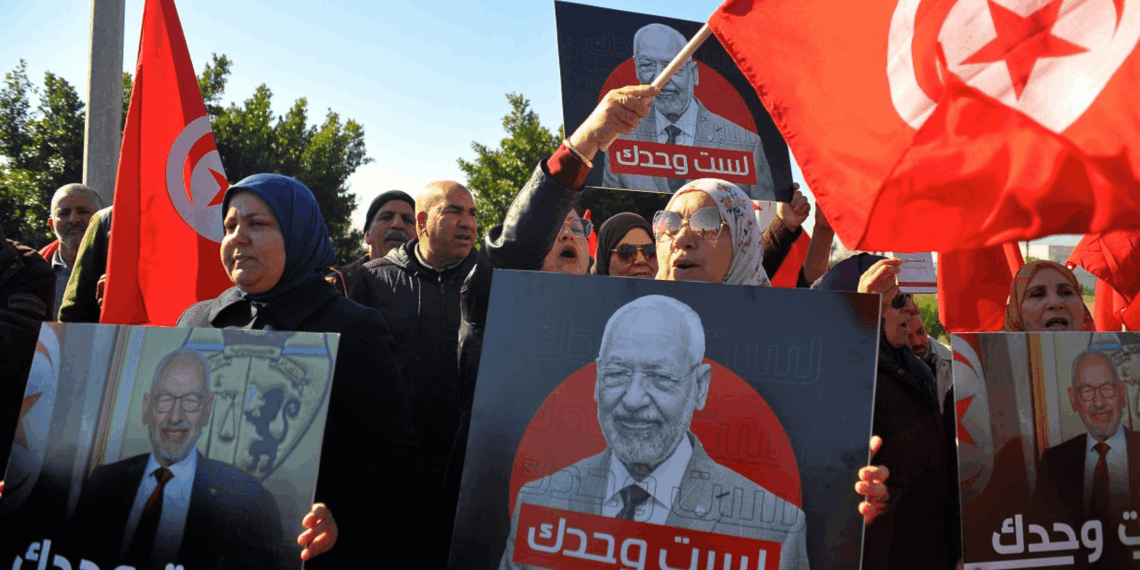
Rached Ghannouchi, the leader of the Ennahda Party, former Speaker of Tunisia’s Parliament, and one of the country’s most prominent political figures, announced last month that he had begun a hunger strike in the prison where he is being held. Arrested in April 2023, Ghannouchi was sentenced to a total of 37 years in prison on charges including “conspiring against the state,” “illegal financing,” and “inciting terrorism.”[1] Claiming that the trials were conducted under the direct guidance of President Kais Saied, Ghannouchi refused to attend the court hearings. His protest against the erosion of judicial independence, alongside that of many other democratic institutions, under Saied’s one-man rule has been further intensified by his decision to launch a hunger strike.

When Ghannouchi’s hunger strike and the political conjuncture that led to this decision are taken into account, it is possible to make three key observations about Tunisia’s current political conditions. First, Ghannouchi’s decision to go on a hunger strike despite his advanced age (84) should be understood not merely as an individual act of protest, but as an indication of the severe narrowing of institutional and legal avenues for political struggle under President Saied’s rule. Elected to the presidency in 2019 after presenting himself as an independent actor “from outside the system” and gaining broad public support with the promise of restoring the “spirit of the revolution,” Saied has, at the present juncture, steered Tunisia back into the shadow of pre-revolutionary authoritarian governance.[2] Drawing on widespread distrust of political parties and coalition governments, as well as accumulated public fatigue stemming from the failure to resolve chronic problems such as corruption and unemployment, Saied has transformed popular dissatisfaction with the existing political system into the primary source of legitimacy for his rule.[3] Over time, however, this discourse of legitimacy has paved the way for an authoritarian form of governance marked by the shrinking of civic space, the suppression of freedom of expression, and the erosion of judicial independence. In this context, Ghannouchi’s hunger strike should be seen not simply as a personal reaction, but as a form of political dissent against the closure of institutional and legal channels of opposition under Saied’s administration. The hunger strike points to a meaningful practice of resistance employed by the opposition to gain visibility and expose mechanisms of repression in an environment where civic space has been constricted and freedom of expression severely curtailed.

Second, when Ghannouchi’s decision to go on a hunger strike is considered alongside the arrest of many key Ennahda figures and the closure of party offices across the country,[4] it necessitates a reassessment of Ennahda’s political trajectory since 2011. Examining the course adopted by Ghannouchi and the Ennahda Party in the post-2011 period, it is possible to say that they pursued a consistent political stance centered on national dialogue and compromise. Ennahda’s withdrawal from power during the 2013 political crisis on the grounds that “the nation is more important than the party,” its continual search for compromise with remnants of the old regime and with different ideological factions, and its prioritization of coalition politics over the pursuit of sole power can be regarded as critical steps toward the institutionalization of democracy and pluralism in Tunisia. To read these choices solely as products of political pragmatism, however, would be to overlook Ghannouchi’s approach to democracy and freedoms. Indeed, Ghannouchi, who has described dictatorship as the most destructive political disease in the Arab world, was fundamentally motivated by the aspiration for Tunisia to present the Arab and Islamic worlds with a vibrant example of democracy rooted in its own social dynamics.[5] At the current juncture, however, despite this emphasis on compromise and dialogue, the accumulation of unresolved structural problems since 2011 being associated with the party has both eroded Ennahda’s social legitimacy and created a political environment that has made it easier for Saied’s administration to label the party as a “foundational enemy.”[6] In this context, Ghannouchi’s hunger strike constitutes not only a protest against the existing regime of repression but also an illustration of how Ennahda’s post-2011 politics of compromise have been reversed and pushed to the margins of the political system.

Finally, it can be observed that the climate of repression that has taken shape in Tunisia alongside Saied’s increasingly deepening authoritarian tendencies has progressively blurred ideological distinctions within the opposition. In President Saied’s campaign of arrests targeting opponents, no ideological differentiation appears to be made among Islamist, leftist, liberal, secular, or independent activists; instead, individuals and groups are broadly labeled with open-ended terms such as “traitor,” “terrorist,” or “conspirator.”[7] On the other side, when one looks at the front of resistance, it is likewise necessary to speak of a form of solidarity that transcends ideological differences. Ghannouchi’s hunger strike is one of the most striking examples of this transformation. Indeed, Ghannouchi announced that he had begun his hunger strike in solidarity with Jawhar Ben Mbarek, a public figure known for his secular identity, who was sentenced to 18 years in prison on charges such as “conspiring against state security” and “membership in a terrorist organization.”[8] Ghannouchi justified this decision by stating that “there is now a cause greater than ideological divisions, and that is freedom, and it concerns everyone in Tunisia.”[9]

Echoing Ghannouchi’s message, Ben Mbarek likewise issued a statement thanking the opposition figures who joined the hunger strike in solidarity with him, Issam Chebbi, Secretary-General of the Republican Party; Rached Ghannouchi; the politician Abdelhamid Jelassi; and Rida Belhaj, leader of the National Salvation Front.[10] Moreover, in a message sent from prison on the occasion of the second anniversary of his conviction in April 2025, Ghannouchi further reinforced this picture by emphasizing that political prisoners representing different segments of Tunisian society stand on a common front against Saied’s authoritarian rule:

“In Mornaguia Prison there are Jawhar Ben Mbarek, Rida Belhaj, Ghazi Chaouachi, Khyam Turki, Issam Chebbi, Abdelhamid Jelassi, Lotfi Mraihi, Habib Ellouz, Béchir Akremi, and others. They all come from different backgrounds, but they are united in their resistance to oppression. Politics divided them, ideologies drove them apart, but dictatorship and repression have brought them together.”[11]

As is evident, one of the defining features of the current political environment in Tunisia is that repression and arrests targeting actors opposed to President Saied are not selective but rather inclusive and generalized in nature. Accordingly, the opposition to Saied is characterized not by ideological differences or forms of social representation, but by being labeled in the president’s discourse as “traitors” or “terrorists.” In response, the opposition appears to be developing a common line of resistance as a relatively homogeneous set of actors against what they describe as a “dictatorial” regime, rather than engaging in a fragmented political struggle grounded in ideological divisions.

In conclusion, Ghannouchi’s hunger strike can be seen as both a product of the political transformation taking shape in Tunisia under Saied’s rule and a meaningful threshold that renders this transformation visible. The strike vividly demonstrates the limits within which recourse to political dissent has become possible in an environment where institutional and legal channels of opposition have been constricted. It also reveals how Ennahda’s post-2011 political line centered on compromise and dialogue has been reversed. Finally, Saied’s process of authoritarian consolidation rests not on a selective form of repression targeting specific ideological actors, but on an inclusive and generalizing discourse that criminalizes the opposition regardless of ideological differences. While this approach serves to suppress ideological pluralism from the regime’s perspective, it simultaneously gives rise, on the opposition front, to a terrain of resistance shaped around a shared experience of repression.

*Opinions expressed in this article are the author’s own and do not necessarily reflect Platform: Current Muslim Affairs’ editorial policy.

[1] “Tunisian opposition leader Rached Ghannouchi begins hunger strike”, Middle East Eye, 8 November 2025.

[2] Soumaya Ghannoushi, “Tunisia was the hope of the Arab spring. Now my father could face the death penalty for his words”, The Guardian, 30 May 2023.

[3] “The Tunisian Public and the Rise of Kais Saied: A Conversation with Hind Ahmed Zaki”, Crown Center for Middle East Studies, 27 May 2022.

[4] “Tunisia jails ex-prime minister on terrorism charges”, BBC News, 3 May 2025; “Tunisian opposition leader Rached Ghannouchi sentenced to three years”, Aljazeera, 1 February 2024; “Tunisia: Police arrest two senior Ennahda leaders”, Middle East Eye, 5 September 2023.

[5] Soumaya Ghannoushi, “Rached Ghannouchi: My father’s ideas will outlive this shameful era in Tunisia”, Middle East Eye, 14 November 2025.

[6] “Ennahda: Before and After the Coup in Tunisia: A Conversation with Andrew F. March”, Crown Center for Middle East Studies, 8 July 2022.

[7] “Tunisia: Wave of Arrests Targets Critics and Opposition Figures”, Human Rights Watch, 24 February 2023.

[8] “Tunisian opposition figures join hunger strike to support jailed politician”, Aljazeera, 8 November 2025.

[9] “Jailed Tunisian politicians go on hunger strike against presidential crackdown”, Financial Times, 16 November 2025.

[10] “Tunisia’s imprisoned opposition figure marks 17th day of hunger strike”, Middle East Monitor, 15 November 2025.

[11] “Tunisia’s Opposition Leader Ghannouchi Speaks After Two Years Behind Bars”, Reset Dialogues on Civilizations, 22 April 2025.
Rumeysa Köktaş

Rumeysa Köktaş

Related Articles

Sharif Osman Hadi and the Politics of Insāf: Youth Mobilization and the Unfinished Revolution in Bangladesh
Analyses

Sharif Osman Hadi and the Politics of Insāf: Youth Mobilization and the Unfinished Revolution in Bangladesh

21 January 2026
The End of Gray Balances: Eastern Yemen, Saudi Security Imperatives, and Yemeni Unity
Analyses

The End of Gray Balances: Eastern Yemen, Saudi Security Imperatives, and Yemeni Unity

9 January 2026
8 Aralık 2024’ten Bugüne Suriye: Devrimin İlk Yılının Muhasebesi
Analyses

From December 8th, 2024, to the Present: An Assessment on the First Year of the Revolution in Syria

8 December 2025
7 Ekim Sonrası Gazze’de Çöken Sağlık Sistemi ve Yeryüzü Doktorları’nın Rolü
Analyses

The Collapse of the Healthcare System in Gaza After October 7 and the Role of Doctors Worldwide

4 December 2025
Possible Scenarios Regarding Iran’s Nuclear Negotiations
Analyses

Possible Scenarios Regarding Iran’s Nuclear Negotiations

2 December 2025
Katliamların Gölgesinde Sudan
Analyses

In the Shadow of Massacres: Sudan

27 November 2025
  • What Does Ghannouchi’s Hunger Strike Say About Tunisian Politics?

    What Does Ghannouchi’s Hunger Strike Say About Tunisian Politics?

    0 shares
    Share 0 Tweet 0
  • Sharif Osman Hadi and the Politics of Insāf: Youth Mobilization and the Unfinished Revolution in Bangladesh

    0 shares
    Share 0 Tweet 0
  • The End of Gray Balances: Eastern Yemen, Saudi Security Imperatives, and Yemeni Unity

    0 shares
    Share 0 Tweet 0
Sharif Osman Hadi and the Politics of Insāf: Youth Mobilization and the Unfinished Revolution in Bangladesh
Analyses

Sharif Osman Hadi and the Politics of Insāf: Youth Mobilization and the Unfinished Revolution in Bangladesh

by Abdullah al-Mamun
21 January 2026
0

Introduction: The July Revolution and the Rise of a New Political Consciousness I want to practice Insāf (justice) even with...

Read moreDetails
What Does Ghannouchi’s Hunger Strike Say About Tunisian Politics?

What Does Ghannouchi’s Hunger Strike Say About Tunisian Politics?

15 January 2026
The End of Gray Balances: Eastern Yemen, Saudi Security Imperatives, and Yemeni Unity

The End of Gray Balances: Eastern Yemen, Saudi Security Imperatives, and Yemeni Unity

9 January 2026
8 Aralık 2024’ten Bugüne Suriye: Devrimin İlk Yılının Muhasebesi

From December 8th, 2024, to the Present: An Assessment on the First Year of the Revolution in Syria

8 December 2025
7 Ekim Sonrası Gazze’de Çöken Sağlık Sistemi ve Yeryüzü Doktorları’nın Rolü

The Collapse of the Healthcare System in Gaza After October 7 and the Role of Doctors Worldwide

4 December 2025

Platform: Agenda of the Muslim World was established within the İLKE Science Culture Education Foundation as a publication organ that aims to follow and analyze the intellectual, political, social, economic and cultural agendas of Muslim societies and to present current and original perspectives on the Muslim world.

  • ANALYSIS
  • NEWS
  • INTERVIEWS
  • VOICES
  • platform@ilke.org.tr
  • (0216) 310 43 18
  • Aziz Mahmut Hüdayi Mah. Türbe Kapısı Sk. No: 13 Üsküdar, İstanbul
Instagram X-twitter

2025 @ PLATFORM is an İLKE Foundation organization. All rights reserved.

No Result
View All Result
  • Home
  • Analyses
  • Infographic
  • Interviews
  • News
  • Database
  • Voices
İLKE Vakfı
  • Türkçe