

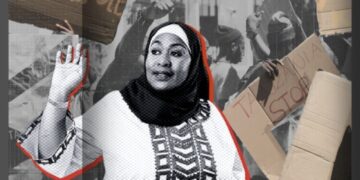






“Mama Samia is a mother who, like many heroines in African history, has led silent revolutions.”
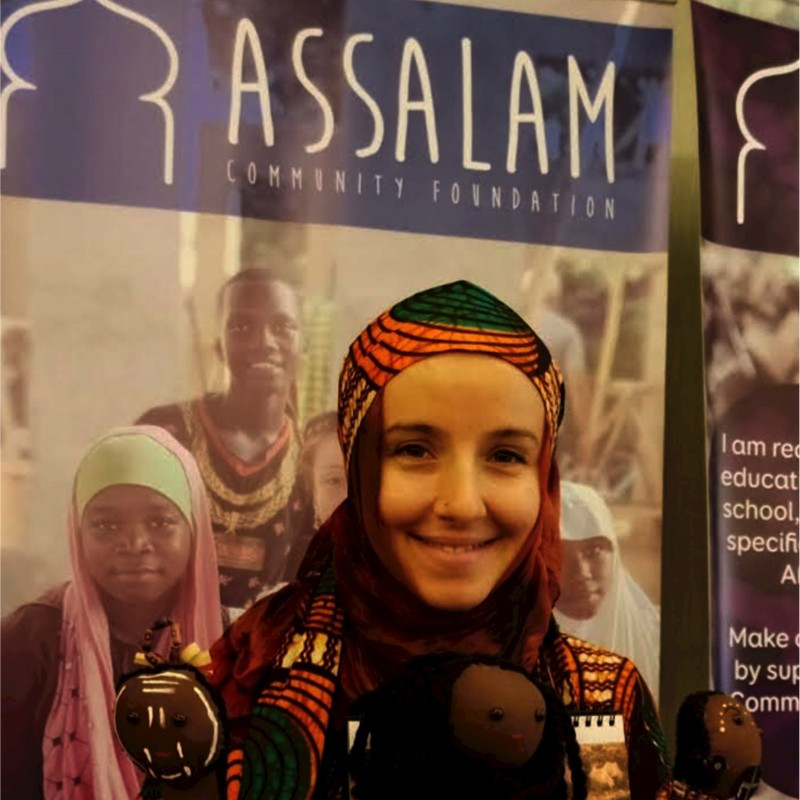
As the founder of the Assalam Foundation established in Zanzibar, you carry out many valuable projects with Assalam. As a woman, you are a name that has accomplished important works in the field of civil society. Could you briefly tell us about your life story leading to Zanzibar and Assalam’s activities?
I believe very much in the transformative role of women in society. I did my master’s degree on the politicization of women and my PhD was on Islamic unity. At Assalam, we are making silent revolutions, partly through the Nana Esma model, that is, through young girls and widows. This transformation is taking place not only among African women, but also among thousands of women from all over the world who are our volunteers and donors. Like Nana Esma, we are not doing this in a feminist way, there are also men among us. Together, we are trying to support each other and overcome difficulties.
Geography is destiny and Zanzibar is my destiny, but I have known many wonderful women who have started similar movements in many other parts of the world too. Nana Esma and her likes, women who rarely come to forefront, are the actual catalysts who keep changing the world consistently yet quietly.
We established Assalam with the inspiration we received from these women. Assalam is a new generation social enterprise that produces projects that stand on their own feet with the goal of “a self-sufficient Africa”. We aim to produce sustainable solutions and income sources for Africa’s problems, to establish collaborations around the world, to create quality education opportunities for children and women, and to be a role model for other NGOs in the world in this context.
Samia Suluhu Hassan, Tanzania’s first female President, is a powerful portrait of a Muslim woman ruler. As a head of state, Mrs Samia is a source of hope for the people of the region, especially for women. As a person who has been in Tanzania for many years, can you tell us about your thoughts regarding Samia Suluhu Hasan?
We first met Mama Samia in the summer of 2019, the first year of our school. Our students prepared and performed a play representing the tribes in front of her. Mrs Samia was the vice president at that time, but she was still the same “Mama Samia”.
The following year she visited our school, caressed the heads of our children, chatted with our mothers and young girls. Each of her visits was a morale booster for everyone in the village. The fact that the most important person from our village was a woman was also a source of pride and hope for our foundation, which focuses on women’s projects especially when there are so many obstacles in front of us that could break our hopes.
The next year Mama Samia became president but she came to our village again. Again, she asked about our well-being, with all her sincerity. The last time we met was on the occasion of the mevlit she gave in the modest house she had built for herself in our village. She sat on the floor like us, we made eye to eye contact many times hence talked about many things without even uttering words. She knew, as we did, how important her very presence was for us. We believe that if God wills, each of our students can become a great hero like her.
When we look at women leaders in history, we are always confronted with the figure of a king, a father or a husband. However, from the time Mama Samia was born in Zanzibar in 1960, up until 1991, when she started taking leadership courses in Lahore and Hyderabad, she had a very local upbringing with no privileges, therefore her surviving clan still lives off fishing and agriculture in a village in Zanzibar.
However, her involvement in a project with the World Food Program at the age of 32, and her postgraduate studies in economics at the Universities of Manchester and New Hampshire in her forties, lead to different openings in her political career. She was elected to the cabinet in her 40s, became a minister at 45 and vice-president at 55. Now 63 years old, Mama Samia’s real journey has only just begun, and we believe that she has much more to contribute to Tanzania and leave deep traces behind.
More than being the first Muslim and female president of Tanzania, or one of the very few Africans to be named among the 100 most influential women in the world by Forbes, or the second female leader of East Africa in history, and many other firsts associated with her name, Mama Samia is for us, our next door neighbour, a woman from our village, a real mother with a heartfelt smile. Like many heroines in African history, she is a mother who leads silent revolutions.
What are the impacts of Samia Suluhu Hassan as a Muslim woman and administrator in Tanzania? How have Mrs Samia’s policies contributed to civil society and the empowerment of women in public roles?
An important characteristic of women leaders is that they do not come to power by shouting, nor do they shout their reforms. Since coming to power, Mama Samia has implemented reforms in many areas, from press freedom to the economy and health care, despite fierce protests within her own party.
Unlike the inward-looking policies of the previous President Magufuli, Mama Samia started to establish strong relations by personally visiting many countries after becoming the head of state; she even acted in documentary films to introduce her country to the world. Her visit to the USA alone brought 1 billion dollars of investment to the country.
Although she did not like to be compared to the previous president, the change was so clear that Mama Samia’s outward-looking demeanour attracted the attention of the whole world after Magufuli, who had a reputation of a “bulldozer” and had travelled abroad only ten times during his six years in power, all of them in Africa, and had been harsh on foreign investors, especially the mining companies.
For the time being, Mama Samia is pardoning and recalling politically banned opposition politicians who were exiled; making democratic inroads in the electoral and constitutional process; trying to bring pregnant women who were banned from school back to education and thus to life; and reopening closed media outlets. Tanzania, with Africa’s sixth largest natural gas reserves, has announced that it is looking for a market in Europe and has rolled up its sleeves for a $10 billion mega-port in Bagamoyo, a city just half an hour north of Dar es Salaam that could be an alternative to Mombasa; hence now asserting itself effectively as a leader in the region.
Mary Chatan, President of the United Women’s Association of Tanzania, presents a gift to Samia Suluhu Hasan.
Can you give examples of the role of women in the public sphere in Africa and of influential female personalities in Africa? Are women in Africa strong enough in the political and social sphere? What projects are being implemented in Africa to empower women publicly and economically?
There are 54 different countries in Africa. Born in 800, Fatima al-Fihri from Morocco, who founded the world’s first university, was an African woman, but thousands of women over time have been prevented even from stepping out of their houses by groups like Boko Haram or many radical organizations. Of course, we cannot say that women are sufficiently strong hence we have a long way to go, but we can definitely say that there is hope. Especially in recent years, some institutions that have realized that small steps hardly carry a benefit and a holistic approach is needed, have started to carry out effective projects on women’s empowerment. From micro-credit to vocational trainings, there are very successful examples not only in Africa but all over the world; as Assalam, we want to be one of these inspiring examples.
Which other women come to mind when you think of Africa and personalities who have left a mark?
In fact, Africa is full of female characters such as Cleopatra and Nefertiti or Queen Candace of Meroe, whose history has not forgotten for thousands of years. We do not hear similar stories from the history of any Western country. There are women who are remembered as the mothers or wives of prophets or kings, but it is not possible to come across a truly independent and ruling female profile before the 19th century in another place. However, in Ethiopia alone, we can talk about 21 queens who ruled until the 9th century. For example, there is the Nigerian Nana Esma, whose father, husband, uncle and twin brother were warriors and politicians, and whose methods of governance were far more effective than theirs. The reformist Nana Esma, who corresponded with governors, negotiated with scholars, translated many books she brought from the Arab world into local languages for her students, catalogued hundreds of her father’s books written in four languages and shared them with centres of knowledge all over Africa, and managed to use her position and all the talents God had endowed her with for the rights of women and to carry progressive ideas from the palace to all levels of society.
Nana Esma is a woman who speaks and writes four languages fluently, including Arabic (Hausa, Fulani, Tamachek), who was educated in Islamic law, Qur’anic and Hadith sciences as well as Greek and Latin literature, who was instrumental in conversion of many local tribes to Islam after entering their empires with her translations of the Qur’an and works on Sufism and poetry in the tribal languages she mastered, and who then organized women from these communities and trained women leaders from disadvantaged groups in her organization called Yan Taru.
Nana Esma, who died at the age of 71, has nearly 60 works surviving to this day. Her poems had travelled beyond the borders of the Sokoto empire in her own time and had become famous in many African countries and the Middle East. The education system she established is still used in many countries and schools, universities, foundations and conference halls are still being opened in her name all over Africa. Mama Samia had three children while Nana Esma had five children. Both of them never developed a feminist discourse. They did not have both a child and a career; they had both a child and a revolution.
Have you ever heard of Mama Asta from Senegal, a Maliki jurist? She was one of the organizers of the Muridiya movement, which had a great role in the independence of Senegal. She was a heroic woman who was influenced by the famous sheikh Ahmad Bamba, who always supported and encouraged her.
Or do you know about Ella Little-Collins, the older sister who brought up Malcolm X? From the age of 14, Ella took him with her, made him go on a pilgrimage, fought for the rights of black people hence Malcolm X referred to her as “The first black woman I know and am proud of”.
In fact, when we look at the history of Islam, the strong influence of black women starts with the Prophet’s mother Barakah, who came from Ethiopia. Barakah, who is better known as Umm Aymen, who knew the Prophet (pbuh) since the pregnancy of his mother Hz Amine, who protected and cared for him after the death of his mother and then his grandfather, whom the Prophet (pbuh) heralded with the glad tidings of paradise and described as “my mother after my mother”, who was one of the first Muslims, who was present at the battle of Uhud and who survived after the Prophet (pbuh) until the caliphate of Hz Osman. Another Ethiopian heroine is Sumayyah, whom we know as the first Muslim martyr. We think there is hardly anyone who does not know her honourable story.
Another famous African woman like her is Fatima al-Fihri of Fez, born in 800, who founded the first university in history, al-Qarawiyyin University, which produced graduates such as Ibn Khaldun, Averroes, Maimonides and Aurillac, whose ideas and inventions changed the world.
And then there are those we have never heard of. For example, Sayyida Al-Hurra, who died in 1552, was an African Muslim heroine, a pirate queen, who was exiled from Granada and defended her country against the Portuguese throughout her life.
By the 20th century, the number of influential women was much higher
These women, only some of whom we have been able to mention, have been recorded in history and are internationally renowned, and many of them are famous for their resistance to colonial systems. However, in Africa, which is largely governed by a tribal system and where only oral history exists, many of such women may have been forgotten. By the 20th century, the number of influential women had increased significantly in this region.
The Egyptian nationalist Huda Shaarawi (1879-1947), who organized a women’s social service organization and became the founding president of the Arab feminist union and a voice for women’s rights throughout the Arab and European world, or Bibi Titi Mohamed (1926-2000), who combined her identity as a singer with her political identity to become one of the leaders of the Tanzanian nationalist movement and recruited more than six thousand women into the party of the independence leader Nyerere. There are dozens of such women, and if we include non-Muslims, hundreds more.
Although we have briefly mentioned here the inspiring stories of many strong African Muslim women, there is no doubt that women in Africa and the world still have a long way to go.