
















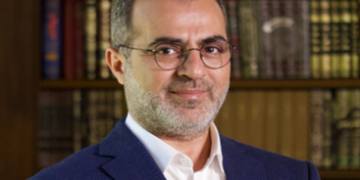









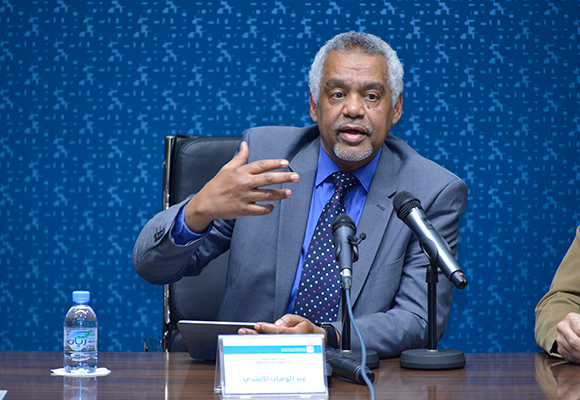
The Sudanese political scientist Abdulwahhap al-Afandi is a scholar whose works are published extensively in various fields of political science, including Islam, democracy, modernity, Islam in the West, and Sudanese and Middle Eastern politics. He holds a bachelor’s degree from the University of Khartoum, a master’s degree from the University of Wales and a PhD from the University of Reading and is currently the head of the Doha Institute for Graduate Studies. Previously, he was the dean of the same institute and the founding coordinator of the Democracy and Islam Programme at Westminster University. He has also held academic positions at universities and institutes in Norway, Chicago, Oxford, Cambridge etc. He is the author of numerous books and articles, including Rethinking Modernity and Islam, Revolution and Political Reform in Sudan, and What Kind of State?
Al-Afandi has made a significant contribution to contemporary Islamic political thought by presenting an original perspective on the debates of Islamic state. By developing his own ideas and theories about the structure of an Islamic political society, he has produced a discourse that differs from mainstream Islamists. Al-Afandi, who stands very close to the tradition of liberal thought, has also developed arguments about the compatibility of Islam and democracy in his works.
Classical and Contemporary Debates on the Islamic State
According to al-Afandi, the modern state was built apart from sets of norms; it created its own norms. The modern state is a system that does not recognise any principles other than the norms it has established. Making a comparative reading between modern state theorists such as Hobbes, Locke, Hegel and Ibn Khaldun, El-Afandi thinks that the views of virtuous man and virtuous society have been shaken in state theories after Ibn Khaldun. According to al-Afandi, Ibn Khaldun, who has a “Machiavellian” view in his thought, rejects the thesis of Muslim theologians and philosophers who consider the social order as the basis of the state. Ibn Khaldun emphasises that the power brought by asabiyyah is critical in the establishment of a strong state, not religion and morality (al-Afandi, 2009, pp.23-32).
Despite its immoral and “godless” basis, the modern Western state has been the most successful system so far. Al-Afandi believes that modern Muslims have serious problems in accepting the modern state and have not been able to establish an Islamically idealised political system. In the classical Islamic political thought, Muslim thinkers set “rashid (high) standards” in defining the characteristics of the caliph, which made it very difficult for the caliph to fulfil these characteristics. One of the main problems of classical theory, according to al-Afandi, is the development of this “rashid standard”. Since the caliph was seen as the “representative of the prophet”, his duties and qualifications were constructed on an ideal basis. Since many ideal qualities such as piety, courage, knowledge, and virtue were sought together in the caliph, which was very rare, it actually created a situation that led to the practical collapse of the ummah in theory. Another weakness of the classical theory is the idea that the regime is considered legitimate, and obedience is necessary as long as the ruler promises to obey the Shari’ah. This idea became more evident exclusively in thinkers such as al-Māwardī and al-Ghazali. Al-Afandi stated that this would lead to authoritarianism as it made it difficult to dismiss the ruler. Al-Afandi described the classical theory as both too idealistic and too pessimistic; he criticised it for not showing the way to fight tyranny while proposing to overcome the impossible by showing the highest standards (al-Afandi, 2009, pp.67-71).
He associates the birth of the contemporary Islamist movements with the atmosphere that emerged with the abolition of the caliphate in 1924 and recognises the Muslim Brotherhood as the pioneer of the Islamist movements. Al-Afandi argues that Islamist movements generally see themselves as virtuous communities and hence assumes the role of the guardian of Islamic morality within the state. According to Ghannouchi, on the other hand, the Islamist movement is an element of the liberal state as one of the political parties presenting its programme to the people. The task of the Islamist movement is merely preaching and persuasion (al-Afandi, 2009, pp.95-96).
According to al-Afandi, the main problem with the contemporary Islamist movements’ view of the state is that it confines the state into narrow boundaries by accepting the modern concept of the state as a principle. The contemporary Islamist movements also reintroduced the classical theory in all its ambiguity and desired the expectance of a Mahdi, which, according to al-Afandi, favoured the existing despotic regimes rather than the establishment of the Islamic order (al-Afandi, 2009, pp.101-102). Al-Afandi has identified aspects in which Islamist thinkers and leaders, such as Mawdudi, Sayyid Qutb and Khomeini, have paradoxed their understanding of the state and their approach to democracy and in which they do not reconcile democracy with Islam (Al-Afandi, 2003). El-Afandi criticised the “authentic” alternative Islamic models put forward by anti-democracy Islamists for their tendency towards authoritarianism and their contradiction with Islamic principles.
According to al-Afandi, to understand the predicament in which Muslims find themselves today, it is necessary to understand the ideals of the rashid caliph and the mistakes made by Muslim theorists in understanding these ideals. Both the search for very high ideal qualities in the caliph and the fact that Muslim theorists considered it impossible to have leaders such as Caliph Abu Bakr and Caliph Umar put them in a contradictory situation. While the caliphate was idealised in theory, it was rendered impossible in practice. With the complete collapse of the caliphate system at the beginning of the twentieth century Islamist movements assumed the mission of being the voice of the ummah. Al-Afandi criticised the tendency of modern Islamists towards authoritarianism and their cooperation with oppressive forces. Al-Afandi argued that Tunisian Islamists offered the best solution to the weakness of Muslims in the contemporary period. Tunisian Islamists defined the basis of politics and political institutions as democracy and freedom (al-Afandi, 2009, p.147)
Al-Afandi sees Islam as a “perfect international system” that has emerged as a religion with a mission of equality for all people. It conflicts with the existing international system because of injustice, racism, and the persecution of Muslims. Islam does not recognise the existence of any other system where it exists and is therefore a rival to the existing international system. Although Muslims are weak, Islam is always very strong and at the ideological level no alternative system is as comprehensive and wholesome as Islam. Moreover, al-Afandi finds the debate on whether Islam is compatible with the nation-state meaningless; according to him, Islam conflicts with the essence and values of the system, not its form (al-Afandi, 2009, p.113).
Al-Afandi’s “Political Society” Model
In his 1994 book Who Needs an Islamic State? he put forward an original theory on how a political society/state should be established. Al-Afandi’s approach and arguments are quite different from the mainstream Islamists.
Al-Afandi’s theory presents a model of political society rather than a centralised state in the modern sense. In this model of political society, societies come together freely, based on mutual co-operation. This society should not be founded on a constitution but on a contract. Al-Afandi gave the example that the first Islamic political society was established with a contract such as “Medinet al-Wasika” and emphasised that the parties to this contract included Jews and various tribes, and that the rights and responsibilities related to the continuity and preservation of the state were determined in the contract (Al-Afandi, 2009, p.163). Stating that individuals are in complete freedom in this society, Al-Afandi notes that Sharia cannot be imposed by force; individuals will live according to their own preferences with their own free will (Al-Afandi, 2009, p.148). Individuals in complete freedom will adopt a lifestyle in accordance with Islam based entirely on their own will. Thus, a “prophetic society” will be established (Al-Afandi, 2009, p.148).
According to al-Afandi, contrary to the thought of Ibn Khaldun and modern state theorists such as Hobbes and Machiavelli, relying on the principle of unlimited ability of the human will to find perfection should be taken as a basis. For al-Afandi, who thinks that people can only challenge social laws with their own will and change them when necessary, “human will” is the most important part of social reality and can find perfection (al-Afandi, 2009, p.132).
Emphasising that the responsibility and active role of the individual in Islamic society should be taken as a basis, al-Afandi believes that the individual will choose what is good for him/herself. Al-Afandi also criticised concepts and institutions in classical Islamic thought, such as “fard al-kifaye” and “ahl al-qaḍd”, which he thought restricted or even ignored the role of the individual. For example, al-Afandi, who thinks that each individual is responsible for social morality, criticises the passivation of the responsibility of individuals with the concept of “fard al-kifaye” and proposes the concept of “fard al-jama’i” (al-Afandi, 2009, p.1444).
In the model proposed by al-Afandi, the Islamic state, whose core value is freedom, must also be a strictly democratic state (al-Afandi, 2009, p.150). Al-Afandi defines democracy as a stable system of governance that seeks to guarantee the widest possible political participation on equal terms and on the basis of a consensus acceptable to the political community and normatively defensible. The democratic consensus is a reconciliation of values and interests so that no one feels victimised. According to Al-Afandi, the principles of democracy and Islam are not in opposition. Equality that is the main principle of democracy is not contrary to Islam. On the contrary, the Qur’an and hadiths also emphasise that all human beings are equal regardless of their colour, ancestry, or level of wealth. The most criticised principle of democracy by Muslims is the centrality of freedom. Those who criticise argue that the Muslim community would not allow unlimited freedom. However, democracy is not incompatible with the rule of law and “obedience to those in authority”. Compliance with Islamic law does not restrict the freedom of Muslims, nor does the free will of Muslim societies to adhere to Islamic law contradict democracy. Islamic law cannot exist without freedom and self-government (al-Afandi, 2006, p. 628). However, conflicts are inevitable in an Islamic society. Democracy means being able to reach a consensus on these disputes in an equal and fair manner. Therefore, democracy is obligatory.
According to Al Afandi, his model is an alternative to the nation-state, which has reached the point of stagnation today. In this model, where societies come together voluntarily, as opposed to the nation-state model, which is divided into strict territorial borders, societies come together not as subjects of a sovereign state, but as members of a society united by their own consent, each in complete freedom and following their own way. Stating that he does not mean an oppressive and centralised state in the modern sense, Al-Afandi emphasises that it is a model in which various societies are together in which members move freely.
Bibliography
El-Afandi, A. (2003). Democracy and the Islamist paradox. In Axtman, R. (Ed.) Understanding Democratic Poltics. London: SAGE Publications.
El-Afandi, A. (2006). Democracy and its (Muslim) critics: An Islamic alternative to democracy?. Khan, M. A. Muqtedar (Ed.). Islamic democratic discourse (pp. 628-705). UK: Lexington Books.
El-Afandi, A. (2009). What kind of a state?. Istanbul: İlke.