


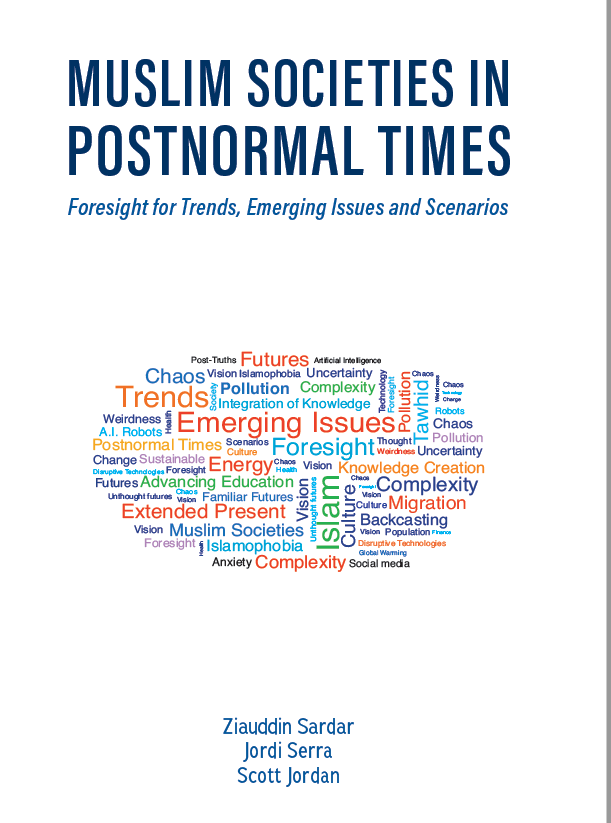
Sardar, Z., Serra, J., & Jordan, S. (2019). Muslim Societies in Postnormal Times: Foresights for Trends, Emerging Issues and Scenarios. UK: International Institute of Islamic Thought (IIIT).
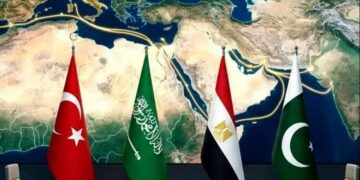
In the past 25 years, as the first quarter of the 21st century draws to a close, dramatic changes have occurred both in the world and in Muslim societies. In addition to technological and scientific developments, a process of change that concerns all of humanity keeps on, such as global warming, climate change, air, and environmental pollution, water scarcity, the international migration crisis, and human rights violations. The book titled Muslim Societies in Postnormal Times: Foresight for Trends, Emerging Issues, and Scenarios, written by Ziauddin Sardar, Jordi Serra, and Scott Jordan, which we will evaluate in this article is a work that examines the current situation and future visions of Muslim societies within the scope of their future studies.
The central focus of the study is Muslim societies. The study, which analyses the current situation of Muslim societies in the context of future studies and their possible positions in the near-middle-far future, is essential. “Why should we consider or be concerned about the future?” seeks an answer to the question. Since the study focuses on Muslim societies, the “How can we as Muslims build a liveable future for ourselves and other societies or how should we take precautions against possible future scenarios?” emerges as one of the main questions. Thinking about the future or trying to shape it depends on current studies, and it is also vital to imagine possible scenarios to be prepared for the problems that may be encountered in the future. Because today’s world is changing faster than ever before, this change leads to the emergence of chaos, disorder, and complex relations rather than order and stability.
The study aims to make Muslims ponder over their destiny for the welfare and happiness of not only Muslims but also all humanity and to induce a better legacy to succeeding generations by developing solutions in the face of current problems, threats, and difficulties. In this context, it is necessary to be aware of where today’s world is going and to consider that our choices, collective or individual decisions, affect our current situation and build our future. It is stated that everyone should be “future literate” in order to realize these goals emphasized in the study (p. viii). As stated in the study, future studies of Muslim communities either do not exist at all or find little place in their educational curricula. For this reason, the authors of the study also state that they aim to prepare a realistic and practical guide for decision-makers, students, and academics that will enable Muslim societies to analyse alternative future visions.
Postnormal Times Theory, conceptualized as a theoretical framework in the study, was developed by Ziauddin Sardar and his colleagues. The theory analyses a time shaped by complex, chaotic, and contradictory relationships with multiple variables interacting in large numbers. Due to its uncertain and complex nature, postnormal time causes events to become ambiguous and the idea of normality to be destroyed. In this context, Postnormal Time Theory is critical because it puts inconsistent and intricate relationships in the near, middle, and far futures on a theoretical ground in the following sections. In the words of the authors, the Postnormal Theory of Time refers to ‘an interim period when old orthodoxies die, new ones are not yet born, and little seems to make sense (p. xv). In standard times, certain judgments, solutions, or interpretations put forward against events, situations, or ideas leave their place to the interconnected and intertwined nature of problems in Postnormal times; a relationship network is open to constant change, where complexity and uncertainty predominate.
Following the foreword, the study consists of five parts: “General Evaluation,” “Trends,” “New Issues,” “Scenarios,” and “Concluding Word.” In the title of “General Evaluation,” a brief introduction to his future studies and why Muslim societies should give importance to future studies are discussed.
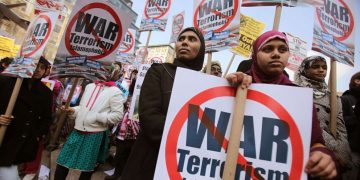
In the “Trends” chapter, the changing factors are discussed in general, and inferences are made for Muslim societies under each title. “Trends” based on qualitative or quantitative data conduce to the predictions or future projections as they address the variable structure of factors in the world. Population and youth, environment and livableness, pollution and cities in danger, migration and refugees, economy and energy, science and technology, armed conflicts and terrorism, cyber-attacks and cyber wars, education and creativity, health and welfare, gender inequality, religion and culture, entertainment and sports, Islamophobia and the rise of the extreme right, social media and artificial intelligence, Islam and religious thought, uncertainty and ignorance, anxiety and awkwardness, the current situation in Muslim societies, despair and feasible solutions are discussed. Under the title “Implications” added at the end of each chapter, comments are made about the favourable or unfavourable situations that Muslims may encounter. The themes highlighted in this chapter are crucial for the apprehension of Muslims’ current and subsequent problems. Since trends will form the building blocks of developments in the near and far future, Muslim communities need to analyse the trends in question and develop solutions. In the absence of this, as stated in many of the study’s conclusions, just as Muslims are experiencing chronic setbacks such as terrorism, civil war, occupation, inequality, injustice, economic crisis, ignorance, and anxiety, they will undergo more significant problems in future scenarios. In addition, as emphasized in the study, it is seen that Muslim societies have the potential to offer solutions to the problems mentioned above due to the young population, high fertility, abundance of energy resources, the increasing Muslim population around the world, and potential development opportunities.
As for “New Issues,” possible situations that can form the basis of future studies are delved into. “New Issues” has a necessary place in ensuing studies as it reveals the probability of various scenarios to eventuate in future visions in the light of some current data. The study examines “New Issues” with three animal metaphors. These are “Black Elephants,” “Black Swans,” and “Black Jellyfish.” The Black Elephants metaphor includes events in highly probable but low-confidence visions of the future and our capacity to evaluate how and why we believe about the outcome of an event. Black Swans are understood as prejudices that believe a future situation will happen and behave in a certain way by preventing alternative options. Accordingly, although it is difficult to predict a situation that may arise in an unexpected situation, it is possible to comment on future visions with the data reflected from chaos, discontinuity, and complexes. The Black Jellyfish allows us to anticipate situations that may seem small and careless but can occur when certain conditions occur. The turning up of situations that we see as unrelated to each other when the conditions are ripe helps us understand the problematic issues of future visions. In this context, specific inferences are made for possible conflicts and solutions after analysing the factors that should be noted as sub-headings in each chapter. In this section, the possible resolution proposals generated against the selected future scenarios appear as an intricate issue due to their multi-layered nature. In addition, how the future scenario will be shaped for Muslims is discussed according to certain conditions and situations.
In the Black Elephants section; possible disputes and resolution proposals, the near future situations of solution proposals, the signs of which are seen in the current debates, with the titles of the collapse of the European Union, the collapse of Western supremacy, the metamorphosis of democracy, the social welfare crisis in the Muslim diasporas, the rise of robots, conflicts in computer systems, the food revolution, the struggle for independence of Muslim women, the reconstruction of the Muslim family structure are analysed.
The Black Swan section discusses topics such as the potential US-China War, fusion power, the end of disciplines, web-based applications for crime, asteroid mining, mapping the complex brain, social disruption through virtual reality, and issues that may serve as examples of possible future visions that are hinted at in the Black Elephants section of the future.
When it comes to the Black Jellyfish section, topics such as post-capitalism, genetic modifications, intelligent life, management by algorithms, the city and the corporate state, bacteria resistant to new antibiotics, quantum computers and mega data, the return of Balkan ghosts, and the degeneration of post-war Muslim societies are discussed. In this section, in which inferences are made against the drawbacks that may occur in the distant future, the position of Muslims in new technologies and conflicts is tackled.
In the “Scenarios” section, possible future scenarios are addressed from three different perspectives, respectively “Extended Present,” “Familiar Futures,” and “Unthought Futures.” “Extended Present” is the vision of the future, which deals with developments and trends that may affect the next decade, but may change with chaos and complexity. “Familiar Futures” is the vision of the future, which is mainly influenced by science fiction novels, movies, simulacrums, and images and is formed by popular science and futurology concepts. Moreover, “Unthought Futures” are considered future visions that are more difficult to imagine, go beyond existing traditions, thoughts, and paradigms, and are fed by alternative ideals and images. In addition, “Scenarios” consist of sub-titles containing a series of possibilities created for alternative futures. In this section, the authors examine the situations that increased uncertainty and chaos can bring about in Postnormal times, focusing on the outline of possible future scenarios and the possibility of multiple futures.
The authors discuss some scenarios that may occur soon in the “Extended Present Tense” section. The scenario where Muslims can experience climate change, water scarcity, sectarian wars, the Battery Cities scenario in which cities are built as solar energy panels, unemployment rising as a result of artificial intelligence, robot workers, and drones, the extreme right rising with fake news produced as a result of artificial intelligence bots, the scenario of increasing Islamophobia and discrimination, the entrepreneurial Smart Youth scenario that will arise in Muslim societies, the scenario of hyper-industrialized China’s breakthrough and cooperation with Muslim countries, the scenario of cyber warfare that may arise between Muslim countries, the Dubai without Borders scenario produced by establishing a large trade and entertainment centre, possible scenarios such as the scenario of international crises caused by terrorist organizations such as ISIS by moving their actions from the physical to the cyberspace are dealt with.
The “Familiar Futures” section discusses the prospective sequence of events that could replace or continue “Extended Present” scenarios. In the chapter, the course of new global powers that emerged after the collapse of the West, the scenario of destroying the infrastructure of the Arab geography with cyber and radioactive attacks by separating Muslims from the holy lands with Mecca and Medina under attack, the scenario that Muslims, shaken by these attacks, will come to life, overcome problems in cooperation, eliminate all differences in sects and traditions among themselves and start an international Muslim movement, the scenario where individuals can be colonized by quickly uploading any information to the brain of the individual thanks to the chip technology with Colonization 3.0, with the conceptualizing of Trans-Islam, the scenario of ensuring diversity in the context of the “makâsıd” of the Shariah by going beyond the differences after the ijtihad debates and reform demands among the Muslims, means that a new crusade will start against the Muslims with the holy war mentality that will rise in the West, the extreme right, Evangelical Christians and other extreme religious groups will come to power in the USA and Europe, that an invasion attempt will occur with the cooperation of the church and politicians in the Jerusalem issue, and that artificial intelligence and robots that will carry out these attacks will be baptized by the church is also tackled. It is understood that the scenarios evaluated in the study are theoretical discussions in the form of future predictions. In particular, the imaginations of the writers, such as company names, organizations to be established, and possible collaborations between countries, make the scenarios more interesting. For instance, imagining a company called CorteDisk to embody the functioning mechanism of neo-colonialism that will pop up in the Colonization 3.0 title, or the use of the asteroid named Zafar 8734 in asteroid mining for commercial purposes with initiatives to be funded by the Global Islamic Investment Bank, strengthen the scenario interpretation of the book and allow the reader to embody the foresight of the future in his mind.
Finally, the “Unthought Future” scenarios go beyond the titles of “Extended Present” and “Familiar Futures” and discuss future visions from a postnormal perspective. In this section, the scenario of negativity in which no one calls himself/herself a Muslim anymore, Islam no longer exists in life but the history books, Islam without Muslims, and that the new generation must exhibit an Islamophobic Muslim attitude to express themselves and be accepted, the “Halal World” scenario, in which the lifestyles of Muslim societies have become international fashion, young, educated and talented Muslim communities immigrating to various parts of the world re-developed countries whose population is aging and whose economy is starting to decline, and the “Omanite Age” scenario, as a criticising for “Humanity”, in which Muslim identity is shaped by a redefined identity such as superiority in professional and business life, pioneering in technology, originality in art and literature, and the “Cyber Islam” scenario, in which this situation will give him an authoritarian personality is discussed by working self-learning robot, an artificial intelligence bot, which includes all Islamic interpretations and jurisprudence in the classical and modern period and can have much more than any scholar can acquire, will want to be the sole arbitrator in Islamic issues.
In the shortest part of the study, “The Last Word,” the authors share only one verse and a hadith that will serve as a compass for Muslims while considering their current and future problems:
” Indeed, Allah will not change the condition of a people until they change what is in themselves.” (Surah Ra’d 11)
“Tie your camel first, and then put your trust in Allah.” (Sunan al-Tirmidhi 2517)
In conclusion, Ziauddin Sardar, Jordi Serra, and Scott Jordan analyse the possible trends, scenarios, and developments that Muslims will encounter in the 21st century, contributing significantly to their future works. It is obvious that the 21st century, whose end of first quarter we are nearing, has started with troublesome and painful experiences for Muslims. In addition to chronic problems such as occupations faced by Muslim states and societies, internal conflicts that have been going on for many years, refugee crises, weaknesses in education and health, brain drain of trained workforce and qualified individuals, inequality, deterioration in justice and economic crisis, global warming, water scarcity Global problems such as climate change, unconscious use of underground and surface resources, environment, air and water pollution, and unplanned urbanization are also issues that Muslims should consider in the coming years. As seen in the scenarios discussed by the authors in the study, some situations can result in utopia or dystopia for Muslims. In addition to the idea of a Muslim society that can be a role model to the world, a dystopia of a Muslim society that can live or experience the worst possible scenarios is also in their vision of the future. It seems clear that which of these scenarios will be “realized” depends on what Muslims do “now” and what they will do “in the future.”