









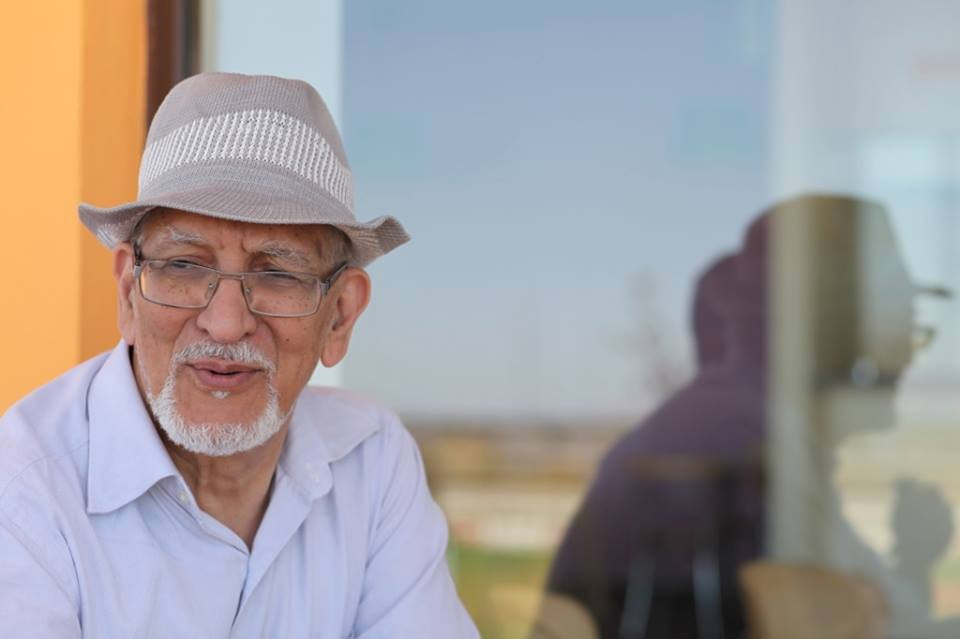
Taha Abdurrahman, a Moroccan thinker who is known as one of the dominant names of contemporary Islamic thought, as well as the Sufi philosopher of the Arabs, and the “philosophy jurist,” is a thinker who produces works for renewal, revival, and building of society. Hence, he is also called the “Ghazali of our Age.” While carrying out Islamic tajdid (renewal) activities, he took care to act by avoiding any imitation and contradicting the tradition he was in. According to Abdurrahman, civilizations that cannot answer the questions of the age cannot survive. The situation that makes a civilization worse is to answer the questions of the age by using the answers of others. Our answers can only be produced using our concepts. Thus, he has always used his conceptualizations in more than thirty works he wrote. Due to the multitude of original concepts put forward by Abdurrahman, it is tough to comprehend his works, even for those who know Arabic. Taha Abdurrahman was awarded the Necip Fazıl International Culture and Art Award in 2020 for his contributions to the renewal, revival, and construction of Islamic thought. Although he is mainly known as a moral philosopher, he has dealt with many subjects, from political philosophy to communication philosophy, due to his efforts to revive and construct the science of Fiqh, Kalam, and Sufism. In this article, Taha Abdurrahman’s views on modernity will be examined within the framework of his general philosophical thoughts.
Introduction to the Philosophical Thought of Taha Abdurrahman
As a thinker who generates new concepts, Taha Abdurrahman presents his ideas through two basic paradigms. The first of these is the “i’timaniya philosophy,” which is a moral philosophy that we can also call the divine contract and trust paradigm, and the second is the “philosophy of circulation,” which is an epistemological and linguistic philosophy that we can also call the Islamic pragmatic and word-action theory.
The i’timaniya philosophy is a contract in which one of the parties is Allah, and the other is human. In this way, Taha opposes the Western secular social conventions with a divine contract. He states that this divine contract is superior to any secular contract because it is based on the value-being relationship (Abdurrahman, 2021, pp. 20-21).
This value-being relationship is a relationship based on morality. Morality, on the other hand, is a phenomenon that comes from human nature and is compatible with it. Abdurrahman says that the word human derives from the word nisyan (forgetting) and that man is not a rational being but a forgetting being. Man is always in the act of forgetting. Fıtrah is the earliest memory of man. Everything he should remember as a mercy from Allah is recorded in his nature. Those subjected to religion do the act of “teshid/physicalize/concrete” by constantly doing dhikr and maintaining this fitrah-based activity. Teshid/Physification/Concretize is the transfer of metaphysical values to the physical realm. Conversely, there is the act of “tagyib / metaphysiciation.” This is a metaphysical value attribution to the physical-mortal realm, which has no sanctity, which is what secular humans do (Abdurrahman, 2021, pp.27-90).
According to Taha Abdurrahman, although humanity has made significant technological advances today, it is incredibly heedless. The primary reason for this is that the distinguishing feature of man is reduced to pure reasoning. The modern western man reckons the feature of the mind as “the lack of knowing a truth that has been cleared of flaw.” However, this deprivation is valid concerning the reasoning of humans in terms of the cognitive power that animals also have. In other words, the modern Western man names the cognitive power of animals as the reason. This cognitive power is superior to animals only in degree, not nature. Therefore, Abdurrahman argues that the limit that separates humans from animals is morality, not the mind. Animals also use their mental understanding to reach sustenance but do not try to reach goodness. Man has been made honourable among the creatures, and since he is strong with the opposite of everything, morality and immorality are bizarre to human beings. This is the distinguishing characteristic of man. According to Abdurrahman, man cannot be moral while being irreligious. Since Islam is the perfect religion revealed to people, a person cannot be a moral being without being a Muslim living according to Islam’s orders and prohibitions. (Abdurrahman, 2021, pp. 22-23).
Abdurrahman calls the mind based on this morality “the practical mind.” It separates the deed from the act. Every act is a deed, but every deed is not an act; just as every deed is an action, every action is not a deed. Movement involves a displacement, but not every movement leaves a trace. Therefore, every action is not a deed because an act produces an effect. On the other hand, the activity that takes place in ‘deed’ is not random; it is a directed activity that is limited to a purpose. There is no deed without a purpose. When this aim is intentional towards the truth, it is a moral deed, and in the opposite case, an immoral deed is performed. Human reasoning is also practical reasoning based on morality (Abdurrahman, 2021, p. 29).
The Notion of Modernity According to Taha Abdurrahman
For Taha Abdurrahman, who approaches the notion of modernity within the framework of i’timaniye philosophy, there is no single fixed modernity; there are modernities. Basically, what we call modernity today consists of the Western application of modernism. Apart from this Western application of modernity, of course, an Islamic application of modernity term is possible as well. What modernity means here refers to the situation (hadese) that is occurring right now. He states that each period has its own “spirit of modernity (ruhu’l hadesa).” He argues that it is possible to develop various modern practices subject to this spirit of modernity. He ponders that his work titled “The Spirit of Modernity” proves the claim that “just as there is an un-Islamic modernity, there must also be an Islamic modernity” (Abdurrahman, 2022, p.18). At this point, he distinguishes between the spirit of modernity and the reality of modernity. While the reality of modernity expresses an application of the spirit of modernity in the West or a different civilization, the spirit of modernity expresses the spirit of the age in which we live.
Principles of the Spirit of Modernity
According to him, three basic principles express the spirit of the age we live in: the principle of maturity, the principle of criticism, and the principle of enclosure (Abdurrahman 2022, p.20). He points out that the generally accepted principles of modernity, such as rationality, subjectivity, individualism, and secularism, belong to the reality of modernity, not the spirit of modernity. While he enhances the construction of Islamic modernity on these principles, he also censures the western application of modernity on these principles. He considers that modernity in Islamic practice requires breaking the relationship with the past in the critical situation. In other cases, it requires maintaining the relationship with the past because, according to him, modernity in Islamic practice is not the modernity of time but the modernity of values (Abdurrahman, 2022, p. 45).
He states that it is necessary to approach modernity not as an external application but as an internal application. He defines the modernization movements, which have been appearing in the Islamic world for several centuries, as an outward-based imitative movement. He explains that these outward-based modernization movements are harmful modernities (Abdurrahman, 2022, p. 37).
For him, morality must first be renewed for a firm modernity movement. Then, after the defeat of ideas, modernization of institutions is required, and lastly, modernization of equipment is required. As a matter of fact, as modernity in the Islamic world is an imitation of Western practice, modernization in the Islamic world started with tools and equipment and followed in the opposite direction (Abdurrahman, 2022, p. 67).
Principle of Maturity
The principle of maturity expresses that the main thing in modernity is the transition from the state of inadequacy to the state of maturity. Here, inadequacy is the inability to use one’s thoughts without the contribution of another, while maturity is the ability to use one’s thoughts independently of others. The principle of maturity has two fundamentals: freedom and originality. Based on freedom, a mature person should be able to think without being dependent on authority. Therefore, it improves mobility. As a requirement of the principle of originality, these thoughts should be free from any imitation. The basis of freedom becomes “movable freedom” in the Western application of modernity and “responsible freedom” in the Islamic application of modernity that Taha Abdurrahman is trying to build. In the western understanding of movable freedom, a person deviates from imitating others to achieve freedom. In responsible freedom in Islamic practice, as the person is free from all kinds of worldly bonds, he gains the ability to act with the energy of absolute freedom. On the other hand, the principle of originality appears in Islamic practice in the form of “pervasive originality.” In this sense of originality, contact with the thing whose usefulness has disappeared or whose harm has exceeded its usefulness is cut off. In this way, the person renews the means that will enable him to discover himself. In western practice, on the other hand, originality comes across as “implied freedom.” The single purpose of originality in this Western practice is to break the relationship with the past (Taha, 2022, pp.179-180).
Principle of Criticism
The second principle of the spirit of modernity, the “principle of criticism” refers to the transition from accepting something without evidence about itself to demanding evidence for accepting it. Accordingly, the principle of criticism has two basic principles: Rationality and Distinction. He means by rationality here to subordinate phenomena, social institutions, and human behaviour in the world to rational principles. The basis of distinction is to transfer similar elements belonging to something from homogeneity to heterogeneity and transform them into different elements (Abdurrahman, 2022, pp.22-23). For him, Muslims have been trying to reconsider their political, legal, and social institutions for a while. However, this reconsidering has been in the form of imitating the modernity of others. Thus, the rationality of Muslims is imitation-based. To get rid of this, they must be able to leave the crisis in which the application of Western rationality has fallen. Three assumptions give rise to adversity in the application of Western rationality: “Mind makes sense of everything,” “Man rules over nature,” and “Everything accepts criticism.” The acceptance of “the mind makes sense of everything” regarding rationality is the most basic acceptance of the Western practice. Nevertheless, the spirit of modernity requires only the use of the mind. The size and shape of this use may be different in another application. The point that this Western practice misses is the inability of the mind to reason itself. The mind itself is part of a whole, and the part cannot make sense of the whole. This means that there is reason in things that cannot be rationally reasoned. In this respect, “instrumental reason” is used in Western rationality, while value reason/moral reason is used in Islamic rationality (Abdurrahman, 2022, pp. 49-50). As for the Islamic application of modernity, which he tried to construct, the acceptance of “man rules over nature” is related to rationality; man does not own nature because he did not create nature by his order or hand. In Islamic practice, the relationship between nature and man is not a relationship of domination but of the interlocutor. Man will not enter into a struggle with nature; he will subject it to harmony (Abdurrahman, 2022, pp. 51-52). When it comes to the principle of everything accepts criticism, this acceptance is based on the following assumption: “The only way to reach the truth in every subject is criticism.” Nonetheless, the ways of acquiring knowledge are not limited to criticism. The Islamic application of modernity also accepts news/transmission, which is the opposite of criticism, as a way of acquiring knowledge. Criticism in Islamic practice is beneficial only when it aims to obtain evidence that confirms or cancels it (Taha, 2022, pp. 53-54).
The distinction, which is the second basis of the criticism principle of the spirit of modernity, in Western practice is based on the following basic assumption: “The distinction between modernity and religion is a definite distinction.” In the distinction here, what Western practice means by religion is the church. The distinction in the West separates modernity and priesthood. On the other hand, Islamic practice does not encompass such an acceptance, since there is no clergy class in Islam. In other words, the main thing that differentiates the principle of distinction in the Islamic application of modernity from the Western application is that the word “religion” in the Western conceptual world has a different meaning than the word “religion” in the Islamic conceptual world. While religion in the West consists of only unseen matters, in Islam, religion does not consist of purely unseen matters. Therefore, the understanding of religion in Islam also comprises a rational comprehension, unlike the West. In summary, the application of the separation principle in Islamic practice will be based on a functional separation. This is a controlled distinction that takes into account certain contexts. It is not a distinction between structures and properties as in Western practice (Abdurrahman, 2022, pp. 57-65).
The Principle of Enclosure
This principle is based on the transition of what is essential in the spirit of modernity from being private to being inclusive. The principle of containment is also based on two fundamental principles: Expansion and Prevalence. On the basis of expansion, the activities of modernity cannot be specific to certain areas. It permeates all areas of life. On the other hand, on the basis of prevalence, modernity cannot survive as confined to society alone. It spreads from one society to another (Abdurrahman, 2022, pp. 30-31).
In other words, if we consider the spirit of modernity at the level of principles, it becomes mature, critical, and encompassing. If we consider these principles at the level of the principles, they are independent, creative, intellectual, discriminating, encompassing, and inclusive. The spirit of modernity is not something that West puts forward as if it had never existed before. The spirit of modernity expresses the spirit of the time and place and has existed throughout history. Today’s spirit, on the other hand, has been formed by the accumulation of a long historical process and has to be present in Islamic practice as well as in Western practice.
Conclusion
Taha Abdurrahman, one of the greatest thinkers of his age, not only among Muslims but globally as a philosopher, strives to reconstruct Islamic thought by developing his thoughts without taking anti-Westernism as the pivotal point. More than thirty of Taha Abdurrahman’s works have unquestionable integrity in themselves. Therefore, it is pretty difficult to fully understand his thought without reading and studying them with the same integrity. As can be understood from this short article, Taha Abdurrahman has made excellent contributions to Islamic thought with his unique conceptualizations. Wael B. Hallaq made one of the best comments about him: “Taha Abdurrahman is one of the most important philosophers that the Islamic world has produced since colonialism set foot in Africa and Asia. His still-in-progress project starts from the epistemological foundations on which the vast majority of modern Muslim intellectuals base their so-called reform programs but leaves these foundations behind” (Hallaq, 2020, p. 9).
References
Abdurrahman, T. (2021). Amel sorunsalı (Trans. T. Uluç). Istanbul: Pınar Publication.
Abdurrahman, T. (2021). Ahlak sorunsalı (Trans. T. Uluç). Istanbul: Pınar Publication.
Abdurrahman, T. (2021). Dinin ruhu (Trans. S. Gündüzöz). Istanbul: Pınar Publication.
Abdurrahman, T. (2021). Modernlik ruhu (Trans. M. E. Maşalı ve M. Maşalı). Istanbul: Pınar Publication.
Hallaq, W. B. (2020). Modernitenin ruhu, Abdurrahman Taha’nın felsefesinde ahlak ve yeni insan (Trans. T. Uluç). Istanbul: Ketebe Publication.