















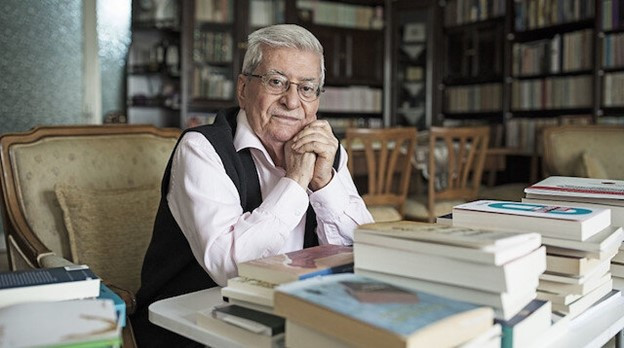
Life of Rasim Özdenören
Özdenören was born in Kahramanmaraş in 1940. After completing his primary and secondary education in Maraş, Malatya and Tunceli, he graduated from the Faculty of Law and Journalism at Istanbul University. There is no doubt that Özdenören’s experience in education, culture-art, research, bureaucracy and civil service spread over one geography has provided him with a broad perspective. Özdenören, who was involved in literary circles since his early youth, shaped his intellectual personality with the experiences provided by being with people had made valuable contributions to the Turkish world of thought. It is known that the late Sezai Karakoç and Necip Fazıl Kısakürek had an influence on his intellectual accumulation. Özdenören passed away in 2022 and left behind an intellectuality that we keep thinking about.
Rasim Özdenören’s Corpus
Rasim Özdenören has many short stories and essays to his credit. His essays such as Essays on Muslim Thinking, Kafa Karıştıran Kelimeler, Müslümanca Yaşamak, Yaşadığımız Günler, Yeni Dünya Düzeninin Sefaleti, Düşünsel Duruş (Thoughtful Stance) and his stories such as The Man Who Raised Roses and The Dissolution are are some classic examples. Özdenören, in his works in the story genre, gives a lot of space to dichotomies such as ontological anxiety-mysticism, life-death and different types of alienation themes. This situation points to the thematic similarity between his essays and stories, and thus to the wholeness of the issues that Muslims face. The dilemmas of the society and the individual who have moved away from their core values and the stance against the dissolution constitute the main theme of his works (Bulut, 2013, p.771).
It is possible to trace the phenomenon of alienation in Özdenören’s stories as well as his essays. In Özdenören’s stories, which deal with rapid and radical changes and their striking effects on individual and community life, alienation of man from himself, society, family members, cultural and moral values, space and order is in question. As a result of the religious, economic and cultural crises of modernisation, the individual has lost the quality of being a subject in modern society and has been objectified. This situation reveals the alienation of the individual from himself. Different types of alienation are the subject of his works such as Mâni Olunmuş Adamlar, Ölünün Odaları, Toz, Hışırtı (Mantu, 2019, p.174).
It is noteworthy that the author wrote his writings intensively in the 1980s and 1990s, despite the repressive conditions of the period. His preferred words and clear expression in his stories and essays make it easy to understand the subjects he deals with. However, when the whole of his corpus is analysed, it is noticed that the author touches upon recurrent issues. This situation, nevertheless, is considered valuable in terms of opening the door to liaisons and analyses between different concepts in each work.
Possibilities of Islamic Thinking in the Contemporary Period
The titles of the chapters in his work “Essays on Muslim Thinking”, in which he presents his ideas on Muslim thinking, are remarkable: Panorama, Towards Healthy Thinking, Qualities of a Muslim, and Originality of Islam. A careful reading of these chapters and their discussed ideas will contribute to a thorough understanding of his thought.
According to Özdenören, the democratic way of life has brought along a point of view that lacks a solid foundation. What should be comprehended here is that the concepts or meanings of the democratic order are not strong and reliable. The confusion of meaning we experience today has deepened with democracy, which is a product of the modern period, and then with post-modern thought. This situation causes concepts to lose their constancy and be easily manipulated. In addition, this situation reveals the problem of trust in politics and society. It has been noted that with the capitalist order accompanying democracy, the fear of hunger has emerged in people, and this phenomenon is filled with a materialistic conditioning. It can be said that selfishness and utilitarianism have taken the place of altruism and unrequited cooperation as a result of the increase in the concern for sustenance and commodification (Özdenören, 2003, p.18-19).
Raising the problem of not comprehending Islam, the author insists that Islam cannot be understood within the framework of Western thought. According to him, Islam can only be comprehended through a Muslim way of living and thinking. In this book, he states that the metaphysical aspect of Islam cannot be understood with the profane and materialistic aspects of Western thought, with which we are surrounded (Özdenören, 2003, p.24).
In the chapter titled “Towards Healthy Thinking”, Özdenören deals with how basic concepts are viewed from the perspective of diverse concepts and actors. Here, issues such as the dialectics of believing, the differences between the concepts of truth and right, the emphasis on the importance of basic preference, and the issues such as looking at Islam with foreign words are examined through an evaluation between Islam and the current time/age,
In the section titled “The Qualities of a Muslim” Özdenören touches upon the necessity of the theory-action unity, the effect of the temperament factor on approaches, the necessity of obtaining Allah’s consent as the ultimate goal, the method to be carried out in obtaining guidance and commitment, the possibilities of being a good Muslim in a world that is corrupt, the methods of understanding ourselves as a servant and obtaining knowledge, and the importance of being conscious.
Under the title “The Originality of Islam” Özdenören argues that the basis of Islamic infrastructure is law, not economics, and points to the dialectical structure of Islam. Culture, philosophy, science, mysticism, asceticism, spiritualism and materialism, traditionalism, rationalism of Islam and their connection with human beings are questioned by the author and the misguided thoughts and behaviours of the people of our age are examined.
According to the author, one of the requirements of thinking as a Muslim is to adopt and live Islamic morality. It is observed that in order to enjoin the good, to forbid the bad and to ensure the consistency of thought and action, Islamic belief and certain moral qualities are underlined in his works. Standing against oppression, acting with a sense of community, giving zakat, avoiding interest, staying away from doubt in faith, remembering death, paying attention to worship, being moral in state administration, not compromising honesty and truthfulness, taking care to preserve decency and good manners are some of them. Contrary to these, behaviours such as unfaithfulness, greed, being sarcastic, envying and being ungrateful are also morally disapproved actions.
Özdenören emphasises that Muslim morality must be protected against the troubles of modernism. In Özdenören’s intellectual and literary works, we frequently encounter thoughts on the virtues of Islamic morality against the manifestations of modernism such as individualism, lack of love, capitalism, secularism, economy of waste in state administration, international relations, consumption practices and social life. He opposes the adoption and use of Western concepts by Muslim societies. The way out of the resulting depression is seen to be possible through the individual and collective realisation of Muslim morality and its accompanying thought. The philosopher argues that the goal of obtaining Allah’s consent with the “understanding of piety” he emphasises is more comprehensive than all other moral understandings that will form the basis for universal integrity (Filiz, 2019, pp.106, 107).
An Attempt to Eliminate the Confusion of Concepts
Rasim Özdenören indicates that one of the most serious problems faced by the Muslim individual in the contemporary period is the misinterpretation of certain concepts. The thinker emphasises this in his classic work titled “Kafa Karıştıran Kelimeler“ and several other essays. For him, with Türkiye’s Westernisation process, our very own concepts have lost their meaning. Stating that this situation has cause a confusion, Özdenören emphasises the necessity to use them in the context of Islamic thought.
Özdenören points out that the understanding and interpretation of Islam by associating a non-Islamic way of thinking is a diversion and delusion. He underlines that the search for a new synthesis that can be created by combining Islam with its antithesis will produce a result that is incompatible with Islam (Özdenören, 1994b, pp.70-71I). In the face of criticisms about Islam and its practice, Özdenören states that Islamic thought is not just a theory apart from practices, that it has a liveable nature, and this can be experienced in the Qur’anic and Prophetic examples (Özdenören, 1994b, p.76).
A State of Desolation: New World Order
In his book The Misery of the New World Order, Özdenören argues that the concept of the “New World Order” emerged with the Gulf War in 1990 and claims that the world has become unipolar and that the hegemonic paradigm is now liberalism. Özdenören notes that the Cold War period lasted only from 1950 until the detente period, after which the United States and Western Europe established global supremacy, while USSR socialism lost power day by day. The USSR’s need for foreign investments and advanced technology caused it to open the door to global capitalism during the detente period (Özdenören, 2022, p. 102). As the colour of the threat changed from red to green, Western European countries and the United States perceived Islam as an ontological threat. On this issue, Ömer Çaha, in his work Open Society Writings, states that the West in general and the United States in particular have based their relations with Islamic countries on the principle of utility. While the United States does not bother with countries that serve its personal interests, even those ruled by dictatorships, it oppresses countries that oppose its interests on grounds such as human rights and democratisation. In this respect, global modernisation is not perceived as sincere by Islamic countries and is not approached for adoption due to the double standard foreign policies of Western states (Çaha, 2004, p. 61).
While globalisation, which is an indispensable part of the new world order, envisages the integration of the world under Western economic and cultural hegemony, Islam rejects such a unification. Based on this idea, Özdenören states that all countries of the world should preserve their cultural uniqueness while establishing mutual relations (Özdenören, 1997a, p.9). Apart from the above mentioned, the ideas on common international relations are included in detail in Özdenören’s Cross Relations (Özdenören, 1997a, p.8).
Conclusion
Rasim Özdenören has contributed in determination of today’s problems and has tried to bring justified answers to the question “What should be done?” As we have discussed in this article, the thinker has made clarifying explanations on how to think in a Islamic way, how to live as a Muslim and in accordance with the idea-action harmony that accompanies Muslim thinking, and how the effort to make sense of global developments and the state of action should be. In the light of his writings on thinking correctly and avoiding misinterpretation of concepts, the importance of developing them in accordance with Islamic principles and having a Muslim mindset is becoming even more crucial, especially in the face of modernity.
References
Akkoç, F. (2019). Rasim Özdenören’in eserlerinde Müslüman ahlakı. (master’s thesis). Social Sciences University of Ankara, Institute for Islamic Studies, Ankara.
Bulut, A. (2013). Rasim Özdenören hakkında bir monografi çalışması. (Doctoral dissertation) Gazi University, Institute of Social Sciences, Ankara,
Çaha, Ö. (2004). Açık toplum yazıları, Ankara: Liberte Publications.
Mantu, U. (2019). Rasim Özdenören’in öykülerinde yabancılaşma. (Master’s thesesis). Istanbul University Institute of Social Sciences, Istanbul.
Özdenören, R. (1997). Çapraz ilişkiler, Istanbul: İz Publication.
Özdenören, R. (1994). Kafa karıştıran kelimeler, Istanbul: İz Publication.
Özdenören, R. (1997). Müslümanca düşünme üzerine denemeler, Istanbul: İz Publication.
Özdenören, R. (1994). Müslümanca yaşamak, Istanbul: İz Publication.
Özdenören, R. (2022). Yeni dünya düzeninin sefaleti, Istanbul: İz Publication.