








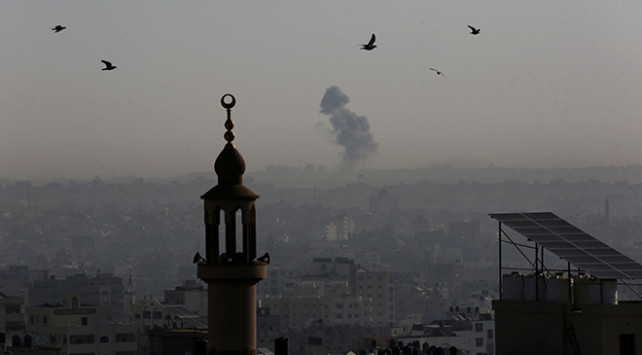
We asked Sarah al-Najjar, who lives in Gaza, “What would you like to tell to us and to all Muslims?” She told us about her experiences since October 7…
Hello, I am Sarah al-Najjar from Gaza.
When people hear my voice, they could usually recognize the distinctive features of my laughter and draw two smiles without seeing me. I used to be known as the Minister of Positivity, but since I lived through aggression and tough war, laughter became an internationally forbidden luxury for us in Gaza. Since October 7, the only thing present in our lives is the constant heartache, either psychological or physical. From the first day of the war, we started welcoming displaced people into our home. On the second day, my dad and his family were pulled out from under the rubble, martyrs. Each passing day brought heartbreaking news, be it the martyrdom of a relative, a friend, the destruction of a house, a university, or a place filled with special memories. Day after day, the terror and fear increased.
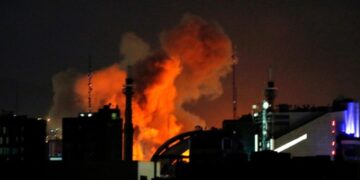
The number of displaced people in our house was more than 50 until November 12, 2023, at 9:00 AM. Without any prior warning, we found that our residential square was being shelled and bombarded with explosive barrels by the Israeli army. It was the biggest catastrophe we could experience. We had thought we were safe in Bani Suheila, Khan Yunis, south of the Gaza Strip, but in the blink of an eye, 15 martyrs, including children, women, and people with disabilities, were gone. Entire residential buildings were destroyed, not to mention the partial damage to all the houses and dozens of the wounded, some of whom cannot get complete medical treatment to this day. On that day, the displaced people were frightened and fled, leaving us alone in the house, or we can say that we remained in a half-house severely damaged. We spent that day trying to organize the house and make it suitable for living during this period. The ceasefire came, and we hoped it would continue until the complete cessation of gunfire. However, starting from December 1, with the violation of the ceasefire, life turned into a bigger hell because of the intensified shelling. With every passing second, shrapnel hit one of us, and we kept praying for safety, hoping not to die.
We remained in this situation until the evening of December 4, when the occupation forces launched a very fierce ring of fire on the east of Khan Yunis and the area we were in. We tried to seek help from the Red Cross, telling them we have children, elderly, and people with disabilities and asking them to come and evacuate us from the area. However, they dismissively stated, “We are not a taxi office,” and indeed, no one came to our rescue. Trapped and surrounded by tanks, any tiny movement exposed us to danger, as the Israeli army targeted anything in motion, and any sound made us vulnerable. We decided to move in the morning; we were surprised to be surrounded by tanks before dawn. It was a shock for us because when the Israeli army distributed evacuation notices, they wrote that our residential square and the block we lived in were safe areas and that we were not required to evacuate. However, at the same time, they sent warning messages to us on our mobile phones that it was prohibited to move from our place. Tanks surprised us, and our pleas to the Red Cross, the Red Crescent and the ambulance went unanswered.
We were trapped there for a whole week without electricity, water, or any essentials of life. The bombing increased, and we inhaled vast amounts of gunpowder during this time until December 9, when a shell pierced the room where we were sitting, affecting my parents and three of my brothers. Since we couldn’t turn on the light, one of us had to hide under the blankets with the injured person. We tried to provide initial aid in almost complete darkness and without making any sound. Morning came, and 16 people gathered in one room, seeking safety. Our pleas to the ambulance and the Red Cross were in vain. After a few hours, the sound of the occupation forces drew near. We heard soldiers speaking in Hebrew, understanding nothing. Suddenly, explosions echoed inside the house. We began screaming in English that we were civilians, children, and women until they heard us. They asked us to open the door, and we went out with our hands raised. My father began talking to them in English, telling them that we were civilians, 16 in number, with an 80-year-old woman, two people with disabilities, and five children. But they simply said the young men should go in one direction and the women and children in another. They started questioning us in an atmosphere of overwhelming terror, no talking and no movement were allowed. After that, we didn’t know anything about my dad, two of my brothers, my two cousins, and my cousin’s son. Of course, after hours, they arrested the six young men, including dad, whose right ear was deaf due to the overnight bombing and whose head was bleeding. My brother Mohammed, who is already visually impaired, had a wound in his hand. The soldiers took them, confiscated our mobile phones, took our belongings, and forced us to leave the house in the middle of the night. We could only take small bags, barely knowing what was inside. They prohibited us from entering the bathroom or doing anything else. We asked them for help to bring an ambulance to take our elderly grandmother because she couldn’t walk, but they refused. The first step we took out of the house unveiled the magnitude of destruction. While we were in the house, surrounded by many soldiers, I don’t remember exactly how many, but they also had many big and intimidating dogs. They launched two explosions in the house while we were present, but we still don’t know where these explosions were. We went out in the middle of the night, and with the first step we took, we found stones, glass, and terrifying holes on the road. We fell into one of the holes and spent an hour trying to get out. The street that usually took us 5 minutes to walk took an hour because of the destruction, and the surveillance drones followed our every step.
We found two cats in the middle of the road accompanying us to an abandoned building. We entered this building to take cover because the bombing was intensifying unreasonably. At the same time, we couldn’t continue our journey, especially since we were barefoot. Our feet were only covered with socks torn from glass and stones. We hid there until morning, and at that time, we noticed that my aunt’s phone was still in her bag with us. Someone called us, and to our relief, she informed us that they released my father and the young men. They are in the European Hospital, kilometers from our current location in Rafah. As dawn broke, we gathered our belongings, raised our makeshift flag, and started walking amidst shattered roads. Glass and stones cut our feet, and everything, including water and electrical wires, surrounded us. The bombing intensified, and reconnaissance aircraft monitored us step by step. My 80-year-old grandmother was walking with great difficulty, and we couldn’t carry her. We walked, prayed, begged forgiveness from Allah and recited shahadah along the way. We covered long distances on foot, and in the middle of the road, we encountered young people who tried to help us. However, as soon as the reconnaissance aircraft spotted them approaching us, a missile was launched. We were completely bewildered because we didn’t know what would happen to us next. The children began to cry, and our elderly grandmother fell to the ground, unable to walk. At the same time, we were threatened that if we took one step, we would be killed.
After many hours of walking, we collapsed on the ground when we reached the European Hospital. There, we reunited with my father, brothers, and my aunt and uncle’s children, who were captives. Their faces revealed how tired they were, and the bruises and marks of beatings were still visible on their hands. We tried to conduct medical examinations for the injured, but there was no medical equipment or medicine. Although we arrived at the European Hospital on December 11, even today, December 19, as I am recording this audio, there is still no medicine or medical equipment here. The shrapnel pieces are still in the hands of my little brothers, aged 9 and 22. It gives them unbearable pain, and the only thing we can give them is an antibiotic. My father, on the other hand, is still unable to hear with one ear, and there are wounds on his body. My mother has wounds on her back, my little sister on her face and abdomen. However, in addition to all of these, the fear we have been experiencing is indescribable. After reaching the European Hospital, we continued our journey to a remote area called Khirbat al-Adas in Rafah, where we managed to take a very primitive means of transportation, a “caro” (cart). We reach our current location, where we stay with more than 60 people in a semi-tent, deprived of basic needs. I’m recording this after managing to charge my phone by 30%, and we will go to a distant place to connect to the internet and send you these recordings.
We can simply say that we survived miraculously, thanks to Allah the Almighty and the Compassionate. We are currently fine; our only prayer is for this war to end. And even though we know that the bombings continue, we hope that the remnants of our house, if they still exist, return to us. There is no safe place in Gaza. While I’m recording this, I can still hear that many targets are being bombed. My phone may be somewhat soundproof, so you might not hear it. Our only wish is for this war to end. Some people have foreign passports and tried to move out, but it was in vain. Be it children, women, youngsters, the elderly, or people with disabilities and the sick, we share the same fate. The situation is so difficult. Hearing your little brother saying he’s hungry is difficult, so you silence him so that no one hears; freezing cold is difficult, so you pretend you’re okay. When we reached the tent where we are currently located and opened the bags we had brought with us, we found that bullets had torn everything—clothes, official documents, laptop, everything. Now, the biggest treasure we can find is a tissue or a fine paper. Our situation in Gaza was economically devastated before the war. However, there are no jobs because of the war, so all prices are extremely high. People cannot afford the basic necessities of life.
We don’t know how we managed to survive 74 days of war under these difficult conditions, but our Lord is Almighty and can give us this strength. In the end, the only good thing in Gaza is social solidarity. We are now with people who are not closely related to us, yet they gave us a place to stay with them and share their tent, remaining food, water… everything. So, despite everything, Gaza is beautiful because of its people. Gaza is good. Gaza used to be a paradise, and all we want is for this war to end.
I am Sarah al-Najjar, a survivor of the relentless war on Gaza, for now, but I don’t know what might happen in the next five minutes. It was my birthday a few days ago, but I declared that day the death of my birth and the birth of my death.