


























The fact that trade union rights are discussed within a class context and the idea that a society with a class structure would not be considered Islamic has negatively affected the development of industrial relations, especially union organizing in Muslim societies. From an Islamic perspective, some argue that workers and employers are equal, so the state should remain neutral in this relationship. On the other hand, some emphasize that the bargaining power of workers is inadequate, so employees should have the right to organize, and the state should intervene in favor of the disadvantaged. Such discussions influence trade unions, collective bargaining, and strikes; however, these influences appear at different levels across countries.
The extent of union organizing, the scope of collective bargaining, and the number of strikes in Islamic countries are important for a more equitable distribution system and should be examined. This article will evaluate union organizing, collective bargaining, the right to strike, and its practices in some Islamic countries.
Trade Unions
A product of the West’s economic, social, and political conditions, the Industrial Revolution led to the dominance of class-based and conflict-oriented labor relations with this major transformation. The implementation of new production and management techniques triggered the transition from individual to collective relations, which in turn brought new necessities to the forefront, and trade unions emerged as a response to these necessities. The fact that there have been unions in the Islamic world since very early times, especially among tradespeople, and that unjust labor practices and exploitative worker-employer relationships are incompatible with Islamic principles have highlighted the need for trade unions in Islamic countries as well.
When we analyze the discussions regarding trade unions, it is known that Islamic countries have implemented legal regulations for trade unions and adopted some of the conventions of the International Labour Organization (ILO). However, we can observe that, essentially, the concept of the trade union is subject to debate, and its compatibility with Islamic principles is being questioned.
The colonial histories, independence struggles, and socio-cultural differences of Islamic countries have created variations in union dynamics, thereby influencing the historical development of trade unions. Undoubtedly, the impact of economic conditions has been quite decisive, and trade unions have also been observed in industrializing countries.
Table 1. Trade Union Density Rates in Some Islamic Countries
| Countries | Year | Trade Union Density Rates |
| Pakistan | 2016 | 4.7% |
| Indonesia | 2019 | 13% |
| Malaysia | 2018 | 8.7% |
| Egypt | 2010 | 23.8% |
| Tunisia | 2019 | 38.1% |
| Kazakhstan | 2017 | 46.9% |
| Türkiye | 2024 | 14.8% (July)* |
Source: QERY, Trade Unions Worldwide, https://qery.no/trade-unions-worldwide/ *https://www.csgb.gov.tr/media/95469/2024-temmuz-ayi-istatistigi.pdf
A few points stand out when we look at the trade union density rates in some Islamic countries, as shown in Table 1. Firstly, the density rates are generally low, and there is a lack of transparent data for us to track. Moreover, we can also argue that Kazakhstan’s high ranking is a result of the lasting effects of the socialist system.
Türkiye appears to stand out from other Islamic countries in terms of the prevalence and impact of trade unions. Despite criticisms of trade unions and activities in Türkiye, membership in a trade union is relatively common among workers, public servants, and employers. However, the control power of political authorities over unions limits this impact.
Driven by nationalist movements and workers’ demands for rights, the early unionization struggles in Egypt and Iran emerged in the 20th century. In Iran, trade unions were influential until the years when political repression intensified. In the oil-rich Gulf countries, the economic structure’s reliance on migrant labor and the abundance of social welfare programs have resulted in low unionization rates. In countries like Malaysia, we see that the demands of the industrial workforce, which emerged due to economic development, have led to relatively higher unionization rates. Economic developments in the manufacturing, service, and public sectors have positively influenced the growth of trade unions.
In Indonesia, where the trade union density rate is relatively good, the impact of nationalist struggles and a large industrial workforce stands out. In North African countries with nationalist struggles, especially Tunisia and Morocco, there is a medium level of union density compared to European countries. In contrast, Gulf Cooperation Council countries have lower unionization rates.
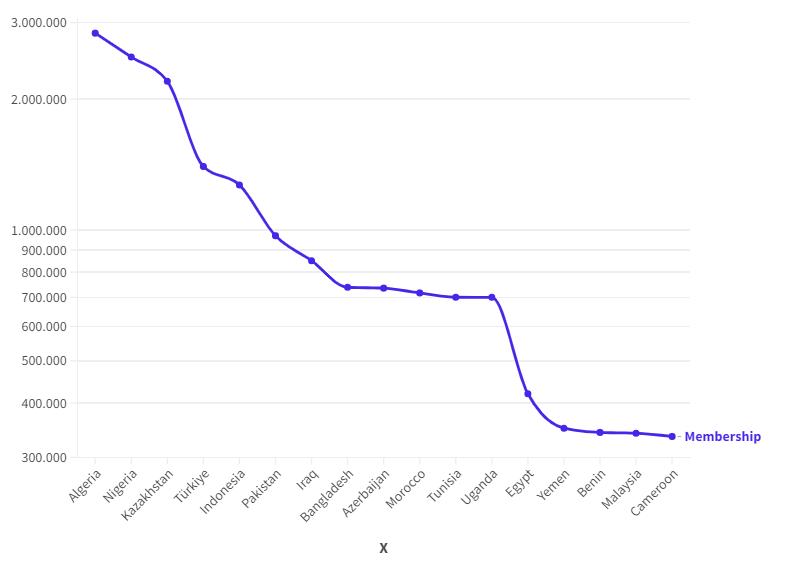
Figure 1. Number of employees who are members of a trade union Reported by Islamic Countries affiliated with ITUC as of 2018 (Those with over 350.000 Members)
Source: Yorgun, 2019, p. 1723
Figure 1 shows countries with more than 350.000 union members, and these countries with relatively strong unionization have more developed industries compared to others. Among these, Egypt and Pakistan stand out as countries with a long history of unionization, while Indonesia and Türkiye seem promising for the future (Yorgun, 2019, p. 1723). Based on this data, we can argue that there is a limited trade union. However, Islam not only talks about equitable distribution of resources in society, but it also gives the whole population a right to a basic standard of living (Ahmad, 2011, p. 607). Al-Banna emphasizes “justice” in the employer-employee relationship, and according to him, the term “justice” crystallizes the primary purposes of trade unions. (Syed, 2008, p. 422). In this regard, the exploited have the right to react, and workers who exercise this right and organize cannot be condemned. The primary aim of trade unions is to achieve social justice and make social policies effective. Hence, trade unions strive not only for their members but also to establish equitable relationships across all segments of society. The limited level of trade unions in Islamic countries leads to a similarly limited impact of these trade unions.
Collective Bargaining
The parties are not equal in typical employment contracts between employers and employees, as the employer generally has greater bargaining power. Therefore, it is necessary for employees with weak bargaining power to unite and engage in collective bargaining. This necessity applies not only to workers but also to employers.
When we examine collective bargaining practices in Islamic countries, we see considerably different approaches. In Türkiye, the first regulation concerning the right to free collective bargaining with the right to strike was introduced in the 1961 Constitution. Following the 1961 Constitution, which was drafted under military tutelage, Law No. 275 guaranteed collective bargaining, and the right to voluntary and free collective bargaining, as well as the autonomy of collective labor, were regulated in the laws and implemented (Yorgun, 2023, p. 100). Despite the fact that the right to collective bargaining in Türkiye is guaranteed by the Constitution, the percentage of workers covered by collective bargaining is around 9%. Civil servants have been granted the right to collective bargaining agreement, but it has not been combined with the right to strike. This situation weakens the bargaining power of unions, and the division among civil servants’ unions further weakens them, leading to competition between trade unions. Consequently, governments exploit this fragmented structure (Yorgun, 2011, p. 153), and the impact of collective bargaining remains limited.
When we examine the process in Pakistan, we see that registered trade unions that are elected through secret ballots are granted the right to collective bargaining. In Malaysia, trade unions must be recognized by employers, and civil servants do not have the right to collective labor agreements; however, they do have the right to negotiate their working conditions. In Indonesia, trade unions can engage in collective labor agreements, but this authority is not extended to federations and confederations (Yorgun, 2019, p. 1726). As we can understand from these explanations, the ineffectiveness of collective bargaining in Islamic countries leads to the loss of workers’ rights.
In Islamic countries, where unionization rates are relatively low, it is generally observed that there has not been much progress in terms of collective bargaining either. Collective bargaining is seen in these countries as a system that hinders development, increases costs, leads to conflicts in the workplace, and is not widely preferred (Yorgun, 2019, p. 1728). This perspective negatively impacts the collective bargaining system, disrupts income distribution, and highlights the fact that it is not a coincidence that Islamic countries are among those with unequal income distribution.
Strikes
When we examine Islamic countries that recognize strikes as a right and grant this right to their workers, the situation is not very promising. In those countries with limited trade union rights, the right to strike has been further restricted, and it has been almost impossible to exercise this right in many countries. For instance, workers have the right to strike in Malaysia, but there are restrictions, such as the requirement to provide prior notice and conduct a strike vote, and the Minister of Labor [Human Resources]* has the authority to intervene in the strike process. In Egypt, workers began striking relatively early, and in the late 19th and early 20th centuries, Egyptian workers went on strikes to improve economic conditions. However, from 1962 to 1986, strikes were banned, and compulsory arbitration was enforced.
Since the right to strike is not recognized as a fundamental right in Pakistan, there is an increasingly negative perception of strikes as an unfair labor practice. Strikes that last longer than 30 days can be prohibited, and the government can unilaterally enforce mandatory arbitration, making it impossible to speak of an effective right to strike in Pakistan as well (Yorgun, 2019, pp. 1726-1730).
From an Islamic perspective, workers have the right to demand their legitimate rights and to strike or engage in collective action against injustice if these rights are not granted (ILC, 2022). Islam regards the right to strike as a means of eliminating injustice within certain limits and does not tolerate actions that exceed these limits (Qur’an 2:190) (Ahmad, 2011, p. 606). Ensuring that workers and employers negotiate on equal terms is considered a fundamental duty of the state. Providing trade unions, collective bargaining, and the right to strike for fair income distribution is considered a basic human right. However, the increasing income inequality, widespread poverty, and rising conflicts among Muslims are undoubtedly rooted in the inadequacy of democratic rights.
Conclusion
We can argue that trade unions cannot operate freely, their capacity to oppose the system is limited, unionization rates do not reflect reality, and they continue to exist under state control in Islamic countries. The suspicious attitude of authorities towards trade unions in Islamic countries leads to restrictions on trade union autonomy and, consequently, to limited trade union activities. Additionally, due to factors such as late industrialization, the inability to break the chain of economic backwardness, the exploitation of natural resources, and the establishment of authoritarian regimes, trade union rights are not effective enough.
Although Islam doesn’t restrict individual or collective rights, the limitations on collective rights in Muslim-populated areas typically stem from governments, leaders, and employers (Yorgun, 2020, p. 318). We should also note that in Muslim societies, there is a widespread liberal approach characterized by the capitalist economic system, a dominant free market, unlimited competition, and opposition to government intervention. It is a serious contradiction for Muslims to discuss the struggle of trade unions against the poverty and exploitation created by a non-Islamic economic system instead of debating how compatible the capitalist system is with Islamic principles.
The primary purpose of both Islam and trade unions is justice. Employment contracts that align with Islamic values should also encompass the principle of justice. Despite having legal equality in employer-employee relationships, the unequal bargaining power between workers and employers often leads workers to accept conditions that employers impose. Hence, it is necessary to analyze unionization, collective bargaining, and the right to strike in Islamic societies and to create proper environmental conditions to improve industrial relations, particularly those involving trade unions.
References
Ahmad, I. (2011). Religion and labor: Perspective in Islam, The Journal of Labor and Society, 14, 589–620.
ÇSGB. (2024). Sendika Üyelerine İlişkin 2024 Temmuz Ayı İstatistikleri. Retrieved from https://www.csgb.gov.tr/media/95469/2024-temmuz-ayi-istatistigi.pdf
Syed, J. (2008). An Islamic perspective of industrial relations: The case of Pakistan. Journal of Management Spirituality and Religion 5(4), 417-440.
ILC (2022). Unions and Collective Bargaining. Islamic Labour Code. Retrieved from https://islamiclabourcode.org/unions-and-collective-bargaining/
Yorgun, S. (2023). Sendikaların toplu pazarlık yetkisi ve Kamu Toplu Sözleşmeleri Çerçeve Anlaşma Protokolü’nün hukuki boyutu. Çalışma ve Toplum 1(76), 97-120.
Yorgun, S. (2020). Müslüman toplumlarda sendika, toplu pazarlık ve grev hakkı. Journal of Economy Culture and Society 61, 297-322.
Yorgun, S. (2019), İslam ülkelerinde sendikal haklar ve yaşanan sorunlar. Çalışma ve Toplum 3, 1707-1736.
Yorgun, S. (2011) Grevsı̇z toplu pazarlık hakkı ve aı̇dat bağımlılığı kıskacında memur sendı̇kaları. Sosyal Siyaset Konferansları 60(1), 145–168.
Trade Unions Worldwide (2024). QERY. Retrieved from https://qery.no/trade-unions-worldwide/