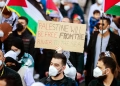







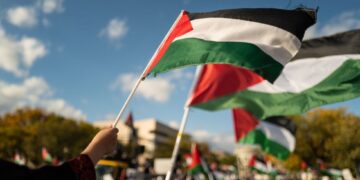









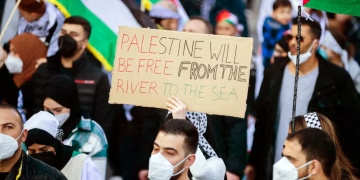






As both popular memory and scholarship attest, youth have long been at the forefront of bottom-up movements for social and political change. University campus protests of 1968 and into the 1970s are well-known not just in Western metropoles such as Paris and Los Angeles, but also in postcolonial Global South countries such as Tunisia and Egypt. Youth demanded greater student autonomy, opposed imperialist campaigns such as the Vietnam War and Israeli occupation of Palestine, and called for democratic reform in (still!) authoritarian regimes. Today’s student movements most conspicuously engage in anti-genocide dissidence in solidarity with Gaza and occupied Palestine, and against government complicity with Israeli settler-colonialism (Artz 2026). This article examines some of the latest youth protests in the Arab region, those calling themselves Gen-Z, within the context of the political turbulence over the past fifteen years.
Gen-Z: Protest as Political Participation
Another set of youth protests and activism has emerged in the past few years. Gen-Z has grabbed headlines in Sri Lanka, Bangladesh, Nepal, and other countries. In the face of high unemployment and socio-economic inequality, these leaderless, largely non-violent movements vocalized opposition to corruption, sometimes even setting in motion regime change (Chenoweth and Cebul 2026). At their most dramatic, such youth protests have deposed governments and ushered in substantial political change, as in Bangladesh. Not to be excluded from new global trends, the Arab region has started to witness its own Gen-Z activism in the past year. This analysis situates itself against the backdrop of the Arab Spring uprisings, then examines Gen-Z activism in Tunisia and, less extensively, Morocco. The article closes by looking ahead at the future prospects of these loose movements in a fast-changing region.
As Nadine Sika argues, in the aftermath of the 2011- Arab Spring uprisings and since, the region’s youth have been increasingly active in politics. Like the rest of the world’s youth, they often participate through informal ways, from street protests to “virtual” civil society to raising money online to the more organized civil society or political party involvement (Sika 2018, 238). She notes that increased repression drives youth to participate in politics in these “unconventional” ways, for instance when there are crackdowns on political parties or civil society.
Tunisian Rebellion
In Tunisia, it is not a surprise, then, that Gen-Z activists broke to the surface online and offline in the wake of Kais Saied’s self-coup in July 2021. No strangers to Tunisia’s recent history of protest, youth had joined the revolution in droves, also taking part in the Kasbah I and Kasbah II protests to steer the political transition on track in the months following the revolution. In 2018, it was young people who orchestrated the Kamour sit-in to demand a share of their governorate’s oil wealth, in marginalized Tataouine. And Tunisia’s football “ultras,” perhaps regionally known for their pro-Palestine performances, had joined the 2011 revolution against Ben Ali, disagreeing among themselves about Kais Saied in the months after July 2021 (see Sadiki and Saleh 2024,).
The 2011 revolution had ushered in relatively free and fair, democratic, consecutive elections. Citizens voted in a National Constituent Assembly (November 2011) that drafted a constitution (2014); a President and a Parliament, and a government (2014); municipal officials (2018); and another President and Parliament (2019). After the fall 2019 elections, conflict between the President, Prime Minister, and Speaker of Parliament, internal bickering-and sometimes even violence- in Parliament, and intense ideological political polarization (e.g. Islamist/non-Islamist) fomented political paralysis and general citizen dissatisfaction with the political elite. It was then, in the midst of the COVID-19 crisis, that democratically elected President Kais Saied made his move.
In July 2021, the President froze Parliament, fired the Prime Minister, and shut down or replaced not just political institutions but also independent bodies tasked with fighting corruption, overseeing the media, and overseeing elections. By demolishing Tunisia’s democratic institutions, his accusations against the country’s political elites fed into popular disaffection with politicians in a difficult socio-economic and health situation. Many people cheered on as the country’s largest party and a major part of all Parliaments and ruling governments since 2011, the Islamist Ennahda, was effectively immobilized. So were the other politicians and their parties. In fact, Kais Saied’s new system of the “horizontal structures” is party-less, and tends towards eliminating or at least weakening civil society and political parties. Repressive measures, as the president putatively targets corruption and protects the state from “fake news,” have landed dozens of politicians (from Islamist, social democratic, and even right-wing populist parties), activists, and journalists in prison.
It is in this political context, of revolution, democratization, and democratic backsliding, that Gen-Z youth cry out in Tunisia. It is unsurprising that they have rallied against the repression of Kais Saied’s new system in ways that defy traditional political organization and mobilization. Gen-Z are vocally critical of existing political parties and many organized civil society groups. They have been present in multiple protests with wider participation, including on the 15th anniversary of the revolution in January 2026. In this sense, Gen-Z works in parallel with new movements like Nafas, which has been organizing protests in summer 2026 in the face of electricity and water shortages, five years into Kais Saied’s new political system.
For Gen-Z, being anti-party has not translated into being for the no-party President who has monopolized executive power. His initial overtures to youth during his 2019 campaign generated a contagious excitement at the “clean” president who was an outsider from rancorous party politics. Years later, however, self-styled Gen-Z activists are not convinced that the President is looking out for their interests.
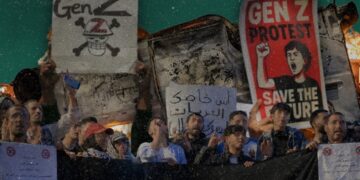
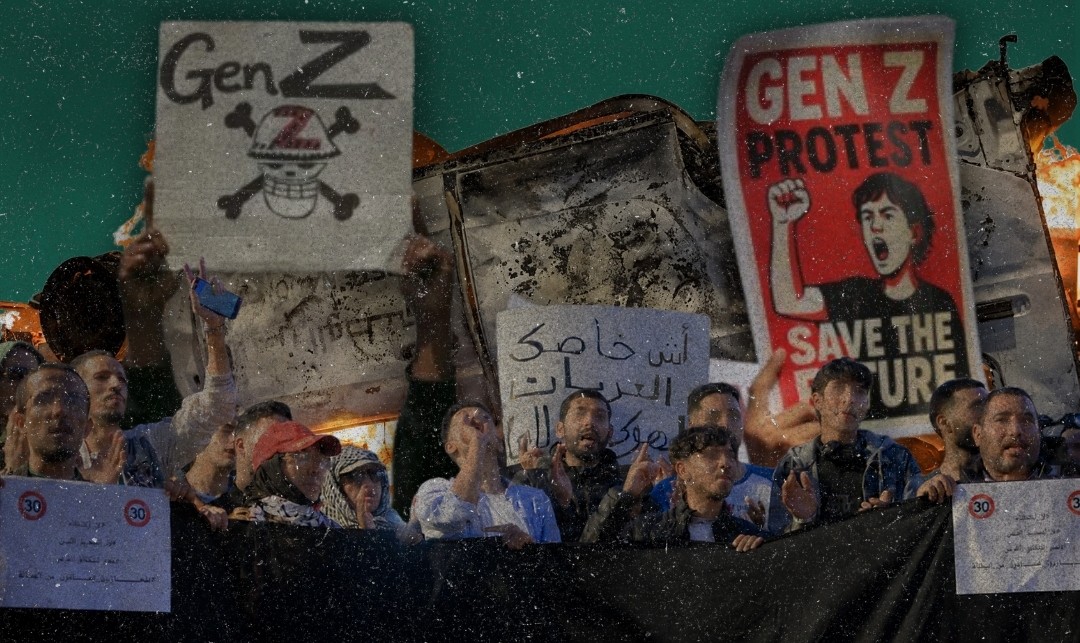
Like many of their counterparts across the world, Tunisia’s Gen-Z activists are critical of authority per se. In Tunisia as in Nepal in September 2025, young protesters hold up banners of One Piece anime character Monkey D. Luffy. Both angry and hopeful, the straw-hat-wearing, smiling skull and crossbones has become a symbol of the struggle for freedom and social justice, and against corruption. Like the wide spectrum of the political opposition, they have opposed the “Fake News” Decree Law 54 that has served as a pretext for political detentions. Tunisian Gen-Z youth have also donned the Palestinian kufiyah and raised slogans in support of the resistance (El-Jehmi 2025), indicating a politicization that is not just global, but also regional and global. They move between online and offline activism. There is relative safety in online activism; some Gen-Z protestors (like others in Tunisia) have been chased and even arrested by police when they physically protest on the street.
Looking Ahead
Degrees of de-democratization, forms of authoritarianism, and intensities of political and violent conflict vary across the Arab geography. However, in their dissidence, Tunisian youth are in many ways similar to their regional cohorts. Over fifteen years ago, as Tunisia’s revolution spread, youth from various ideologies were a huge presence in Morocco’s February 20 movement in 2011 (Sika 256-8). Sustained street protests, part of the traveling popular mobilization (“hirak”)of the Arab uprisings (Sadiki 2016), prompted the King to launch a constitutional reform process, but the top-down changes have yielded little more than “managed pluralism” (Kadaoui 2026). Since then, notable protest campaigns include the Rif Hirak of 2016. Doubtless this time around, Tunisia’s Gen-Z was inspired in part by the regional pioneer in Morocco. The Gen-Z212 protests were triggered in September 2025 after several maternity deaths in Agadir, spreading into a wider campaign for public health services and education, against corruption and for social justice. In the face of severe crackdowns, Gen-Z212 is more active in online than offline activism, on the Discord servers made famous.
Tunisia, Morocco, and countless other Arab countries face massive challenges in a “new Middle East” being reshaped by the Trump administration, some compounded for the region’s youth. De-democratization and its authoritarian symptoms of censorship and political exclusion; severe socio-economic marginalization and unemployment prompting youth to escape when possible, even precariously; and the additional frustrations of Israel’s genocide in Gaza that no Arab country (and no country at all) has been able to halt, in addition to the concurrent wars in Lebanon and Iran, make for a heavy, if abbreviated, list. Will the Gen-Z movements successfully push for political change? In Tunisia, without cooperating with the (still-fragmented) political opposition to Kais Saied, that seems unlikely. And the upcoming Moroccan parliamentary elections in late September, with few youth candidates, may end up signalling that “politics as usual” marches on, social injustice and all. But if there is one lesson learned from the past fifteen years or more, whether they call themselves “Gen-Z” or not, the region’s youth seem frequently poised for protest and dissent.
References
Artz, Lee. 2026. “Introduction to Protest Special Issue on Palestine.” Protest 5(2): 159-168.
Chenoweth, Erica and Matthew Cebul. 2026. “Why Gen-Z is Rising.” Journal of Democracy 37(1): 5-14.
El-Jehmi, Chaker. 2025, 17 October. “Gen-Z with Pirate ‘Luffy’ Banners: Contours of the New Anger.” Nawaat, https://bit.ly/4zXWBqR [in Arabic].
Kadaoui, Aisha. 2026, February 17. “An Eye on Moroccan Democratization: Towards an Adaptation?” Toda Peace Institute, https://toda.org/publications/policy-briefs-and-reports/an-eye-on-moroccan-democratization-towards-an-adaptation/
Sadiki, Larbi. 2016. “The Arab Spring: The People in IR.” Chapter 15. In Louise Fawcett (ed.), International Relations of the Middle East, Edition 4 (Oxford: Oxford University Press), pp. 325-355.
Sadiki, Larbi and Layla Saleh. 2024. Revolution and Democracy in Tunisia: A Century of Protestscapes. Oxford: Oxford University Press.
Sika, Nadine. 2018. “Civil Society and the Rise of Unconventional Modes of Youth Participation in MENA.” Middle East Law and Governance 10: 237-263.
*Opinions expressed in this article are the author’s own and do not necessarily reflect Platform: Current Muslim Affairs’ editorial policy.