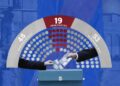


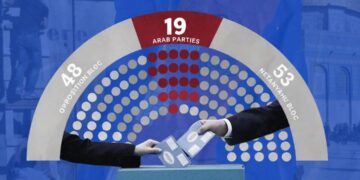






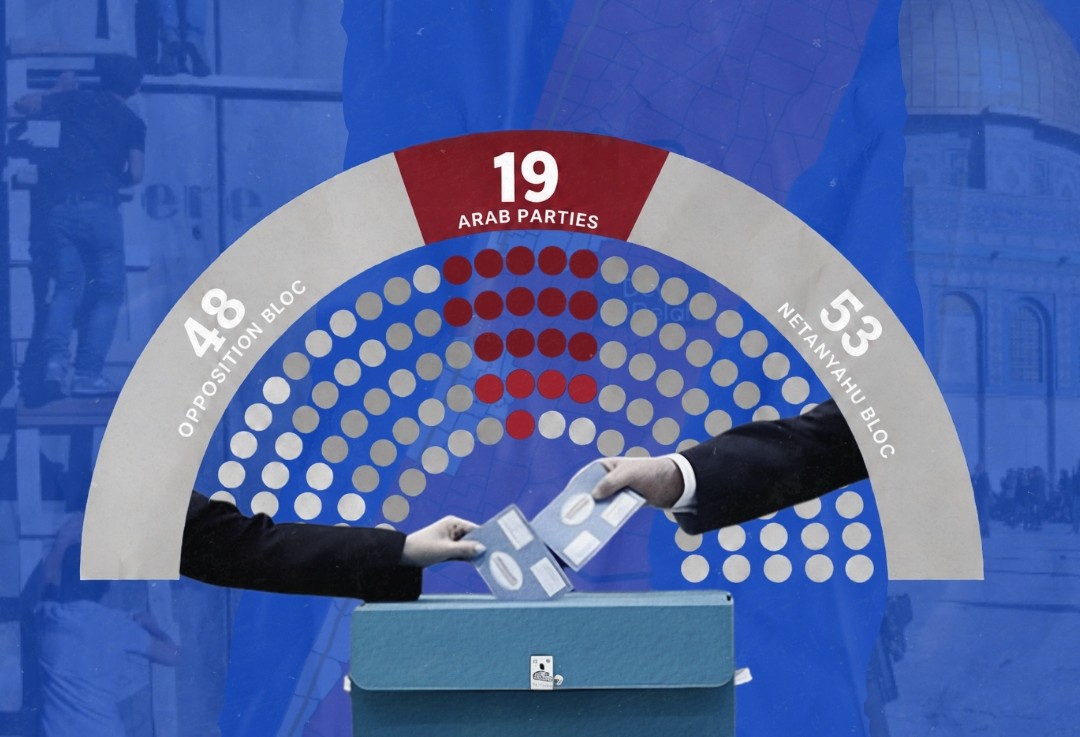
The general elections held in Israel on 27 October produced a picture reminiscent of the government crises that followed 2019. Prime Minister Benjamin Netanyahu and his allies won 53 seats, while the anti-Netanyahu Zionist opposition bloc led by Gadi Eisenkot secured 48. Neither bloc therefore reached the 61 seats required for a majority in the 120-member Knesset. Meanwhile, the Joint List and Ra’am, which represent Palestinian citizens of Israel, together won 19 seats, the highest level of representation they have achieved to date (Dincel, 2026).
At the time of writing, the final results were expected to be presented to President Isaac Herzog on 4 November, after which Herzog would meet with party representatives to determine whom he would task with forming the government (Dincel, 2026; Knesset, 2001). Apart from the most fragile scenario, such as a minority government, the scenarios that await us are Netanyahu finding supporters in the opposing bloc, Eisenkot obtaining the support of either the Arabs or the Haredim, or a unity government, as in 2020 (Karmel, 2026). If none of these occurs, the country will go to elections once again.
The most striking outcome of the elections was the historic increase in the parliamentary representation of the 1948 Arabs. While the success of the Arab parties strengthened the political weight of this community, it also raised the question of the extent to which the seats won would translate into a genuine voice in decision-making processes. Meanwhile, although Likud performed better than some polls had predicted, this was not enough to halt the erosion of Netanyahu’s political dominance. The governing bloc, whose partners, Shas foremost among them, also suffered losses, lost its parliamentary majority (Segev et al., 2026; Dincel, 2026).
However, it would be unrealistic to expect this change brought about by the ballot box to produce a fundamental transformation in the short term in Israel’s occupation policies in the Palestinian territories or in its regional military aggression. These policies rest not only on the preferences of the Netanyahu government but also on a conception of security shared by broader segments of Israeli politics and on the established strategic priorities of the state (Gorenberg, 2006; Freid et al., 2026).
The Change Brought About by the Ballot Box
For Palestinian citizens of Israel, the 27 October elections can also be read as a referendum on the Netanyahu government’s three-year record since 7 October 2023. Just ten days after the operation carried out by the Qassam Brigades and other Palestinian armed groups, the then Israel Police Commissioner, Yaakov Shabtai, threatened to put those who expressed solidarity with the people of Gaza on buses and send them to Gaza (Association for Civil Rights in Israel, 2023). During the same years, organised crime continued to claim lives in Arab towns. Under National Security Minister Itamar Ben-Gvir, the budget of a violence-prevention programme run in seven localities, including Umm al-Fahm and Rahat, was cut and its field team was reduced (Sadeh, 2025).
This issue of personal safety also lay at the heart of Ra’am’s cooperation with anti-Netanyahu Jewish politicians. The Islamist conservative party, led by Mansour Abbas, reserved the second slot on its candidate list for former Yesh Atid Member of Knesset Yoav Segalovitz. Segalovitz, who founded Lahav 433, the Israel Police unit responsible for corruption and organised crime investigations, had coordinated the fight against crime in Arab towns as Deputy Minister of Public Security in the Bennett–Lapid government, of which Ra’am was also a partner (Schneider, 2026a). This choice illustrated how Palestinian voters’ search for solutions to their everyday problems intersected with anti-Netanyahu political alliances.
The final poll published by Channel 12 on 23 October gave Ra’am five seats. Four days later, the party won eight seats at the ballot box (Kushmaro & Liel, 2026). Behind this surprise lay a striking increase in turnout among Arab voters. According to the Israel Democracy Institute, turnout in Arab and Druze localities stood at 53.2% in the 2022 elections; this time, according to the estimate for Arab voters released by Channel 12 on election day, it reached approximately 80% (Abu Hadoba-Frieh & Rudnitzky, 2026; Chouiref, 2026). Participation in the elections thus became not only an expression of reaction against the Netanyahu government but also a means of demonstrating that political representation is in fact rooted in sociological reality.
Indeed, this right to representation had also been called into question at the judicial level before the elections. Israel’s Central Elections Committee had disqualified both Ra’am and the Joint List from running, but on 2 October the Supreme Court unanimously overturned both decisions. Balad leader Sami Abu Shehadeh (Adalah, 2026), meanwhile, was forced to withdraw from the race after the court indicated that it was preparing to annul his candidacy. This time, running on two separate lists, the Arab parties surpassed the record of 15 seats they had won on a single list in 2020.
The support of these two lists, whose very presence on the ballot was in question just a month before the elections, now offers Eisenkot’s 48-seat bloc the possibility of reaching a parliamentary majority of 67 seats. However, serious political obstacles stand in the way of converting this arithmetical advantage into the power to form a government. Eisenkot’s Yashar party, Naftali Bennett’s B’Yachad alliance, and Avigdor Lieberman’s Yisrael Beytenu all oppose sitting in the same coalition as the Arab parties. By contrast, Joint List Member of Knesset Ahmad Tibi has announced that they are prepared to support an anti-Netanyahu government from outside the coalition (ToI Staff & Stub, 2026; Karmel, 2026). The historic success of the Arab parties therefore also shows that the gap between the strengthening of parliamentary representation in Israeli politics and the translation of this representation into political decision-making processes has yet to be closed.
Why Did Netanyahu’s Coalition Partners Lose Ground?
Another significant outcome of the elections was the losses suffered by Netanyahu’s Haredi and far-right allies. While United Torah Judaism, the political representative of the Ashkenazi Haredi community, retained its seven seats, Shas, which appeals not only to Haredim of Sephardi and Mizrahi origin but also to a broader traditional electorate, fell from the 11 seats it had won in 2022 to six. One of the decisive factors behind this sharp decline was the tension generated by the debate over exempting the Haredim from compulsory military service (Shlezinger, 2026).
Indeed, criticism voiced from within Shas after the elections suggested that the party’s hard-line stance on military service had alienated traditional voters without strong ties to Haredi identity. While United Torah Judaism largely retained its more homogeneous and institutionalised electoral base, the political balance Shas had struck between its Haredi identity and its broader Sephardi-Mizrahi conservative base weakened (Peled, 1998; Anabi, 2022; Shlezinger, 2026). Thus, although military service was a common demand of the Haredi parties, it produced different results at the ballot box.
On the far right, the most notable losses stemmed less from a complete collapse in voter support than from fragmentation. While Itamar Ben-Gvir’s Otzma Yehudit party won seven seats and Bezalel Smotrich’s Religious Zionism alliance won six, the Amcha Yisrael party, led by former army officer Ofer Winter, fell below the electoral threshold with 1.68% of the vote (Bakalpi, n.d.). Concern about preventing the splitting of the right-wing vote also lay behind Netanyahu’s pre-election call for the far-right parties to merge, and even his attempts to persuade Winter to withdraw from the race (ToI Staff, 2026b; Karmel & Levaton, 2026).
It is therefore difficult to interpret the far right’s electoral performance as a loss of legitimacy for the ideology it represents within Israeli society. While the parties of Ben-Gvir and Smotrich retained their presence in parliament, the failure of actors such as Winter, who draw on the same political constituency, to clear the threshold cost Netanyahu the seats he needed to form a government. This outcome suggests not that the far right’s social influence has disappeared, but rather that its fragmented structure has constrained the parliamentary strength of the Netanyahu-led alliance.
Indeed, Likud, which had fallen to as few as 18 seats in some pre-election polls, outperformed expectations by winning 27 seats. Yet this result still fell short of the 32 seats the party had won in 2022. More importantly, the bloc of right-wing and religious parties led by Netanyahu failed to maintain the 64-seat majority it had secured in 2022 and dropped to 53 seats. Thus, although Likud remained the largest party in Israeli politics, the parliamentary majority Netanyahu needed to form a government once again with his traditional partners had vanished.
Nevertheless, the weakening of Netanyahu’s capacity to form a coalition does not mean that Israeli politics has undergone a fundamental ideological transformation. Although the election results show that the governing bloc has lost its parliamentary advantage, the extent to which the core assumptions regarding occupation, settlement policies, and the conception of regional security have changed remains open to debate. Assessing the true significance of the 27 October elections for the Palestinian question therefore requires looking not only at Netanyahu’s losses but also at what the political actors likely to come to power in his place promise to change.
What the Elections Will Not (and Cannot) Change
Like the Netanyahu bloc, a significant part of the anti-Netanyahu Zionist opposition also opposes the establishment of an independent Palestinian state. For example, in a statement on 11 October, Eisenkot explicitly rejected the principle of a two-state solution (Baruch, 2026), while Bennett, known for his past role in the Yesha Council, the umbrella organisation of illegal settlement bodies in the occupied West Bank, advocates the expansion of settlements (ToI Staff, 2026a; Freid et al., 2026; UN Security Council, 2016). Likewise, Lieberman, the representative of the secular nationalist right, is known for his hard-line stance on this issue. Indeed, although he is one of the staunchest opponents of the Haredi exemption from military service, he is known for having said: “The Haredim are my rivals, but the Joint List is my enemy” (Fox, 2019).
On the left wing of the opposition, Yair Golan’s Democrats party embraces the two-state solution as a long-term goal, while former Prime Minister Yair Lapid, number two on the list of the Beyachad (Together) party, has also supported this formula in the past (Golan & Mekelberg, 2025; Lapid, 2022; Schneider, 2026b). However, these approaches have not become part of a common political programme for the opposition.
Moreover, the military background of Eisenkot, Netanyahu’s strongest rival, should also be read as one of the key indicators of this continuity. Eisenkot, who served as Chief of the General Staff of the Israel Defense Forces from 2015 to 2019 and sat on the war cabinet formed after 7 October (Israel Defense Forces, n.d.; Baruch, 2026), was one of the principal architects of the Dahiya Doctrine developed in the wake of the 2006 Lebanon War. This approach, which Eisenkot openly advocated in 2008 (Fishman & Ringel-Hoffman, 2008), envisaged the use of disproportionate military force and the infliction of large-scale destruction in areas from which attacks on Israel were launched. It is therefore difficult to argue that Eisenkot, despite his criticism of Netanyahu’s war policies, has entirely distanced himself from Israel’s core assumptions regarding the use of military force.
That said, a possible change of government could produce certain tactical differences in Israel’s regional policies. In particular, defining an exit strategy that would reduce the economic, diplomatic, and social costs of protracted military operations may become a priority. Examples of such differences might include a focus on limiting Iran’s military capacity rather than pursuing wide-ranging operations aimed at regime change (Helm, 2026; Schneider & Horovitz, 2026), and a preference for narrower security zones and diplomatic arrangements in Lebanon (Bob, 2026). In Yemen, too, a shift towards more limited operations rather than large-scale military engagement is possible; however, this would not mean that Israel will abandon regional military interventions.
Indeed, greater continuity can be expected with regard to Syria. Although Eisenkot tends to give more weight to diplomatic initiatives than Netanyahu, he advocates that Israel maintain its military presence in the strategic areas it has occupied and retain the ability to strike Syrian territory whenever it deems necessary. Similarly, expanding normalisation with Arab states within the framework of the Abraham Accords is not a goal the opposition is expected to abandon. However, the demands of countries such as Saudi Arabia regarding a Palestinian state will continue to pose a significant obstacle to this process, even if the government changes.
The 27 October elections thus showed that the balance of political power in Israel can shift and that the parliamentary representation of Palestinian citizens can grow stronger. However, there are no strong signs that a government succeeding Netanyahu would end the occupation policies or abandon the pursuit of regional military superiority. The ballot box may change Israel’s political cadres and the methods it employs; yet for this change to amount to a genuine transformation for Palestinians and the countries of the region, the prevailing conception of security must itself be called into question.
References
Abu Hadoba-Frieh, M., & Rudnitzky, A. (2026, November 1). העלייה באחוז ההצבעה בחברה הערבית בבחירות לכנסת ה-26 [The rise in turnout in Arab society in the elections for the 26th Knesset]. Israel Democracy Institute.
Adalah. (2026, October 2). Adalah: Supreme Court rejects disqualification of Joint List, Ra’am and MK Cassif, after pushing Abu Shehadeh out of the race.
Anabi, O. (2022, August 1). The demographic characteristics of voters. Israel Democracy Institute.
Association for Civil Rights in Israel. (2023, October 19). Incitement remarks by the chief of police, Yaakov Shabtai, against the Arab community.
Bakalpi. (n.d.). Amcha Yisrael.
Baruch, U. (2026, October 11). ”אני לא שמאלני”: איזנקוט מבהיר את עמדותיו לימין [“I’m not a leftist”: Eisenkot clarifies his positions to the right]. Arutz Sheva.
Bob, Y. J. (2026, September 3). Nuclear kill zones: How Eisenkot would contain Iran if he manages to beat Netanyahu – exclusive. The Jerusalem Post.
Chouiref, T. (2026, October 28). Israeli election turnout reaches 77.7% as Arab parties poised for historic gains. Anadolu Agency.
Dincel, S. (2026, October 30). Factbox – With all votes counted, how Israel’s legislative election results compare with previous vote. Anadolu Agency.
Fishman, A., & Ringel-Hoffman, A. (2008, October 2). שים לב, נסראללה [Watch out, Nasrallah]. Ynet / Yedioth Ahronoth.
Fox, N. (2019, September 22). ליברמן: “לא ממליצים על אף אחד, הרשימה המשותפת – אויבים” [Lieberman: “We are not recommending anyone; the Joint List are enemies”]. Ynet.
Freid, S., Ettinger, A., Azulay, M., & Halabi, E. (2026, September 30). Annexation, settlements or separation: Where Israel’s parties stand on the West Bank. Ynetnews.
Golan, Y., & Mekelberg, Y. (2025, March 10). Yair Golan: ‘Israel must not annex millions of Palestinians’. The World Today. Chatham House.
Gorenberg, G. (2006). The accidental empire: Israel and the birth of the settlements, 1967–1977. Times Books.
Helm, T. (2026, July 16). Israeli PM hopeful condemns ‘insane’ alleged plot to install Ahmadinejad as Iranian leader. The National.
Israel Defense Forces. (n.d.). Lt. Gen. Gadi Eisenkot (2015–2019).
Israel Democracy Institute. (2022). 2022 Israeli elections and parties.
Karmel, A. (2026, November 1). Netanyahu lost his majority, but can the opposition form a government? A look at possible paths ahead. The Times of Israel.
Karmel, A., & Levaton, S. (2026, October 20). Netanyahu, Smotrich meet Winter’s rabbi to pressure him to quit race; he refuses. The Times of Israel.
Kenig, O. (2020, May 17). Israel’s 35th government: A portrait. Israel Democracy Institute. https://en.idi.org.il/articles/31613
Knesset. (2001). Basic Law: The Government.
Kushmaro, D., & Liel, D. (2026, October 23). סקר המנדטים האחרון של חדשות 12 לפני הבחירות: גוש השינוי מתחזק, וינטר והנדל-זליכה מתחת לאחוז החסימה [Channel 12 News’ final pre-election seat poll: The change bloc strengthens, Winter and Hendel-Zelekha below the threshold]. N12.
Lapid, Y. (2022, September 22). Prime Minister Lapid addresses the United Nations General Assembly. Israel Ministry of Foreign Affairs.
Ministry of Foreign Affairs of the Kingdom of Saudi Arabia. (2024, February 7). The Ministry of Foreign Affairs states the discussions between the Kingdom of Saudi Arabia and the United States of America on the Arab-Israeli peace process.
Peled, Y. (1998). Towards a redefinition of Jewish nationalism in Israel? The enigma of Shas. Ethnic and Racial Studies, 21(4), 703–727. https://doi.org/10.1080/014198798329838
Rudnitzky, A. (2020, March 10). The Arab Israeli vote in the 23rd Knesset elections. Israel Democracy Institute.
Sadeh, S. (2025, October 23). כך הוקרסה תוכנית הדגל לעצירת האלימות בחברה הערבית מאז מונה בן גביר לשר לביטחון לאומי [How the flagship programme to stop violence in Arab society has collapsed since Ben-Gvir was appointed National Security Minister]. Shomrim.
Schneider, T. (2026a, September 17). A Jewish Zionist running with Ra’am, Segalovitz tells ToI he aims to smash the political paradigm. The Times of Israel.
Schneider, T. (2026b, September 6). Naftali Bennett unveils opposition B’Yachad party’s slate, tapping former senior officials and reservists. The Times of Israel.
Schneider, T., & Horovitz, D. (2026, October 6). Bereaved by war, determined to heal, protect and revive Israel: Gadi Eisenkot’s prime ministerial mission. The Times of Israel.
Segev, Y., Kenan, L., Shemesh, M., & Drucker, R. (2026, October 14). נתניהו נחלש, הנדל וזליכה עוברים – ומפת הגושים שוב משתנה [Netanyahu weakens, Hendel and Zelekha cross the threshold, and the bloc map shifts again]. Hadashot 13.
Shlezinger, Y. (2026, October 29). Shas officials blame hardline draft stance for one of party’s worst-ever election defeats. The Jerusalem Post.
ToI Staff. (2026a, June 23). Bennett calls to dismantle illegal settlement outposts, draws right-wing leaders’ ire. The Times of Israel.
ToI Staff. (2026b, August 27). Netanyahu urges Ben Gvir, Smotrich to unite as poll shows Winter’s new party surging. The Times of Israel.
ToI Staff, & Stub, Z. (2026, November 1). Senior Arab MK says Joint List ready to back anti-Netanyahu government from outside. The Times of Israel.
United Nations Security Council. (2016, December 23). Resolution 2334 (2016) (S/RES/2334).