




























(The original Turkish version of this article was published by the Platform: Current Muslim Affairs on May 13, 2026)
The simultaneous attacks carried out across Mali on April 25, 2026, emerged not merely as isolated security incidents but as a coordinated challenge aimed at targeting the state’s nationwide control capacity and exposing the fragility of the central authority. The areas targeted by these attacks carry significance at three distinct levels: Bamako and Kati represent the heart of the military administration and the perception of security around the capital; Mopti and Sévaré point to transition and military shipment lines in central Mali; while Gao, Bourem, and Kidal signal long-disputed sovereignty zones in the north. The synchronicity of these attacks across diverse geographical points has pushed the impact of the crisis beyond a single conflict zone, directly targeting the Mali state’s nationwide security reflexes. The parallel rise of JNIM and the FLA indicates a strengthening of pragmatic engagement between Al-Qaeda-aligned armed structures and Azawad-oriented Tuareg separatist elements. These developments deepen question marks regarding the sustainability of Russia-backed security arrangements on the ground, demonstrating that the military administration’s capacity to establish authority and generate deterrence across a vast geography is under severe pressure.
Pragmatic Realignment: The Historical Background of the FLA-JNIM Axis
The first actor at the center of this wave of attacks, the FLA (Azawad Liberation Forces), is a separatist umbrella organization established in November 2024. It is largely composed of Tuareg elements, including the National Movement for the Liberation of Azawad (MNLA), the High Council for the Unity of Azawad (HCUA), the Self-Defense Group of Imghad Tuaregs and Allies (GATIA), and the Arab Movement of Azawad (MAA), all aiming for independence or broad autonomy in northern Mali. The second actor is Jama’at Nusrat al-Islam wal-Muslimin (JNIM). Formed in 2017 through the merger of Al-Qaeda-linked radical groups -AQIM, the Tuareg-led Ansar Dine, the primarily Fulani Macina Liberation Front (MLF), and Al-Mourabitoun- JNIM is one of the most effective armed structures claiming to build a religion-based socio-political order across the Mali-Burkina Faso-Niger axis.
While cooperation between these two actors may seem ideologically contradictory at first glance, Mali’s recent history shows that such temporary partnerships are not new. Furthermore, the structures under the FLA umbrella are not ideologically monolithic. While the MNLA positions itself on a more nationalist and relatively secular line distant from religious radicalism, the HCUA maintains a profile more open to radical religious norms. The HCUA’s harsh implementation of bans on alcohol and intoxicants in Kidal reflects how this approach translates into local governance. The fact that HCUA leader Alghabass Ag Intallah was previously associated with the Al-Qaeda-linked Ansar Dine, and that former HCUA military commander Cheick Ag Aoussa maintained long-term contact with Ansar Dine leader Iyad Ag Ghali, signals a strong organizational fluidity between Tuareg political-military movements and radical networks.
In this context, the rapprochement between the FLA and JNIM should be viewed as a current reflection of recurring pragmatic alliance-seeking in northern Mali rather than a coincidental partnership. Following the 2012 coup, Tuareg rebel groups gained influence in the north, securing control over strategic centers like Gao, Kidal, and Timbuktu, with Ansar Dine eventually joining the rebellion. On May 26, 2012, an agreement between the MNLA and Ansar Dine to merge regions and establish an Islamic state was announced. Although this alliance proved fragile due to ideological differences, it demonstrated that Tuareg separatists and Al-Qaeda-linked elements could cooperate against a common enemy. Reports of non-aggression pacts between JNIM and certain northern armed groups in 2023 point to the same continuity. The April 25 attacks, claimed by both JNIM and the FLA, can be considered the most visible result of these historical contacts on the ground. These gains in the north have forced the Malian army into a defensive posture. Recent reports indicate that while the FLA and JNIM are increasing pressure on northern settlements like Kidal, Ber, Léré, Tessit, and Intahaka, JNIM has been emphasizing a blockade rhetoric against Bamako as of April 28.
The April 25 Attacks and Multi-Front Security Pressure
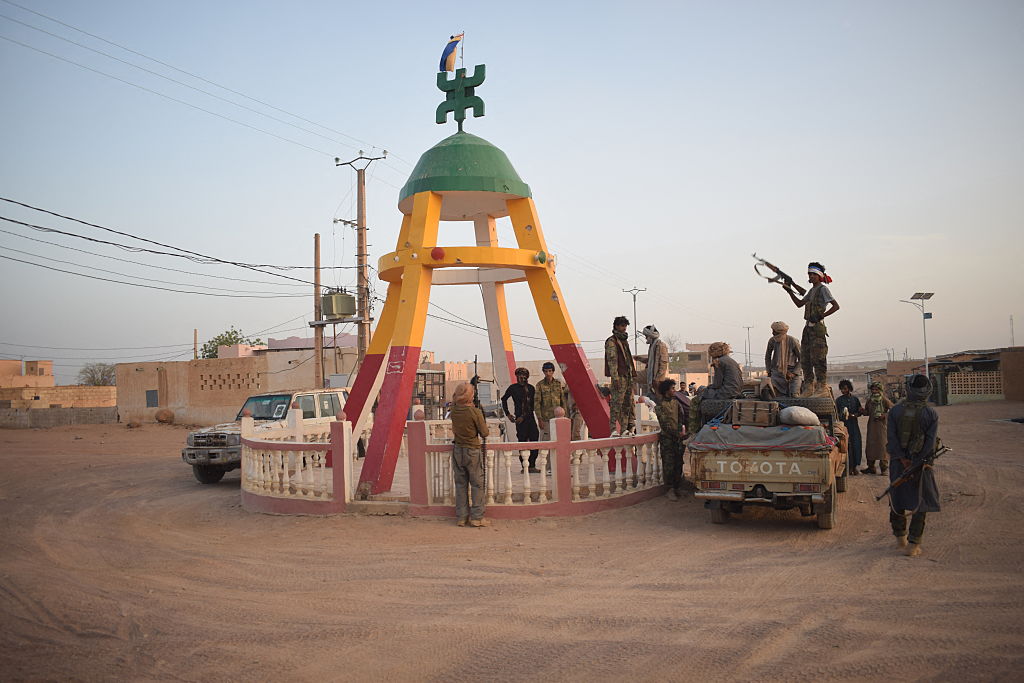
The geographic axis of the operations is the product of a clear strategic logic rather than randomness. Kidal stands out as the political and symbolic center of the independentist Azawad project; Gao serves as the main base for military and logistical mobility in northeastern Mali; and Bourem is a critical transit point controlling the connection between Gao and Kidal. Sévaré and Mopti are strategic hubs in the center where security, supply, and transportation networks intersect. Kona draws attention as a key threshold in the pressure corridor moving from north to south, while Kati and Bamako are vital for the security of the regime and the continuity of state authority.
According to this distribution, the FLA’s goal of northern-centered territorial control and JNIM’s nationwide strategy of attrition complement each other. Attacks on military targets in Kati and the vicinity of Modibo Keita International Airport in Bamako demonstrate that JNIM is no longer just a rural or northern-based threat. Following the attacks, President Goïta appeared in public to call for unity, and official channels broadcasted images of a meeting with a Russian embassy delegation.
These developments are not independent of JNIM’s blockade strategy against Bamako. Since September 2025, the organization began exploiting Mali’s landlocked vulnerability by targeting fuel tankers and commercial convoys heading to the capital. These attacks, which intensified in late 2025, resulted in fuel crises, disruptions in public services, price hikes, and the closure of educational institutions in Bamako. On April 28, 2026, JNIM declared a full blockade of Bamako. Therefore, the April 25 attacks represent a new phase of the blockade strategy, expanded with military and symbolic targets. JNIM first targeted state capacity by creating pressure on lines critical to the capital’s economic functioning, and then, in coordination with the FLA, directly strained the regime’s security architecture with multi-faceted attacks across the Kati, Bamako, Sévaré, Gao, and Kidal axes.
Sahel’s New Geopolitics: Russia, Algeria, and the AES Equation
The role of Russia and the Africa Corps is central to this picture. Following the withdrawal of French and UN forces, the Malian junta’s security architecture has relied heavily on Russian support. However, recent attacks have exposed the fragility of the model Moscow presents as an alternative security provider in the Sahel. The potential for turmoil in Mali to threaten Russia’s influence, gold and lithium projects, energy investments, and planned nuclear cooperation must be considered.
A message allegedly directed at Russia in JNIM’s initial statement is noteworthy. The organization’s implication that it does not wish to clash directly with Russia and could establish a balanced relationship in the future is a diplomatic-strategic move rather than a purely military one. This approach brings to mind the model of Hay’at Tahrir al-Sham (HTS) in Idlib, Syria (2017-2024), which moved away from a classic radical image to develop local governance capacity. It can be assessed that JNIM is also seeking to establish a manageable political order in northern Mali and open pragmatic communication channels with external actors. The ISGS (Islamic State in the Greater Sahara) factor is also critical. ISGS is JNIM’s most significant rival in the east Mali-Niger-Burkina Faso line. The fact that ISGS is not a primary actor in the current wave of attacks confirms that the FLA-JNIM axis is the main driver. For JNIM, the alliance with the FLA offers a secure rear area not only against the Malian state but also against ISGS. For the FLA, this partnership may yield short-term gains in Kidal, Gao, and possibly Timbuktu, but in the long run, it risks damaging the FLA’s international legitimacy and making the Azawad project dependent on JNIM’s ideological agenda.
The Algeria-Mali-Morocco axis also shapes the regional backdrop. The Malian military’s inability to prevent losses against armed groups brings Algeria back to the forefront as a mediator. Algeria’s influence had weakened since late 2023 due to deteriorating relations with Bamako. However, the new situation in the north has revitalized Algeria’s historical contacts with Tuareg groups and its mediation experience from 1991, 2006, and 2015. Some claim that Algeria has indirect involvement in this new wave of attacks, particularly through the FLA, and that it mediated the rapid withdrawal of the Africa Corps. However, there is insufficient open evidence to establish direct causality regarding Algeria’s role. While Mali’s move toward Rabat regarding the Moroccan Sahara has certainly unsettled Algiers, attributing the current attacks solely to Algerian orchestration remains an allegation that requires analytical caution.
Finally, this crisis calls into question the security strategy of the AES (Alliance of Sahel States) -the military administrations of Mali, Burkina Faso, and Niger. Anti-Western and specifically anti-French rhetoric provided short-term domestic legitimacy for these regimes. However, the security vacuum created by the withdrawal of France, G5 Sahel, and UN missions has not been filled by the Russia-centered model. The recent attacks reinforce the narrative that the threat to Mali’s territorial integrity is increasing and the risk of fragmentation is real.
In conclusion, the events in Mali post-April 25 cannot be treated as a classic wave of attacks. The FLA-JNIM rapprochement produces multi-layered consequences: territorial control in the north, logistical pressure in the center, psychological shock around Bamako, strategic messaging to Russia, balancing against ISGS, and Algeria’s return to the diplomatic game. For Mali, the most likely short-term scenario is the consolidation of FLA-JNIM control zones in the north, continued JNIM pressure in the center, and Bamako being held under economic-psychological blockade even if it does not fall militarily. In the medium term, two risks stand out: first, the de facto partitioning of Mali into fragmented control zones; and second, the strengthening of a “proto-state” trend where the FLA’s Azawad project becomes intertwined with JNIM’s search for governance and religious order. Consequently, the Mali crisis must now be addressed not just under the heading of counter-terrorism, but through the lenses of state capacity, ethnic balances, external actor competition, and the new geopolitics of the Sahel.
*Opinions expressed in this article are the author’s own and do not necessarily reflect Platform: Current Muslim Affairs’ editorial policy.