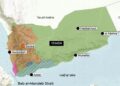









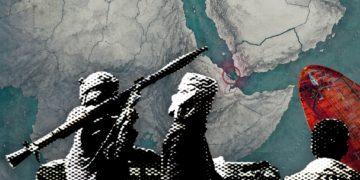


















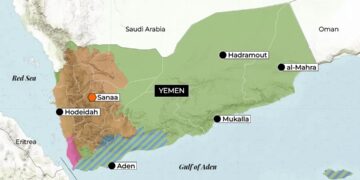







The Houthi takeover of Bab al-Mandab on 11 September came as a shock to many Middle East analysts, including those who follow Yemen closely. The shock lay not in the Houthis’ advance itself- but in its manner of how they advanced, and in its speed. Why Mokha fell so quickly remains open to debate. What is clear is that the number of military forces on the ground, and their divided loyalties, played a central role. The forces of Tareq Saleh, which held primary responsibility for the west coast, blamed the forces in Taiz for the defeat. According to this account, the Houthis exploited the weakness of the Taiz forces to put pressure on Mokha and the west coast, which eventually led Tareq Saleh’s forces to withdraw. This matters because Tareq Saleh’s leadership belongs to the General People’s Congress, while the Taiz military axis is affiliated with Islah, the Congress’s fiercest rival.
The Houthis seized wide areas of the west coast, including Bab al-Mandab, with startling speed. Yet Operation “Dawn of Yemen”, launched by the internationally recognized government, has also made surprisingly rapid gains in the same areas. On 5 October, the head of the Presidential Leadership Council announced the start of the operation with the objective of retaking Sanaa and state institutions from the Houthis. The operation is led by the Southern Giants Brigades and the Nation’s Shield Forces-both are mainly Salafi forces. They stand apart from the polarization and hidden rivalry between the General People’s Congress and Islah that marked the west coast and Taiz.
The operation produced unexpected advances. On its first day, the internationally recognized government announced that it had retaken a large part of the areas the Houthis had seized on the west coast and around Bab al-Mandab. This included Mokha, the largest city on the west coast. These claims put control of Bab al-Mandab back at the centre of events. However, while Yemen’s official, government-affiliated news agency announced these gains, no independent sources on the ground have confirmed them.
These rapid events are part of Yemen’s civil war, which began in 2014, when the Houthis, backed by forces loyal to former president Ali Abdullah Saleh, staged a military coup and seized power. This led to a larger intervention by Saudi Arabia and the UAE to fight the Houthis, who are accused of receiving support from Iran. The UAE later withdrew.
Both sides have suffered sudden collapses, and control of the west coast and Bab al-Mandab has changed hands at a startling pace. This raises a question: Why do these developments matter to the world? The short answer is that the Houthis did not use their control of Bab al-Mandab to close it to the world. Instead, they turned it into a lever of pressure aimed specifically at Saudi Arabia, while reassuring international powers that their shipping is safe. This makes recent developments more dangerous than they appear. The conflict in Yemen is gradually turning into a direct confrontation between the Houthis and Riyadh, with Riyadh bearing almost the entire cost.
The answer can be broken down into economic and military dimensions.
1. Economic Implications: Why Do the Military Developments in Bab Al-Mandab Matter?
The economic weight of events in Bab al-Mandab, including the back-and-forth control of the west coast, is shaped by developments in Iran and the Strait of Hormuz in particular. After Iran constrained Gulf exports through the Strait of Hormuz from March 2026, Saudi Arabia used its East-West pipeline to divert around four million barrels per day to the Red Sea. This volume equals about four percent of global oil supply. The Houthis have offered reassurances to the international community that the strait is not closed. But any new military escalation, especially a new round in the war against Iran, could change that. A full closure of Bab al-Mandab would halt Saudi oil exports to Asia and could reduce global oil supply by seven percent. Senior Iranian officials have made several statements linking Bab al-Mandab to the course of the war against Iran. The risks are not limited to oil. Around 15 percent of global seaborne trade passes through the strait each year, worth more than one trillion dollars. One estimate puts the economic losses of a 30-day Houthi blockade at 30 billion dollars, rising to 40 billion for a 45-day blockade.
Control of Bab al-Mandab helps the Houthis enforce the maritime blockade they declared on Saudi Arabia in July. That blockade cut Saudi exports from Yanbu through the strait by nearly 90 percent. They fell from 11 million barrels in the week of 20 July to 1.3 million barrels in the week of 3 August. Houthi control of the strait will therefore help them sustain this blockade. Overall, Saudi crude exports fell to about three million barrels per day in August, the lowest level in records going back to early 2017. This decline cannot be attributed primarily to the Houthis. Much of it stems from the disruption in Hormuz. Still, the attacks have also reached facilities on land. Saudi oil facilities in Yanbu and the south of the kingdom have come under repeated Houthi attacks over the past two months. Houthi strikes caused fires at several oil facilities, and the Energy Ministry announced a temporary halt to some operations. Riyadh then adapted again. Saudi exports rose to about six million barrels per day in September, nearly 80 percent above August, after shipments were redirected back through the Strait of Hormuz.
2. Military Implications: Why Do the Military Developments in Bab Al-Mandab Matter?
The military significance of Bab al-Mandab lies in its direct link to the Iran war. Houthi control of the strait would give the “Axis of Resistance” the ability to close both straits at once. This could trigger an unprecedented energy crisis. It is this risk that led the G7 to warn of the impact of Houthi control on energy security and freedom of navigation in the strait.
Any Houthi move to close Bab al-Mandab, fully or partially, would also draw Yemen into the war and expands its scope. The stakes go beyond a wider war. The strait itself, along with Saudi ports and oil facilities, would become targets. That would push oil prices even higher across the world.
Some reports suggest that Russian military support helped the Houthis take control of Bab al-Mandab. This opens the door to a new international player in Yemen’s war, a conflict that has mainly been shaped by Saudi Arabia and Iran as regional powers. This matters all the more given that Russia has an interest in continued tension over Middle East oil exports and in keeping oil prices high.
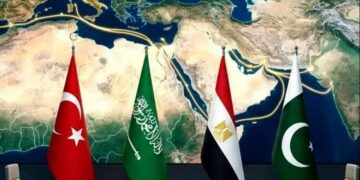
The Mecca Pact adds another dimension. Early discussion of the pact centered on the unlikelihood of intervention in Yemen to defend Saudi Arabia. But its latest meeting announced the activation of collective deterrence against Houthi attacks on the kingdom and Mecca. Developments in Bab al-Mandab therefore open the way to regional intervention against the Houthis.
Future Scenarios
Where could the military developments in Bab al-Mandab lead? Three scenarios seem plausible.
1. All-out war in Iran and Yemen
This scenario rests mainly on a return to full-scale war in Iran, especially after the US midterm elections. That would escalate events in Yemen, particularly if the Houthis fully close Bab al-Mandab. Growing US threats could render this pathway plausible. Yet so far the Houthis have not carried out any major military action in support of Iran. This weakens the likelihood of this scenario.
2. An Intra-Yemeni settlement
This scenario rests on an intra-Yemeni settlement with Saudi participation. Military operations would stop without either side establishing control over all territory. The core argument is that neither side can fully defeat the other. As losses mount on both sides, they may be forced into agreements or concessions short of total victory.
3. A continued civil war
In this scenario, the Yemeni war continues on a broad scale, but separately from the Iran war. The Houthis would focus on attacking Saudi Arabia and Saudi ships while fighting the internationally recognized government. They would stop short of fully closing the strait, which would shield them from a major US or Western military campaign. What makes this scenario plausible is the popular rejection, on all sides, of the current state of neither war nor truce. That leaves war as the only option for both parties. Both sides also share a long history of continuous war, roughly six years from 2015 to 2021. A return to war would not be unfamiliar to either of them.
All three scenarios are possible. In my assessment, however, the second is the most likely. The clashes and shifting control in Bab al-Mandab, and across Yemen’s front lines, look like attempts by each side to improve its negotiating position. They do not aim at destroying the other side, which would be hard to achieve. I also believe the Houthis are too shrewd to close Bab al-Mandab completely. Doing so would trigger an international military campaign against them.
*Opinions expressed in this article are the author’s own and do not necessarily reflect Platform: Current Muslim Affairs’ editorial policy.