





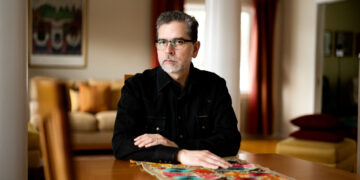






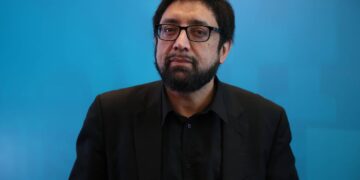
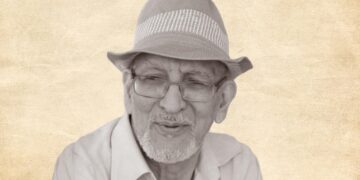
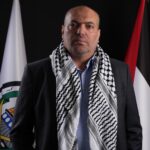
In this interview, we met with Jaser AlBarghouthi, the prominent Palestinian leader who personally witnessed and experienced some of the most critical stages of the Palestinian national struggle in the West Bank. AlBarghouti is a leading figure who left a lasting mark through the leadership he demonstrated during the Al-Aqsa Intifada and who subsequently continued his struggle in a different form under imprisonment by the Israeli occupation.
First arrested in 1993, sentenced to nine life terms, and released in 2011 as part of the Wafāʾ al-Aḥrār prisoner exchange before being exiled to Gaza, AlBarghouti continued throughout this entire period to shoulder the cause of his homeland. We discussed with him the impact of his prison experience on his personality and intellectual outlook, his relationship with the martyr Yahya Sinwar, both during their time together in prison and later in the Gaza Strip, as well as his assessments of the proposed “Peace Council” in Gaza and the future of the reconstruction process.
1) How did the years you spent in Israeli occupation prisons change your perspective on the Palestinian cause and the process of political struggle? Could you explain in greater detail the impact of your experiences, particularly during the period between 2003 and 2011, on your intellectual and political outlook?
I believe that, from the moment of birth, a person passes through successive stages of maturation and the construction of one’s character. At the same time, however, there are also events of a historical turning-point nature that leave profound marks on one’s personality, thought, and conduct. For me, the experience of captivity was one of the most important and influential of these turning points. This experience was not merely a period in which I was deprived of my freedom; rather, it was a genuine school that reshaped many of my convictions and enabled me to grasp, in a much deeper way, the Palestinian cause, the nature of the struggle against occupation, and the instruments of national struggle.
One of the most significant aspects that distinguished the experience of captivity was that it brought together, in the same space, figures from all the intellectual, political, and organisational structures of the Palestinian national movement. One would find oneself engaged on a daily basis in an exchange of ideas with individuals possessing long-standing experience, historical leaders, and activists from a wide range of orientations; this created an intense environment of intellectual and political interaction. For this reason, I would always say that, despite all its hardships, prison was for me akin to an open national university. The discussions, readings, assessments, and self-criticisms carried out during this period provided the opportunity to acquire, within a limited span of time, knowledge and experience that under ordinary circumstances could only have been gained over many years.
The period between 2003 and 2011 was one of the most influential stages in shaping my intellectual and political personality. During that time, the Palestinian cause witnessed events of a turning-point nature. Throughout my years of captivity, I also closely observed many transformations that compelled us to rethink the priorities of the national project and the methods of political struggle. I came to realise that the strength of our people lies not only in their resistance and steadfastness, but also in their ability to formulate an inclusive national vision that transcends divisions and preserves unity of purpose and destiny.
One of the greatest sources of pride for me with regard to this period was that the prisoners, despite the extremely harsh prison conditions and the state of isolation behind walls and locked doors, demonstrated an exemplary stance in terms of national responsibility. Indeed, the Prisoners’ Document, which would later come to be known as the National Conciliation Document, emerged from within the prisons as a sincere attempt to unite and reunify the Palestinian ranks and to establish common ground among the various national and Islamic movements.
This experience confirms that captivity was never a state of stagnation or detachment from society; on the contrary, it constituted a ground upon which national thought and initiatives were produced. At the same time, this also reflected the level of political and intellectual maturity that the prisoners had attained. They never regarded themselves as passive individuals merely subjected to the consequences of their people’s struggle, but rather as an active part of that very struggle.
2) During the time you spent in the same ward as Yahya Sinwar in Hadarim Prison, what was his manner of organising resistance activities inside the prison and managing his fellow prisoners? How did this experience contribute to the formation of his later political and military identity?
First of all, I can say that Yahya Sinwar possessed leadership qualities even before his arrest and imprisonment. These qualities were not a product of the experience of captivity, but rather an integral part of his personality. Indeed, he had headed Hamas’s security apparatus, which would later become known as the “Majd Organisation,” and demonstrated a high level of competence in organisation, decision-making, and anticipating potential challenges.
Nevertheless, the prison experience added new dimensions to his character, and these would play a decisive role in his subsequent struggle. Foremost among these was his profound understanding of the Zionist mindset, its mechanisms of thought, and its functioning at the levels of security, politics, and society. This understanding was also reflected in his approach to leading the prisoners’ movement. He believed that the prisoners’ movement was not merely one segment of the Palestinian people, but an integral part of the Palestinian national decision-making process, and that it necessarily had to have a voice in determining national choices.
Yahya Sinwar (Abu Ibrahim) was one of the rare figures who, despite long years in captivity, was able to sustain his influence beyond the prison walls. His presence and impact continued to be decisive both for the Palestinian national movement and for decision-making processes in Palestine. Despite many years of isolation, he succeeded in preserving his intellectual and political presence and continued to influence the course of events.
Due to the close relationship I had with him during that period and the fact that we experienced many stages of prison life together, I had the opportunity to observe closely that he possessed a vision different from the prevailing understanding. While most of us were focused on how Palestine could be liberated, he approached the issue from a broader strategic perspective. For Sinwar, the liberation of Palestine had to be a gateway that would open the way for the revival and renewal of the ummah; it was not to be regarded as a goal in itself, detached from the broader conditions in which the ummah found itself.
The years of captivity did not weaken his spirit of initiative or his capacity for profound reflection; on the contrary, they further strengthened them. He spent his time developing various scenarios concerning how the occupation could be confronted, and he assessed matters from a long-term strategic perspective. Today, in light of the events that have unfolded in the region, I can comfortably say that the idea of the “al-Aqsa Flood” had occupied his mind for many years. Nevertheless, the details of this idea were not opened for discussion.
There is a memory that still remains vivid in my mind. When we would go out into the prison yard for fresh air, we would walk together and speak about the future, even though at that time the idea that we might be released seemed almost impossible. On one such occasion, he said to me with great confidence: “I will do something that will force the world to stand on one foot.” Those words left a deep impression on me. They reflected the extent of his confidence that he could bring about a fundamental transformation in the course of the struggle against the occupation and make the Palestinian cause the central issue of the ummah, despite the harshness and prolonged duration of the conditions of captivity.
3) From a Palestinian perspective, does the proposed “Peace Council” model for Gaza constitute a mechanism of transition toward sovereignty, or does it represent a new internationalised form of occupation?
From a Palestinian perspective, any model for the governance of the Gaza Strip that is imposed from outside or formulated independently of the Palestinian national will cannot be regarded as a mechanism of transition toward sovereignty. On the contrary, even if such a model bears names that may appear more acceptable at the political level, it is viewed as a new- and perhaps more complex- form of occupation or of an internationalised system of tutelage.
For the essence of the matter does not lie in the names employed or in institutional arrangements, but rather in the source of legitimacy. Sovereignty is not something bestowed through international resolutions or regional arrangements. Rather, it rests upon the right of the Palestinian people to choose their own leadership and to administer their own affairs directly- that is, upon their right to self-determination.
Any arrangement concerning the post-war period must proceed from a comprehensive Palestinian consensus and must respect the will of the Palestinian people, who are the sole holders of the right to determine their future. Any model that does not make Palestinians the first and final authority in the management of their own affairs will not, in our view, establish genuine sovereignty- regardless of what name it is given or what guarantees it is supported by.
4) How might conditioning the reconstruction process of the Gaza Strip on political requirements such as disarmament, security coordination, or external oversight affect the future of the Palestinian cause?
Conditioning the reconstruction process of the Gaza Strip on political requirements such as disarmament, security coordination, or the imposition of various external oversight mechanisms transforms reconstruction from a humanitarian and legal obligation into a tool of political pressure, and turns the fundamental rights of the Palestinian people into matters of negotiation and bargaining.
Reconstruction, however, is not a favour granted by anyone; rather, it is a right guaranteed by international law, particularly in the aftermath of the large-scale destruction that has targeted the Gaza Strip’s infrastructure, vital public services, and housing. To condition civilians’ access to shelter and basic services on political or security requirements imposed upon them under extraordinary circumstances is unacceptable.
The fact that more than two million Palestinians in the Gaza Strip continue to live under extremely harsh humanitarian conditions and amid severe deprivation of the most basic necessities of life constitutes a humanitarian tragedy requiring urgent international intervention. This situation places upon the international community both a moral and legal responsibility to bring this suffering to an end, to ensure the uninterrupted delivery of humanitarian aid, and to initiate the reconstruction process without delay and without politicisation.
From a Palestinian perspective, any reconstruction process must be carried out on the basis of respect for the rights and dignity of the Palestinian people. This process must be kept free from any conditionality that would violate the Palestinian people’s right to self-determination or turn reconstruction into a means of imposing political arrangements that are not grounded in the will of the people and national consensus.