


(The original Turkish version of this article was published by the Platform: Current Muslim Affairs on June 9, 2026)
For nearly two centuries, the Islamic world has been undergoing a profound transformation in almost every sphere or, more precisely, a difficult confrontation with itself. This wave of modernization, extending from politics to economics, from social structures to everyday life, has most deeply wounded the realm of aesthetics and art, although this remains perhaps the least discussed dimension of the process. Yet art is not merely the external shell of a civilization; it is its spirit, memory, and identity.
When we look today at the cities, architecture, and artistic production of the Islamic world, the picture we encounter often resembles a state of liminality: on the one hand, a conservative aesthetic that mechanically repeats the past; on the other, a rootless modernism that imitates Western forms. How, then, can this aesthetic impasse be overcome? How can the Islamic world construct an artistic language within the modern world without losing its own spirit?
The Aesthetic Rift between Tradition and Modernity
The founding philosophy of Islamic art is grounded in the pursuit of the earthly reflection of the divine-that is, ḥusn (beauty)- and the absolute truth that lies behind it. In Islamic aesthetic thought, art is an extension of cosmic order and contemplation. Calligraphy, illumination, miniature painting, and classical architecture are not merely elements of visual pleasure that appeal to the eye; as thinkers of the traditionalist school, such as Titus Burckhardt[1] and Seyyed Hossein Nasr[2], have frequently emphasized, they are the material embodiment of a transcendent truth and the sacred within the world of matter. Form is always subordinated to essence and meaning.
However, from the nineteenth century onward, modernization—accelerated by the dynamics of colonialism and Westernization—produced a profound rupture in this holistic aesthetic perception. This rupture was not merely a technical transformation, but also an epistemic break in mentality. As the Islamic world adopted modern instruments, factories, railways, and models of urbanization based on the nation-state, it also, to a large extent and often without awareness, internalized the secular aesthetics and positivist worldview embedded in these structures.
Space and art lost their ontological depth and were drawn into a profane, non-sacred plane. The most tragic manifestations of this aesthetic rift became visible in three main domains:
Eclecticism and Anachronism in Architecture
In classical Islamic architecture, the engineering that extended from stone to dome simultaneously symbolized an ontological hierarchy and a celestial order. In the modern period, however, a discord emerged between the possibilities offered by new materials-particularly reinforced concrete- and the traditional forms that remained in the collective imagination. The result was the emergence of anachronistic domes and minarets placed atop reinforced-concrete structures, almost like mechanical caps, emphasizing symbolic representation rather than structural function. Detached from its meaning, form was reduced to a kitsch imitation.
Loss of Memory in Urban Squares
The Islamic city possessed an organic urban fabric centered on the mosque, the külliye complex, and the marketplace, and was sensitive to human scale and privacy. With modernization, however, rational-geometric grid plans and vast monumental squares shaped by Western-centered planning models erased the social memory of this geography. Urban squares were transformed into soulless spatial voids incapable of establishing a meaningful connection with local culture.
Imitation in the Plastic Arts
With the adoption of educational approaches based on Eurocentric models of art education, the centuries-old tradition of abstraction and ornamentation was pushed aside. Under the influence of Eurocentric artistic training, perspective and figurative language came to be regarded as indicators of modernization; yet, because they could not be integrated with local aesthetic codes, much artistic production remained at the level of belated imitation.
This situation led both the artist and society into a profound crisis of identity and alienation. Once art became detached from the spiritual and philosophical codes of its own geography, it turned into an incomprehensible, elitist, and imported luxury for the broader masses. On the other hand, traditional arts, having lost their intellectual foundation, ceased to function as living organisms; instead, under the influence of the West’s Orientalist gaze, they were reduced almost to museum objects or to mechanical crafts aimed at the tourist market.
The Path toward a Solution: From Imitation to Verification, from Nostalgia to Construction
The search for solutions to the artistic and aesthetic crisis of the Islamic world cannot be explained either by confining itself to an anachronistic nostalgia oriented toward the formal patterns of the past, or by accepting the loss of cultural identity through the direct imitation of Western-centered avant-garde tendencies. Drawing on Edward Said’s critiques, the central issue is to establish an original aesthetic language without falling into self-Orientalism. In this context, the concept of taḥqīq—rather than imitation—makes it possible to approach tradition not as a frozen form, but as a continuously interpretable field of meaning.
In line with this approach, rather than reproducing traditional aesthetic forms exactly as they were, it is necessary to reinterpret the cosmological imagination, conception of proportion, and perception of space that made these forms possible through contemporary means of production, digital technologies, and new materials. Within this framework, the process of aesthetic and intellectual reconstruction for the Islamic world may be addressed through three fundamental axes:
1. Aesthetic Tajdīd (Renewal) and the Rethinking of Form in the Post-Digital Age
Traditional aesthetics is not a static historical remnant, but rather a dynamic field of meaning that can be reproduced through new interpretations in every period. The non-figurative structure of Islamic art, its capacity for abstraction, its understanding of geometric order, and its language of rhythmic composition bear certain structural affinities with modern artistic practices such as minimalism, abstract expressionism, and digitally generative art. In this context, traditional forms such as calligraphy, geometric ornamentation, and muqarnas are not confined merely to classical materials; rather, they offer a powerful aesthetic foundation that can be reinterpreted in public and digital spaces through new tools such as digital modeling, augmented reality, and parametric design.
What is decisive here is not so much the historical character of the material, but the continuity of the aesthetic principles, conception of proportion, and depth of meaning underlying these forms.
2. Critical Regionalism and the Ecological Restoration of Spatial Consciousness
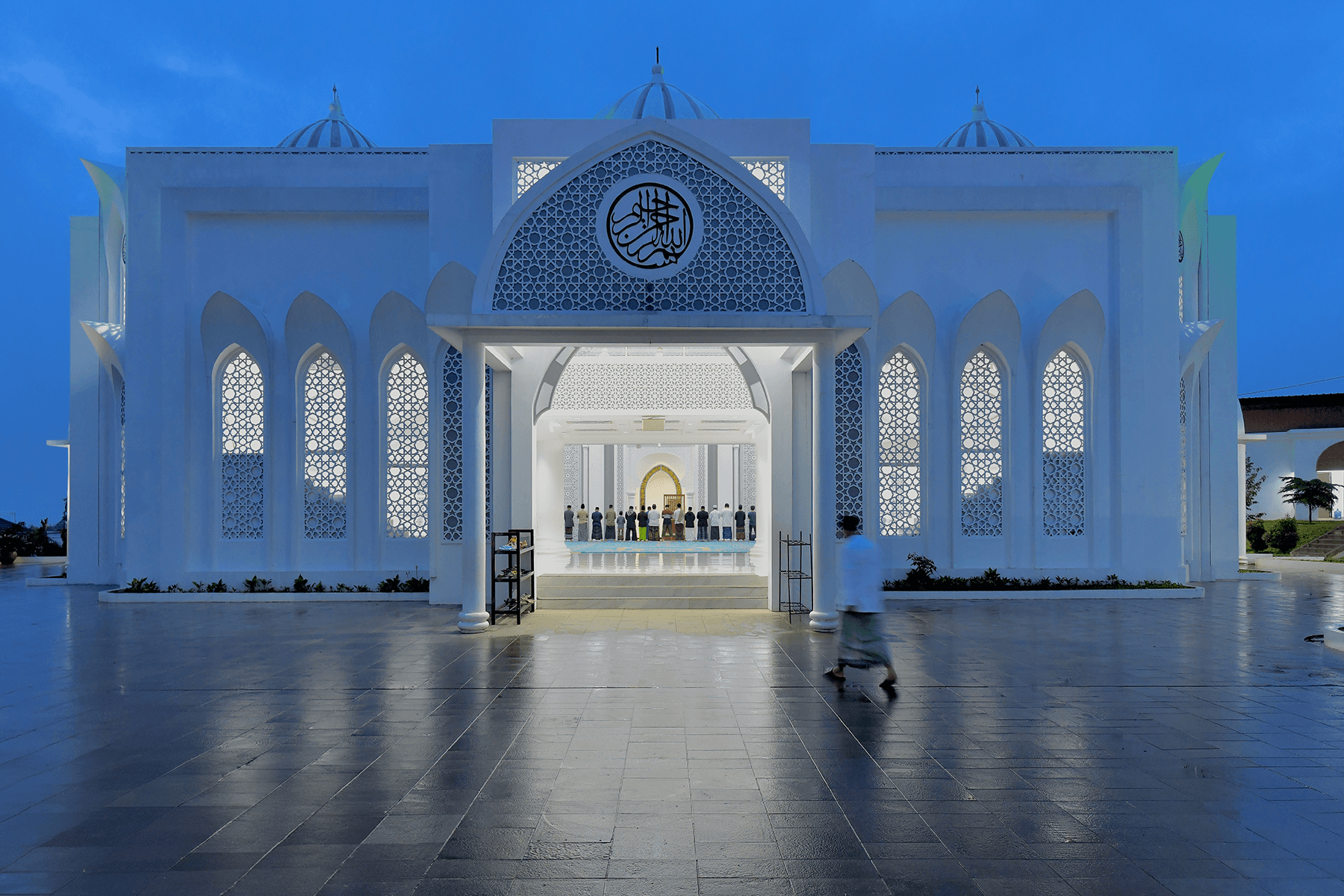
Our cities and architecture are spaces in which our social identity and existential orientations become concretized. Today, the salvation of Islamic cities does not lie in constructing kitsch shopping malls or imitative buildings squeezed between glass skyscrapers—products of capitalist aesthetics—with Seljuk or Ottoman motifs superficially attached to their façades. In architectural theory, Critical Regionalism, as conceptualized by Kenneth Frampton[3], offers a universal perspective for overcoming this impasse: while making use of the possibilities offered by global technology, it calls for fidelity to the spirit of place (genius loci), climate, light, and local materials.
The genius of the Egyptian architect Hassan Fathy[4], who reinterpreted earth and local adobe architecture in response to modern housing needs, or the achievement of Pritzker Prize-winning architect Tadao Ando[5], who brought the traditional Japanese conception of space to global recognition through an ultra-modern material such as exposed concrete, represent some of the most concrete successes of this method.
The essence of Islamic architecture lies in the cosmic balance established among the human being, nature, and the Creator. The solution is to synthesize this philosophy with contemporary green building technologies, sustainable architectural practices, and models of horizontal urbanization. We must urgently develop an eco-Islamic philosophy of the city—one that prioritizes privacy in space, simplicity free from ostentation, functionality, and respect for the environment, and that does not overwhelm the human being—and integrate it into urban planning regulations.
3. A Two-Winged Model in Art Education
There is a need for a radical decolonization and reform of curricula in our art academies, faculties of design, and the general education system. The current educational system either trains the artist entirely within the paradigm of Western-centered art history, or transmits the traditional arts merely as forms of craft imitation through the master–apprentice relationship. This situation produces a one-winged artist profile—one that, by definition, is unable to fly.
Today’s Muslim artist must learn the discipline of the Bauhaus, the courage of the avant-garde, and the production tools of the digital age, while at the same time rethinking Ibn al-Haytham’s theory of vision and Ibn ʿArabī’s horizon of the ʿālam al-mithāl—the imaginal world. Only such a two-winged intellectual formation can give rise to a generation of artists who are not defensive toward their own tradition, who do not imitate the global language of art, and who are capable of offering the world an original aesthetic proposition.
Conclusion: A New Word to Offer the World
The Islamic world’s search for identity cannot be explained solely through geopolitical maneuvers, military strategies, or indicators of economic development. These are undoubtedly important; however, a lasting civilizational breakthrough can only arise in societies capable of establishing their own distinctive aesthetic language and rendering it meaningful on a universal scale. A society that cannot construct its cultural independence on the aesthetic plane, no matter how economically powerful it may become, will often be unable to move beyond living out the dreams of others.
Today, humanity is experiencing a global aesthetic drought and crisis of meaning under the homogenizing pressure of mass production and the grip of digital alienation. Young people no longer wish merely to consume; they want to become part of stories that are in harmony with the environment, possess a soul, and carry high ethical and aesthetic value. If the Islamic world can regenerate, through the possibilities of the modern age, the profound consciousness of tawḥīd—unity and wholeness—and tanāsub—cosmic harmony—embedded in its roots, it will not only overcome its own internal crises, but also breathe fresh and revitalizing life into a modern world that is itself undergoing a global crisis of meaning and aesthetics.
References
[1] Burckhardt, T. (2013). İslam sanatı: Dil ve anlam [Islamic art: Language and meaning]. Klasik Yayınları.
[2] Nasr, S. H. (2024). İslam sanatı ve maneviyatı [Islamic art and spirituality]. İnsan Yayınları.
[3] See Frampton, K. (1983). Towards a critical regionalism: Six points for an architecture of resistance. In H. Foster (Ed.), The anti-aesthetic: Essays on postmodern culture (pp. 16–30). Port Townsend, WA: Bay Press.
[4] Fathy, H. (1973). Architecture for the poor: An experiment in rural Egypt. Chicago: University of Chicago Press.
[5] Frampton, K. (1991). Tadao Ando. New York: The Museum of Modern Art.
*Opinions expressed in this article are the author’s own and do not necessarily reflect Platform: Current Muslim Affairs’ editorial policy.