























(The original Turkish version of this article was published by the Platform: Current Muslim Affairs on July 27, 2026)
Today, we are witnessing a major societal transformation rooted in language, culture, and communication. At the center of this transformation lies the evolution of mass media into public spaces in which individuals can spend extended periods of time. Indeed, people today devote a significant portion of their waking hours to social media platforms.[1]
The emergence of new mass communication networks as alternative public spheres has paved the way for the formation of a new market. Moreover, since this space enables individuals to be simultaneously present in both the virtual and real worlds without severing ties with everyday life, it has generated the profit and motivation that the market seeks. Social media networks are, in effect, engaging in a form of global stock market speculation based on the number of minutes users spend daily within their platforms. When a modest share of the generated economic value is offered to users, they voluntarily begin to invest more of their time, thereby causing the market to organically produce its own labor force.
The new forms of communication[2] produced by the internet were, at their inception, clearly distinguishable from real life. The concept of the “virtual world” served to demarcate the real from the unreal. However, social media operates according to a logic that increasingly permeates everyday life, merging with it, generating new forms that are inseparable from daily existence, and rendering our lives dependent upon them. Since this transformation is driven and sustained by market forces[3], the distinction between the virtual and the real gradually dissolves- to the point where the boundary between the two becomes altogether meaningless.
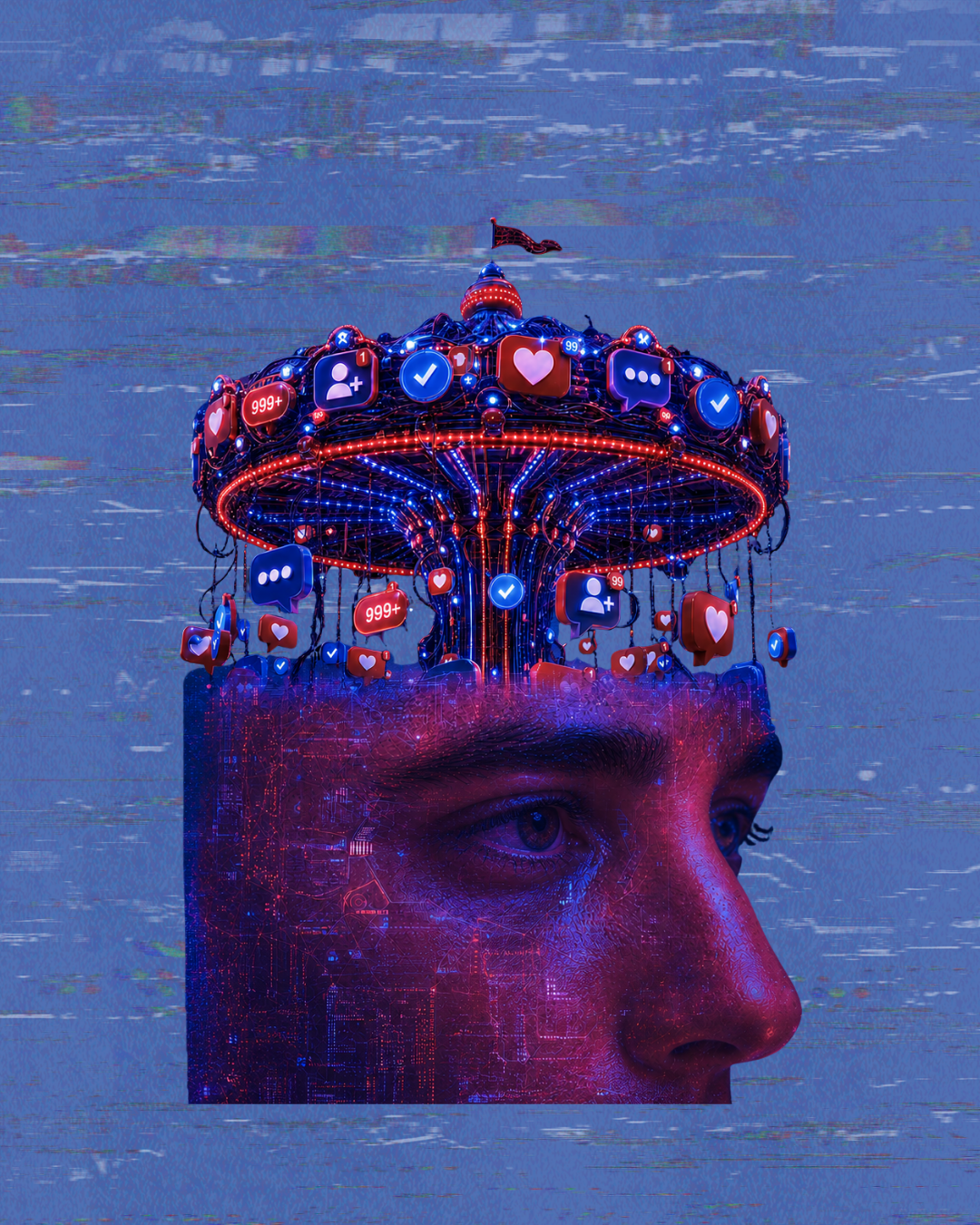
In order to better comprehend the form of language, culture, and communication that is increasingly coming to dominate the world we inhabit, it is apposite to draw upon Mikhail Bakhtin’s concept of the carnivalesque. Bakhtin’s notion of the carnivalesque is inspired by the carnivals of the Middle Ages. In these carnivals, people were temporarily liberated from the rigid rules of everyday life; peasants could mock the nobility, and social hierarchies could be briefly inverted. During a carnival, the norms of daily life are suspended – masks are donned, jesters take the place of kings, social hierarchies are turned upside down, and the public square resounds with laughter. Yet when the day draws to a close, the square returns to its former state; the carnival ends, and the rules of everyday life resume their operation.
While social media may appear to mirror Bakhtin’s carnival in every respect, it is distinguished by two defining characteristics. Whereas the real carnival has an end, social media is timeless – the carnival never concludes. And whereas the real carnival is confined to the public square, social media transcends the boundaries of physical space. The carnival continues at every moment and in every place. Nevertheless, the carnivalesque features described by Bakhtin, which constitute the foundation of the forms of language, culture, and communication addressed in the introduction of this paper, retain their validity to this day.
In the carnival, the world is turned upside down. Hierarchy is dismantled – indeed, inverted. A social media influencer who holds the position of a research assistant may speak of a professor who once gifted them a book in the following terms: “I haven’t read the book, but I know the professor – I’m sure it’s good. For that reason, I have no doubt it is a successful work.” The publishing house that released the book may then share this remark as promotional material. Let us assume that this particular incident never took place. And yet, does not the mere possibility of such an occurrence already invert the relationship between the two individuals? Perhaps it is for this reason that, if one has a modest following on social media and visits a restaurant to film a video, one is likely to be served generously- or that a police officer who pulls one over may treat one with considerably more courtesy than usual.
The number of followers determines one’s position within the carnival, and this number is not accumulated through likes but through engagement. The ability to generate engagement is a skill acquired through mastery of the carnival’s language. This language is embedded, for instance, in the confrontational and gossipy tone of a YouTuber who dons academic robes, in the popular historical storytelling of historians, in the clickbait practices of journalists, in the staged stumbles of vloggers, in the sudden catcalling of a woman exercising in the park, or in a veiled influencer accidentally exposing her foot. This language is part of, or indeed has produced, a culture in which a person deliberately commits a wrongdoing, is subsequently subjected to public lynching in the comments, then makes a yet more self-serving statement declaring “I’ve been lynched,” only to be lynched again until the incident fades from public memory. The existence of individuals who profit in direct proportion to the volume of abuse directed at them, given that every insult posted in the comments is converted into economic value, renders the carnival not merely entertaining but dangerous. Carnival masks are no longer necessary, for our real faces have themselves become masks. Are the ostensibly spontaneous videos of an influencer who daily surprises her husband with a particular behavior, such as acting in a stereotypically masculine manner, genuinely spontaneous? Or has she transformed her own face into a mask, her home into a stage, and her conduct into a performance? All impropriety is concealed beneath the laughter of the carnival. Yet this is not the kind of laughter that provokes reflection while it amuses. It is a laughter that dissolves the boundaries between jest and reality, between seriousness and indifference, between the decorous and the indecent. If strangeness and incongruity generate comedy, then in this endless carnival, strangeness and incongruity themselves become things that must be continuously produced. In such a condition, the carnival’s laughter tears through the veil of seriousness and instills within us a shrugging indifference-a disposition that compels one to seek the absurd dimension of everything that occurs in real life, and to introduce an incongruous element even into the most grave of matters.
As I have previously noted, social media and real life are becoming increasingly intertwined, each producing the other, and the language, culture, and modes of communication of social media are progressively permeating everyday existence. In this era, a young man in a blue shirt may be lynched without cause; a young man who has committed a crime may be acquitted by public opinion simply because society deems him justified; a person trapped under rubble following an earthquake may be called on their phone and mocked. If one amasses a sufficiently large following on social media, one may be hired for a job, absolved of a crime, obtain something for free, or even be elected mayor of a city. As one’s fame grows, so too does one’s capacity for influence. Trump, for instance, may make a joke, and by virtue of that joke, thousands of small investors on the stock market may be ruined.
What we are witnessing here is, in fact, what Baudrillard sought to articulate through his concept of simulation, namely, the interpenetration of the real and the virtual. In my view, within our present context, the violation of reality manifests in three distinct forms. The first is that something presented on social media as real may in fact be fictitious. This is the most rudimentary and innocent form of such interpenetration. The second is that, because this fiction is well-received, a practice from real life may be deliberately constructed as fiction for social media consumption. For instance, a person may intentionally arrive late to an examination they consider inconsequential, fabricating a sense of grievance at the door, filming the entire process, and subsequently going “viral”, thereby gaining followers. The third is that, through artificial intelligence, something that never existed can be produced entirely from nothing. All three of these conditions are occurring in the present day, or at the very least, their occurrence cannot be denied. If that is the case, then which of the images we encounter on social media are “genuinely” real? Furthermore, if a person with whom you are arguing in traffic is simultaneously filming the incident, can their speech, tone, manner of argumentation, choice of words, decisions, and, in short, their entire mode of communication with you be considered real, or is it a simulation? Consider, moreover, that this individual is a social media influencer who rides motorcycles. Can you be certain that they will not deliberately collide with you in order to provide their followers with compelling content? If we cannot answer these questions in the negative, then the wall between reality and simulation has effectively collapsed. Just as in “Cake or Fake”, where we cannot distinguish whether an everyday object is a cake or the real thing, we are increasingly losing our ability to differentiate the real from the fabricated, both on social media and, gradually, in real life itself.
In this analysis, I argue that social media is increasingly permeating the world we inhabit, and that in doing so, it is injecting into real life the carnivalesque language, culture, and modes of communication that define it. I further contend that this process will continue to expand, given that the conversion of everyday practices into a carnival atmosphere generates economic value. Moreover, what we once thought would simply end when we deactivated our accounts has now escaped our control entirely – whether or not we are present on social media, it continues to shape and distort reality. I believe the principal reason for this lies in the aforementioned conversion value and in the inescapable ecosystem that has emerged with Web 4.0. For instance, when a person wishes to reach a mass audience with a piece of writing drawing attention to the dangers of social media, there are very few, if any, alternatives outside of social media itself. The moment an idea enters circulation, it can be rapidly consumed as carnival content. If this trajectory continues, we will find ourselves living not in a carnival within the world, but in a world within the carnival.
Bibliography
[1] For further details, see We Are Social Report.
[2] In this article, the term “communication” refers not to the mere transmission of emotions and thoughts between individuals, but to all forms of interaction that a being establishes with the world.
[3] By “market,” I refer not solely to global social media corporations, but to the entire economy generated by the multifaceted impact of social media on real life. A vlogger who earns income by filming videos, the consumer electronics company that advertises through that vlogger, and the individual who purchases a product after watching the content are all participants in this market and, being beneficiaries of the new form that has emerged through the intersection of the virtual sphere and real life, they actively contribute to its reproduction.
*Opinions expressed in this article are the author’s own and do not necessarily reflect Platform: Current Muslim Affairs’ editorial policy.

