




















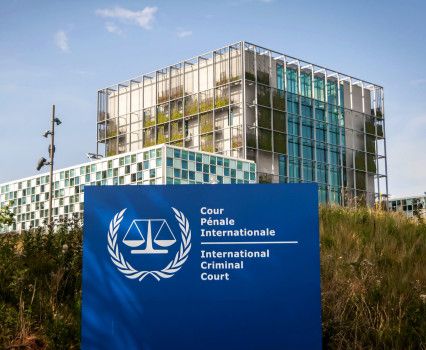
The International Criminal Court (ICC) is an independent international judicial body based in The Hague, established under the Rome Statute adopted in 1998 to try individuals for genocide, crimes against humanity, war crimes, and the crime of aggression. Today, 125 countries are party to the Rome Statute.
Recently, the suspension of ICC Chief Prosecutor Karim Khan reignited debate in the international community. Khan had applied to the Pre-Trial Chamber for arrest warrants against Israeli Prime Minister Benjamin Netanyahu and then-Defense Minister Yoav Gallant; the Chamber found the submitted evidence reasonable and approved the decision. However, Khan’s suspension right after this critical move brought serious questions regarding the legal and political dynamics behind the process.
Prosecuting Individuals, Not States
To understand the ICC, it is first necessary to clarify what it is not. The court is often confused with the International Court of Justice (ICJ), one of the principal organs of the UN. However, while the ICJ deals with disputes between states, the ICC directly prosecutes individuals.
Established by the Rome Statute, the court’s jurisdiction is limited to four core crimes: genocide, crimes against humanity, war crimes, and the crime of aggression.
The court’s core operational rule is “complementarity.” The ICC does not replace national judicial systems; it steps in only as a last resort when a state is unwilling or unable -due to a collapsed domestic judicial system- to prosecute these crimes internally.
Sanctions Decisions Against the ICC
Amidst all this geopolitical storm, the turmoil surrounding Chief Prosecutor Karim Khan -who drew widespread attention by requesting arrest warrants for Netanyahu and Hamas leaders- stood out.
Misconduct allegations against Khan laid bare internal fractures within the institution. Khan’s removal dealt a heavy blow to the court’s already delicate image of impartiality and credibility. The perception that critical cases were being overshadowed by political pressure became evident in statements by US officials and previous sanction decisions targeting ICC personnel.
Khan’s removal occurred when tensions between the court and the US administration reached a peak. Following the arrest warrants for Israeli officials, including Netanyahu, and ongoing investigations into US personnel actions in Afghanistan, US Secretary of State Marco Rubio declared the ICC “a direct threat to US sovereignty” and announced a comprehensive campaign against the court. Rubio indicated that aggressive steps would be taken, such as forcing member states to withdraw from the Rome Statute, sanctioning entities cooperating with the court, and barring ICC employees from entering the US. Furthermore, he stated that pressure would be exerted on allied nations benefiting from the US security umbrella not to recognize the court’s jurisdiction over US citizens. Following these statements, Khan and 12 ICC officials were placed on sanction lists.
Under the principle of territoriality, the fact that the US is not a party to the Rome Statute does not mean its citizens are completely immune from this judicial process. The commission of the alleged crimes within the territory of an ICC member state is considered a sufficient basis for establishing the court’s jurisdiction.
To What Extent Does the ICC Deliver Global Justice?
Whether an institution where major global and regional powers like the US, China, Russia, and Israel are not even parties can truly be “universal” has always been a subject of debate. For many years, the ICC faced criticism for producing “Western-centric selective justice,” as it predominantly prosecuted deposed leaders and warlords in Africa.
While the Gaza decisions carried the potential to break this perception, the court remains trapped in a major crisis due to its lack of enforcement mechanisms, double standards among member states, and internal scandals. Designed on paper as the representative of the global conscience, in practice, the court unfortunately cannot escape appearing as an institution that dispenses justice only within the boundaries permitted by major powers.