
































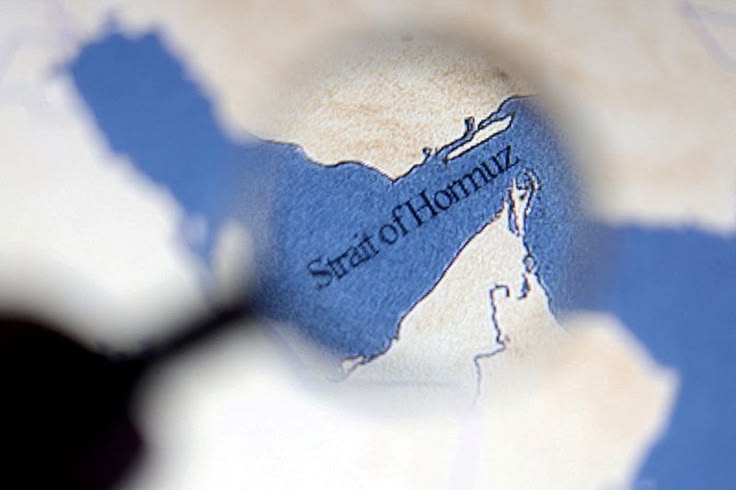
Today, the Strait of Hormuz is frequently mentioned in discussions ranging from global energy markets and evening news broadcasts to international relations and geopolitical analyses. It has become an even more prominent topic in recent weeks due to Iran’s threats to close the strait and the escalating military tensions across the region.
What Is Happening in the Strait of Hormuz?
The Strait of Hormuz is the only maritime passage connecting the Persian Gulf to the Gulf of Oman and the open ocean. Iran borders its northern coastline, while Oman and the United Arab Emirates lie to the south. Although the strait is only about 33 kilometers (21 miles) wide at its narrowest point, this small corridor is one of the world’s most strategically important trade routes.
Following the outbreak of conflict sparked by the joint U.S.–Israeli strikes, Iran moved to disrupt shipping through the Strait of Hormuz—the heart of the global energy network. In the immediate aftermath, oil prices surged dramatically, rising by as much as 65 percent compared with pre-conflict levels.
Is It Merely a Commercial Waterway?
Not at all. The Strait of Hormuz is regarded in geopolitics as a chokepoint—a narrow passage through which global trade and energy supplies must pass and for which there are very few viable alternatives. Any disruption to traffic through the strait can quickly create severe consequences for the global economy.
Why Is the Strait of Hormuz So Important?
The strait’s strategic significance stems primarily from oil and natural gas. It serves as the principal export route for some of the world’s largest energy producers, including Saudi Arabia, Iraq, Kuwait, the United Arab Emirates, and Iran.
Approximately one-third of the world’s seaborne oil trade and around 20 percent of global oil consumption pass through the Strait of Hormuz every day—equivalent to roughly 20–21 million barrels of oil daily.
Qatar, one of the world’s leading exporters of liquefied natural gas (LNG), also relies almost entirely on this passage to reach international markets.
Although a limited number of pipelines bypass the strait, their capacity falls far short of replacing the enormous volume of energy transported through Hormuz.
Why Is It Receiving So Much Attention Today?
The Strait of Hormuz has once again become the focus of international attention because of rising geopolitical tensions and the growing threat of asymmetric warfare in the region.
As the country controlling the northern coastline of the strait, Iran has repeatedly used the possibility of closing Hormuz as both a diplomatic and military bargaining tool during periods of confrontation with Western powers and regional rivals. In recent years, regional conflicts, drone attacks on commercial vessels and oil tankers, ship seizures, and retaliatory actions have turned the security of the strait into a matter of global concern.
Even a limited military incident in the area has the potential to trigger sharp increases in global oil prices, fuel worldwide inflation, and create energy shortages capable of disrupting industrial production. For this reason, the Strait of Hormuz is not merely a regional issue—it is a geopolitical flashpoint closely monitored by major powers from Washington to Beijing.
In Brief
The Strait of Hormuz is one of the world’s most critical energy corridors, playing a decisive role in the stability of the global economy. Power struggles surrounding this narrow waterway affect not only the countries bordering it but also fuel prices, inflation, financial markets, and the daily lives of people around the world.
For a more in-depth perspective on this issue, see Feyza Gümüşoğlu’s comprehensive analysis: Security, Fragility, and the Search for a New Equilibrium in the Gulf Following the Iranian Attacks