



















(The original Turkish version of this article was published by the Platform: Current Muslim Affairs on June 27, 2025)
These words are an excerpt from a speech delivered by US President Trump in Saudi Arabia on May 13 during his tour of Gulf countries. Although Trump’s decision to lift American economic sanctions on Syria had been a subject of debate, no one expected such a step from the US in the short term. Aside from the lingering impacts of destruction wrought by 13 years of civil war, considering the collapsed state authority, the new Damascus administration faced countless short-term economic challenges to overcome. Therefore, the lifting of US sanctions deserves to be examined as a significant development directly impacting these issues.
This article examines the historical nature of economic sanctions against Syria from past to present, the foundations of the Trump administration’s emerging new Syria policy, the new foreign policy principles of the new Syria through the process leading to the decision to lift sanctions, and Israel’s approach toward Syria, which conflicts with Trump’s policies. By bringing all these elements together, this article aims to present a more comprehensive framework regarding the new Syria.
The Content of Sanctions Against Syria
The economic sanctions targeting Syria consist of numerous decisions enacted particularly as a result of the Assad regime’s systematic violence and massacres against civilians during the civil war that began in 2011. Alongside United Nations (UN) sanction resolutions, European Union (EU) and US sanctions targeted both elements of the Assad regime individually and the Syrian state as a whole. Therefore, it is possible to divide the sanctions against Syria into two categories: sanctions targeting the Assad regime and sanctions targeting the Syrian state.
The American economic sanctions—the subject of this article—began in 1979 when the US placed Syria on the “State Sponsors of Terrorism” list (“From Assad to,” 2025). Thus, the first feature distinguishing US sanctions from others is that, because they predate the civil war, they reflect the US policy aimed at isolating Syria within the international system. Hence, beyond its economic ramifications, Trump’s decision to lift sanctions can politically be interpreted as a sign of the changing US approach.
Secondly, the Caesar Act—the most prominent of the US economic sanctions—differed from other sanctions in that it targeted not only the regime and Syria, but also third countries and international corporations entering into economic relations with individuals and entities subject to sanctions (Tabler & Zweig, 2023). This prevented countries and companies cautious of falling subject to US sanctions from establishing economic ties with the Assad regime due to the Caesar Act. However, following the collapse of the Assad regime and the establishment of the new Damascus administration, these sanctions turned into an obstacle to Syria’s economic development and reconstruction. In other words, with the elimination of the Assad regime, while sanctions targeting regime elements became redundant, sanctions directly targeting Syrian state institutions turned into a factor negatively affecting the new Syria. Trump’s decision to lift economic sanctions, besides arising from this political and economic environment and carrying immense significance for Syria’s reconstruction and escape from diplomatic isolation, also offers key insights into the Trump administration’s Syria policy.
With the elimination of the Assad regime, while sanctions targeting regime elements became redundant, sanctions directly targeting Syrian state institutions turned into a factor negatively affecting the new Syria.
Syria’s Place in Trump’s World
It can be argued that the Trump administration’s newly forming Syria policy runs parallel to Donald Trump’s broader foreign policy vision, world view, and approach to the use of US military force abroad in his new presidential term. In addition to his bold statements during his November victory speech regarding competition with China, the war in Ukraine, and relations with Europe, Trump emphasized that he would be “a president who stops wars, not starts them” (Nicholls, 2024). Rather than a pacifist or peace-loving ideological stance, these ideas point to an approach asserting that the unnecessary deployment of American military power imposes severe economic and political costs on the US. Accordingly, under the Trump administration, the US should step back from Cold War-relic alliances like NATO—where Europe’s security is underwritten by the US—as well as Middle Eastern regime-change approaches like the invasion of Iraq that seek regional dominance through military force. This manifests in Trump’s promise to end the war in Ukraine, his warnings to NATO members to increase military spending, and his demand for Israel to end the war in Gaza. The core objective of this line of thought is to free the US from unnecessary military interventions and the costs of engaging in secondary regions, allowing it to focus on the Asia-Pacific and ultimately pivot toward competing with China. Consequently, Syria’s significance (or insignificance) for Trump stems directly from this logic.
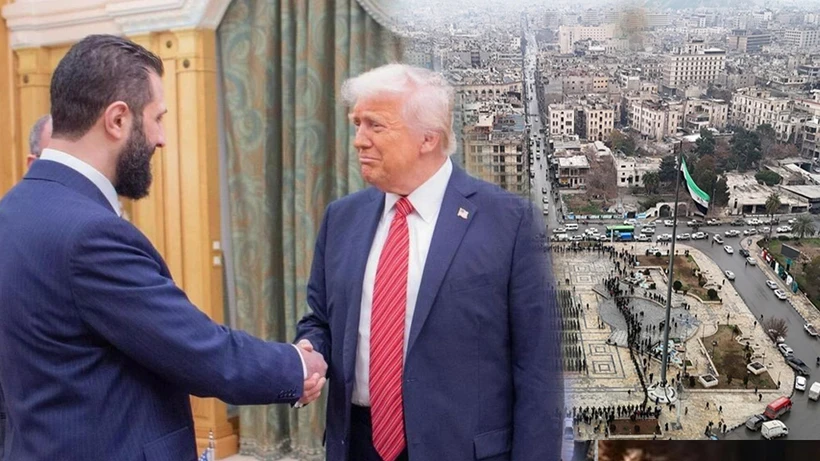
Trump’s stance against general American military interventionism, and specifically against interventionist policies in the Middle East and Syria, can be supported by several examples demonstrating his struggle against hawkish, interventionist approaches prevalent among the American political elite, such as “Neoconservatism”[1]. His declaration during his Saudi Arabia visit that the US would no longer lecture regional countries on how to live (Nereim, 2025), alongside statements from his appointed Ambassador to Ankara, Barrack, highlighting how extraterritorial interventions via the Sykes-Picot Agreement destabilized the region (“US Ambassador,” 2025), demonstrate that the Trump administration has adopted an anti-interventionist policy. Furthermore, Trump’s dismissal of Waltz and other “hawkish” or “neocon” foreign policy team members who worked closely with Netanyahu toward military intervention in Iran (Mathews, 2025a) illustrates that he is translating these ideas into practice. Finally, while advisers suggested assassinating Syrian President Sharaa prior to his Saudi Arabia visit (Mathews, 2025b), Trump did the exact opposite: he lifted sanctions against Syria and met Sharaa face-to-face—a key indicator symbolizing a rupture with traditional American policy. Additionally, the great power competition between the East and West likely influenced Trump’s decision to lift sanctions (Cafiero, 2025). The risk of Russia and China capturing a dominant role in Syria’s reconstruction may have contributed to Trump taking the step to lift sanctions.
On the other hand, Trump’s push to pull the US into an anti-interventionist stance, combined with the fact that the figures he opposes in his struggle with the American political elite are staunchly pro-Israel, creates accumulating tension in US-Israel relations. Compounded by personal friction between Trump and Netanyahu, US Middle East and Syria policy is drifting away from the comfort zone Israel traditionally enjoyed. However, forecasting the exact limits of this rupture remains difficult at present. While it is impossible to draw exaggerated conclusions such as the US abandoning its special relationship with Israel, it is appropriate to state that Trump’s regional and global vision collides with that of Israel and Netanyahu.
Israel Resists Adapting to the New Reality
The Syrian Revolution on one hand, and Trump’s departure from traditional American Middle East policies on the other, have pushed Israel—which benefited from both the Syrian civil war and traditional US policies—into a position where it is relatively more uncomfortable. For Israel, the ideal scenario in American Middle East policy was one where US troops maintained a regional presence ensuring Israeli security, while simultaneously launching military interventions against regimes and countries perceived as threats by Israel. For Israel, the ideal Syria was a fragmented Syria with a weak Damascus government, lacking central state authority, possessing low military capabilities, and thus posing no military threat to Israel. Trump’s foreign policy vision and Middle East approach outlined in the previous section, coupled with the fall of the Assad regime and Trump’s lifting of sanctions on Syria, represent a defeat for Israel precisely for this reason. When adding recent reports that Israel lobbied in the US against lifting sanctions on Syria (Gebeily & Pamuk, 2025), it becomes clear that developments are unfolding far from Israel’s ideal scenario.
Israel’s distorted threat perceptions manifested as supporting YPG terrorism in Syria to divide the unitary state structure, destroying military capabilities remaining from the Assad regime that previously posed no threat to it, and expanding its occupation around the Golan Heights under various pretexts.
However, it is evident that Israel resists adapting to this new equation, continuing its attacks against Syria’s stability and territorial integrity as a result. In this context, Israel’s distorted threat perceptions have manifested as supporting YPG terrorism in Syria to divide the unitary state structure, destroying military capabilities remaining from the Assad regime that previously posed no threat to it, and expanding its occupation around the Golan Heights under various pretexts. Yet, several developments are shrinking Israel’s comfort zone in Syria: Turkey’s support for the Damascus administration, Damascus’s negotiations with the SDF, the gradual withdrawal of US military presence in Syria, and finally, the establishment of an anti-ISIS coalition partnered by Turkey, Syria, Iraq, Jordan, and Lebanon. The US military withdrawal process weakens the SDF’s leverage in negotiations while rendering it impossible for Israel to unilaterally sustain support for the SDF within its framework of a divided Syria vision. Meanwhile, the anti-ISIS coalition provides regional support to Damascus in counter-terrorism while enabling a Turkish military presence around Damascus, further constraining Israel’s maneuverability. Nonetheless, the Netanyahu government’s insistence on resisting this new reality threatens Syria’s stability and inflames Turkey-Israel rivalry. In short, Israel claiming to be concerned about terror threats emanating from Syria on one hand, while continuously launching air and ground strikes against Syria on the other, can be described as a “policy of a self-fulfilling prophecy” (Lister, 2025).
New Syria, New Foreign Policy
The US decision to lift sanctions undoubtedly carries immense significance for Syria. As previously emphasized, because US sanctions—unlike others—threatened state actors and private companies doing business with Syria, no significant economic development occurred in post-revolution Syria during its first six months. Therefore, major progress will follow the lifting of sanctions. One of the earliest signals of this is a $7 billion agreement signed with a Qatar-based consortium that includes Turkish and American companies (Alkousaa, 2025). Under this agreement, investments in Syria aim to significantly meet the country’s electricity demands. Similar deals are expected to be implemented rapidly in the coming period. However, lifting sanctions does not mean Syria will fall under American and European influence economically and politically; rather, it indicates Syria’s integration into the international economy and global politics. In other words, beyond contributing to Syria’s reconstruction, lifting sanctions will provide massive backing to the authority of the Damascus administration in both domestic and foreign policy. Considering that the EU followed the US in lifting sanctions, alongside claims that Sharaa will deliver a speech at the UN General Assembly in New York in September, Syria has clearly entered a trend of rapid integration into the international system. Although the new Syria’s foreign policy prioritizes establishing ties with all actors and gaining international recognition, Turkey and Qatar stand out given their policies during the civil war and their support during the revolution. Considering the Damascus administration’s efforts to establish relations even with Russia—the Assad regime’s biggest supporter since the 1970s, which carried out countless military strikes against the opposition during the civil war—Sharaa’s meetings with Trump and European leaders should be read not as growing Western influence, but as the new Syria’s quest to break free from the constraints of Assad-era foreign policy.
Politically, Trump’s decision to lift sanctions means the US will not use sanctions as leverage against the new Damascus administration regarding the Abraham Accords or the SDF.
In addition to all this, it should not be forgotten that executing Trump’s decision to lift sanctions against Syria will take time. Because the Caesar Act was passed as legislation by the US Congress, repealing these sanctions requires Congressional approval following an executive order signed by Trump. However, during the approval process, the implementation of sanctions will be paused thanks to exemptions and waivers issued by the Trump administration. Thus, even though the legal process will take time, sanctions can be considered lifted following Trump’s statements and executive order. As for the US administration’s demand for Syria to join the Abraham Accords, this will be a subject of subsequent negotiations and diplomatic relations established with the Damascus government, rather than part of the sanctions lifting process itself. In short, politically, Trump’s decision to lift sanctions means the US will not use sanctions as leverage against the new Damascus administration regarding the Abraham Accords or the SDF. Therefore, negotiations on these topics will conclude based on the performance demonstrated by the Damascus administration throughout the process.
In conclusion, Trump’s decision to lift sanctions on Syria can be seen as a major victory for Syria and its allies, notably Turkey (Şensoy, 2025). On the other hand, considering Trump’s approach to Middle East policy and priorities that conflict with Israel behind this decision, it signals developments that transcend Syria. The Trump administration has moved away from using the PKK/YPG as a proxy war tool during the civil war, choosing instead to establish a local partnership with Damascus as a model of relationship capable of generating regional stability in the Middle East. The primary obstacle preventing Syria from “showing something very special,” as Trump put it, remains Israel with its expansionism and destabilizing interventions.
References
- Alkousaa, R. (2025, May 29). Syria signs $7 billion power deal with Qatar’s UCC Holding-led consortium. Reuters. https://www.reuters.com/business/energy/syria-signs-7-billion-power-deal-with-qatars-ucc-holding-led-consortium-2025-05-29/
- Cafiero, G. (2025, May 14). Trump’s wise, bold Syria reset. Responsible Statecraft. https://responsiblestatecraft.org/trump-syria/
- Gebeily, M., & Pamuk, H. (2025, February 28). Israel lobbies US to keep Russian bases in a ‘weak’ Syria, sources say. Reuters. https://www.reuters.com/world/israel-lobbies-us-keep-russian-bases-weak-syria-sources-say-2025-02-28/
- Lister, C. (2025, June 4). Rocket attack triggers Israeli retaliation in Syria & fears of self-fulfilling prophecies. Syria Weekly. https://www.syriaweekly.com/p/rocket-attack-triggers-israeli-retaliation
- Mathews, S. (2025a, May 14). Trump fires slew of pro-Israel officials in America First ‘course correction’. Middle East Eye. https://www.middleeasteye.net/news/trump-fires-slew-pro-israel-officials-america-first-course-correction
- Mathews, S. (2025b, May 14). Jordan’s King warned US against assassinating Syria’s Sharaa before Trump meeting. Middle East Eye. https://www.middleeasteye.net/news/jordans-king-warned-us-against-assassinating-syrias-sharaa-trump-meeting
- Nereim, V. (2025, May 14). Trump’s pledge to the Middle East: No more ‘lectures on how to live’. The New York Times. https://www.nytimes.com/2025/05/14/world/middleeast/trump-middle-east-nation-building.html
- Nicholls, Flynn. (2024, November 6). Donald Trump’s victory speech in full: Transcript. Newsweek. https://www.newsweek.com/donald-trump-victory-speech-full-transcript-1981234
- US Ambassador Barrack: Syria will not be divided (What is the Sykes-Picot agreement?) (2025, May 26). NTV. https://www.ntv.com.tr/dunya/abd-buyukelcisi-barrack-suriye-bolunmeyecek-sykes-picot-anlasmasi-nedir,ZmGnkTOKQ0mIMmQY2SIDjg
- Şensoy, A. A. (2025, May 15). Why is the lifting of sanctions in Syria important? Anadolu Agency. https://www.aa.com.tr/tr/analiz/suriyede-yaptirimlarin-kalkmasi-neden-onemli/3568598
- Tabler, A. J., & Zweig, M. (2023, June 17). How the Caesar Act restricts normalisation with Syria. The Washington Institute for Near East Policy. https://www.washingtoninstitute.org/policy-analysis/how-caesar-act-restricts-normalisation-syria
- From Assad to Alsharaa: Timeline of US sanctions on Syria (2025, May 14). TRT Global. https://trt.global/world/article/abdcecf7b1af
Footnote:
[1] Neoconservatism defines a political ideology that emerged in the US in the 1960s. According to this ideology, the US should play an active role in world politics, should not refrain from using military force, and specifically in the Middle East, should support Israel and conduct military interventions to “spread democracy” across the region. The most concrete example of this policy was the invasion of Iraq during George W. Bush’s presidency.
*Opinions expressed in this article are the author’s own and do not necessarily reflect Platform: Current Muslim Affairs’ editorial policy.