



















(The original Turkish version of this article was published by the Platform: Current Muslim Affairs on September 30, 2025)
Islamic cities, beginning with Mecca and Medina, expanded through conquests and developed a distinctive identity around religious centers and commercial life. While Western-style urbanization offers benefits through its rational order, Islamic urbanization provides a holistic understanding of the city grounded in spirituality, social solidarity, and harmony with nature.
When examining the settlement history of Islamic cities, it is seen that the first formations began in Mecca and Medina during the time of the Prophet Muhammad. Later, during the periods of the Four Caliphs, the Umayyads, and the Abbasids, Islamic urbanism continued to develop. Studies categorize Islamic cities into two groups: “cities founded by Muslims” and “cities conquered through expansion.” Examples of cities built by Muslims include Kufa, Fustat, Basra, Baghdad, and Samarra. Cities such as Mecca, Medina, Damascus, and Aleppo are among those acquired through conquest (Can, 1991: 19–59).
The first nuclei of Islamic urbanism are Mecca and Medina, also referred to as al-Haramayn (the Two Sanctuaries). These two cities are directly mentioned in the Qur’an. Regarding Mecca, the Qur’an states in Surah Ibrahim, verses 35 and 37: “And [My Lord] when Abraham said, ‘My Lord, make this city secure and keep my sons and me away from worshipping idols.’” and “Our Lord! Indeed, I have settled some of my descendants in an uncultivated valley near Your Sacred House, our Lord, that they may establish prayer. So make hearts among the people incline toward them and provide for them from the fruits that they might be grateful.” Likewise, in Surah Al-Baqarah, verse 126, Abraham prays: “My Lord, make this a secure city and provide its people, who believe in Allah and the Last Day, with fruits.” These verses highlight Mecca as a sacred city. The significance of Mecca lies in its being the location of the Kaaba, the first holy sanctuary built for the worship of Allah. Surah Al-Imran, verse 96, states: “Indeed, the first House [of worship] established for mankind was that at Mecca-blessed and a guidance for the worlds,” emphasizing the sacredness of Mecca and the Kaaba (Can, 1991: 19–21; Bozkurt & Küçükaşçı, 2003b: 555–563).
The city of Medina earned the title “the city conquered by the Qur’an” because it was the place where the Prophet and his companions migrated (Hijrah) and where the people willingly embraced Islam. The city’s original name was Yathrib, but after the establishment of Islam, it became known as Medina. It was primarily an agricultural settlement. After the migration, Medina developed into an urban center and became the capital of Islam during the Prophet’s time and the era of the Rightly Guided Caliphs. The Prophet Muhammad had a residence built in Medina alongside a mosque, known as Al-Masjid an-Nabawi (the Prophet’s Mosque). He lived there with his family, and his blessed tomb is also located within it. Over time, Al-Masjid an-Nabawi became the central point of the city. The Qur’an refers to Medina in Surah Al-Ahzab, verse 13: “And when a faction of them said, ‘O people of Yathrib, there is no stability for you here, so return [home]!’” It is known that the Prophet personally intervened in the urban planning and development of Medina (Can, 1991: 22–27; Bozkurt & Küçükaşçı, 2003a: 305–311; Karataş, 2013: 59–84).
The proverb “Sharafu’l-makān bi’l-makīn” — meaning “the honor of a place derives from the virtue and rank of the one residing in it” — aptly expresses that Mecca and Medina are the most sacred of Islamic cities because of the Prophet Muhammad’s presence and the existence of the Kaaba.
As Islam rapidly expanded beyond the Arabian Peninsula, new military encampment cities were established to support further conquests. These cities, initially founded by Muslims for military purposes, gradually transformed into permanent urban settlements. Cities such as Kufa, Fustat, and Basra were established as bases for the expansion into Bilad al-Sham, Iraq, and North Africa. Baghdad and Samarra, located in present-day Iraq and developed under the Abbasids, stand out as historically significant settlements in terms of organized urban planning within Islamic civilization. In other early Islamic cities such as Jerusalem, Damascus, and Aleppo, elements of Greek, Roman, and Byzantine urban traditions continued to some extent. Yet, these cities were imbued with an Islamic identity. Although Islamic cities retained some features of earlier civilizations and cultures where they were founded, they also developed distinctive characteristics of their own. Ancient roads and streets were often reused, while existing spaces and monumental buildings were converted into Islamic public structures (Can, 1991: 19–59; Can, 2005: 215–235; Çil, 2009: 87–106).
Just as Islamic urbanism possesses unique characteristics, it also shares certain features with other cultural traditions.
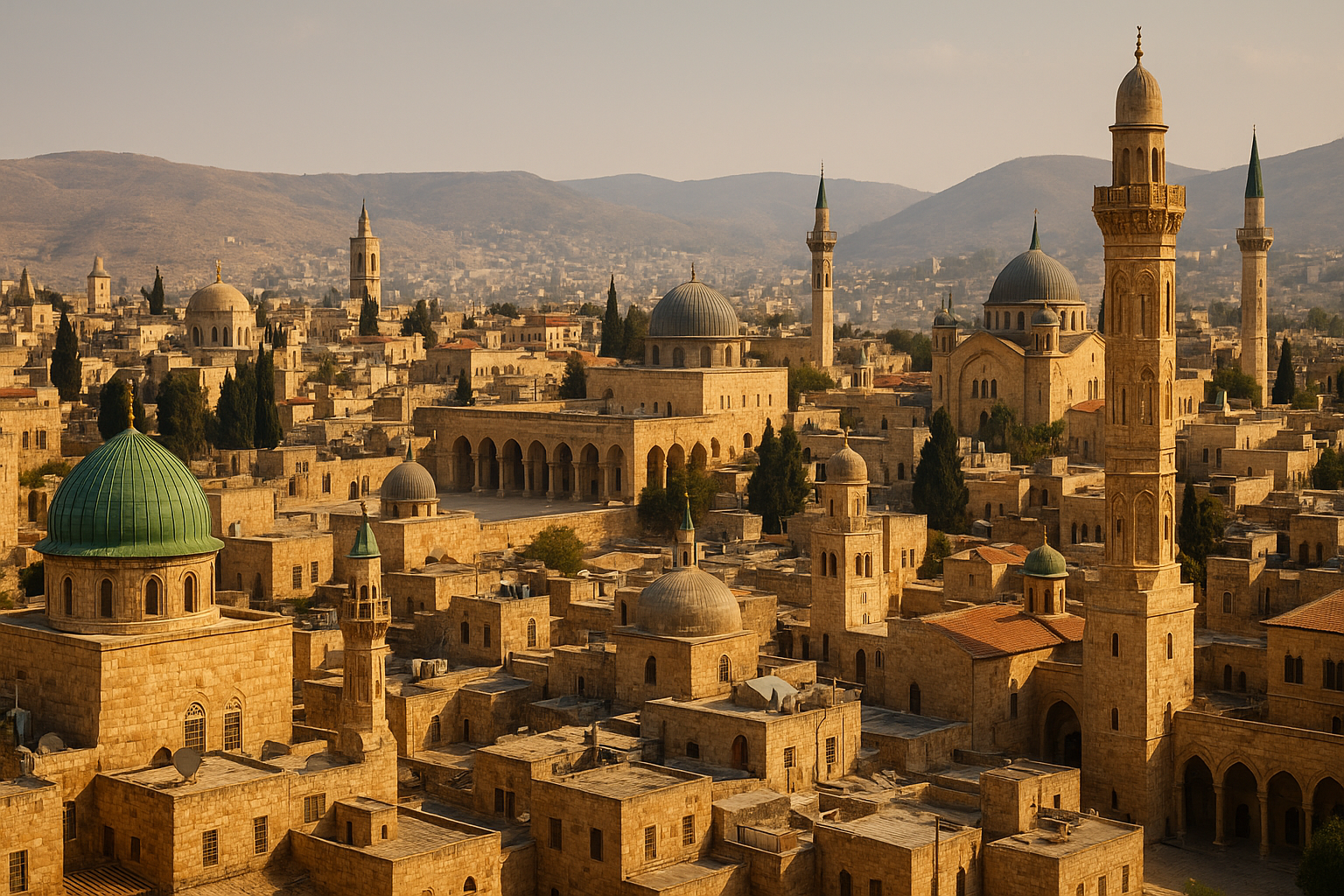
Islamic cities were typically entered through gates opening toward different directions or neighboring cities. Thus, city gates often bore names such as Tabriz Gate, Aleppo Gate, or Damascus Gate. The general population lived in the outer citadel, while the inner citadel housed the administrative center. At the city’s heart stood the Jami‘al-Kabir, or Great Mosque. In early Islamic urbanism, adjacent to the Great Mosque was the Dār al-Imāra—the residence and administrative headquarters of the caliph or ruler. The proximity of the Great Mosque and the administrative center symbolized the unity of religious and political authority.
Main streets in these cities typically converged on the city center, and minor roads branched from these primary avenues. Residential districts were organized along kinship or tribal lines. Depending on geographical conditions, the layout of streets and alleys varied. Moreover, reflecting an emphasis on privacy and protection, cul-de-sacs (dead-end streets) were common in Islamic cities. This design allowed residents to quickly notice strangers entering their neighborhood.
While the physical appearance of houses varied by climate and geography, the principle of privacy remained central. The presence of inner courtyards, in particular, allowed family members to move freely within the household without exposure to the public eye.
Social and economic life in Islamic cities was vibrant. Large bazaars were concentrated along the main streets, and specialized markets sold a wide range of goods. Distinct market districts existed for specific trades, such as book markets, textile markets, and date markets. In addition to local commerce, intercity trade diversified products and strengthened the economy, while also accelerating cultural exchange.
Public baths (hammams) served not only hygienic purposes but also social ones. They were essential spaces of daily life, especially for women, who would gather there on special occasions such as pre-wedding or postpartum celebrations. Cemeteries also occupied a significant place in Islamic urban planning. Although excessive sanctification of graves is disapproved of in Islamic jurisprudence, the construction of monumental tombs and shrines (turbes) contributed to the preservation of collective memory. In addition to major cemeteries, each neighborhood often had its own small burial ground (hazire).
To support social and intellectual development, various religious and educational institutions, such as maktabs, madrasas, tekkes, zawiyas, and khānqāhs, were built throughout Islamic cities. Different Islamic centers became renowned for their schools of religious and scientific thought and often engaged in scholarly competition. Beyond the Great Mosque, where Friday and Eid prayers were held, smaller neighborhood mosques also contributed to the spread of the call to prayer across the city (Can, 1991: 60–102).
The Effects of Western-Style Urbanization on the Urban Image and Identity of Muslim Societies
Western-style urbanization refers to the systematic and orderly city planning that emerged in Europe and North America after the Industrial Revolution. These cities emphasized well-structured road networks and infrastructure systems. Elements that facilitated daily life, such as water, electricity, sewage systems, and rail networks, contributed significantly to economic progress. Spacious squares, main avenues, and public buildings became essential features of urban design. In city centers, high-rise commercial buildings gained prominence. With industrial development replacing agricultural production and factories being established in cities, the working class emerged. Suburban neighborhoods built for workers and their families became integral parts of urban life. Industrialization also led to the formation of distinct social strata: upper, middle, and lower classes.
A review of urban history reveals that different typologies and patterns of urban organization have existed throughout time. Today, however, the metropolitan planning models pioneered by the Western world have spread globally. While the establishment of human-centered cities and the aesthetic design of urban spaces can create atmospheres that appeal to the human spirit, the capital-oriented nature of Western urbanization has gradually eroded the spiritual dimension of society. For Muslim communities, social spaces and buildings should be shaped in line with the hadith “Allah is beautiful and loves beauty.” The development of orderly streets, reliable infrastructure, cleanliness, and the facilitation of daily life are indeed consistent with Islamic principles of living.
The social class divisions that emerged in Western cities under capitalism represent a system incompatible with the Islamic worldview. Civilization, urbanization, and coexistence align with progress and religious life in Islam. However, instead of adopting the Western notion of hierarchical human classes, Muslim societies should be guided by taqwa (piety) and the Prophet’s saying, “The best of people are those who are most beneficial to others.” Urban designs featuring vast public squares, parks, and buildings detached from spiritual structures leave an inner void in people’s lives. Conversely, the presence of mosques, tekkes (Sufi lodges), cemeteries, and the resting places of saints should remain integral parts of city life. In such spaces, individuals of all social roles, men and women, young and old, rich and poor, employers and workers, share a familiar environment, reinforcing equality in urban society and in Islamic urbanism.
Ultimately, while specific urban planning methods developed in the West may be adopted for practical reasons, Muslim societies must ensure that every aspect of their city-building aligns with the principles of divine unity (tawhid) and the teachings of Islam. Any system implemented without reference to these principles will inevitably result in contradictions and a loss of spirituality in urban Muslim life.
The Reconciliation of Modern Urbanization and Islamic Values
In the modern world’s approach to urbanization, Muslims need cities grounded in the principle of tawhid (oneness of God)—a vision achievable only through the consciousness of servitude to Allah. In the process of urbanization, Muslims must remain connected to nature. Urban development should never violate Allah’s natural laws (sunnatullah) or contradict the Prophet’s sunnah (Demirci, 2003: 129–146; Kelebek, 2020: 149–202). Cities should be established away from earthquake-prone regions; large buildings should not block sunlight or wind circulation; green spaces should be preserved to protect animal habitats; and apartments should be designed to accommodate the needs of children and the elderly. As stated in the hadith, “Gabriel advised me so much about neighbors that I thought he would make them my heirs,” buildings must also be constructed in ways that respect neighborly rights. Therefore, while urban life should be made easier, cities must remain connected to nature and divine justice.
The trend toward multi-story apartment buildings in modern cities should be abandoned in favor of low-rise or, ideally, detached homes. Apartment life makes it challenging to maintain an Islamic way of living; thus, neighborhood-based communities should be developed through the construction of individual houses. Each neighborhood should have its own mosque or prayer hall (masjid), ensuring that places of worship are not lost amid apartment blocks. The architecture of mosques should reflect the aesthetic sensibilities of the community; after all, one of the signs of an Islamic city is the visibility of its minarets from afar.
There are no inherent barriers preventing the implementation of Islamic urban principles today. Unfortunately, the weakening of faith and the prioritization of materialism have hindered Muslims from building truly modern Islamic cities. In the capitalist world, as human-centered approaches are replaced by capital-centered systems, Islamic cities have increasingly imitated Western models. It is indeed disheartening to see even the holy places of Islam surrounded by secular structures.
The transformation of Yathrib, a rural settlement, into the city of Medina during the Prophet’s time must be understood as a guiding example for contemporary urban motivation. When building cities and neighborhoods today, urban spaces should be designed to evoke the spiritual essence of Al-Masjid an-Nabawi (the Prophet’s Mosque). In line with the hadith “Seek knowledge even in China, for seeking knowledge is an obligation upon every Muslim,” Muslims must study how cities developed historically, how natural laws function, and how urbanization evolved in other civilizations. Cities that do not wage war against nature, respect all forms of life, and contribute to human well-being inherently embody Islamic values.
While the legal systems of modernity may have adverse effects on urban life, Muslims should adapt and refine the aspects that align with their beliefs and principles. In conclusion, the principles of urbanization in Muslim societies must take into account Allah’s natural laws, the jurisprudence (fiqh), and the sunnah of the Prophet Muhammad. Cities should not be organized according to the standards of modernity but should instead reflect the communal aesthetics and moral order of Islamic civilization.
References
Biçakcı, H. & Yıldırım, C. (2018). İslam Uygarlığında Kent ve Kentleşme. Bitlis Eren Üniversitesi Sosyal Bilimler Enstitüsü Dergisi, 7(2), 541–561.
Bozkurt, N. & Küçükaşçı, M. S. (2003a). Medine, TDV İslam Ansiklopedisi, Vol. 28, 305–311.
Bozkurt, N. & Küçükaşçı, M. S. (2003b). Mekke, TDV İslam Ansiklopedisi, Vol. 28, 555–563.
Çil, H. (2009). Halife Ömer’in Askeri Şehirleri (Ordugahlar). Dini Araştırmalar, 12(35), 87–106.
Demirci, M. (2003). İslam’da Şehir ve Şehrin Sosyal Dinamikleri. İstem, 1(2), 129–146.
Karataş, M. (2013). Hz. Peygamber’in Yerleşim ve Şehirleşmeye Yönelik Çabaları: Medine Örneği. İstanbul Üniversitesi İlahiyat Fakültesi Dergisi, 28, 59–84.
Kelebek, M. (2020). İdeal İslam Şehrinin Fıkhî Özellikleri (Serahsî ve İbn Rüşd Örneği). Yakın Doğu Üniversitesi İslam Tetkikleri Merkezi Dergisi, 6(1), 149–202.
Yılmaz, C. (1991). İslâm Şehirlerinin H. I–III (M. VII–IX) Y.Y. Fizikî Yapısı (PhD Dissertation). Ankara: Ankara University.
Yılmaz, C. (n.d.). Hulefâ-İ Râşidin Döneminde Ortaya Çıkan Ordugâh Şehir Modeli Üzerine Bir Değerlendirme. İstem, 3(6), 215–235.
https://kuran.diyanet.gov.tr/
*Opinions expressed in this article are the author’s own and do not necessarily reflect Platform: Current Muslim Affairs’ editorial policy.