



(The original Turkish version of this article was published by the Platform: Current Muslim Affairs on June 17, 2026)
Gayatri Spivak’s question in her essay “Can the Subaltern Speak?” constitutes a fundamental issue for all forms of art and narrative. To position Iraqis from the outside as “subaltern” may itself be interpreted as another form of discursive violence; yet Hasan Hadi’s film The President’s Cake appears almost to have been made as a response to this very question. If we assume that a people’s having been represented for years on television screens as an “object” places them within the category of the “subaltern,” then the subaltern speaks in Hadi’s film.
Hadi’s film tells the story of a family from the Ma’dan Arabs, who live in the marshlands of Iraq. When one speaks of “an Iraqi family” in the 1990s, what inevitably comes to mind is a familial model that has lost members to war and has been depleted of nearly everything by the sanctions then in force. For viewers who followed the 1990s through television, The President’s Cake is a film that finally turns the camera away from the psychological problems of American soldiers who, like the Israelis, were “forced to kill Arabs,” and toward the Iraqis themselves.
The film opens with the breathtaking beauty of the marshlands inhabited by the Ma’dan people at twilight: dark blue waters beneath a violet sky. A grandmother and her granddaughter are travelling on a raft. The grandmother tells the child the story of Gilgamesh, who once swam in these very waters. The ancient histories of Middle Eastern peoples and cultures—especially in comparison with the Americans who bomb them—are repeatedly brought back into circulation on social media with each new act of aggression by the United States, as in the case of Iran. This, of course, does not cause American imperialism to pause and reflect for even a moment; nevertheless, it remains worth remembering for the rest of the world’s peoples.
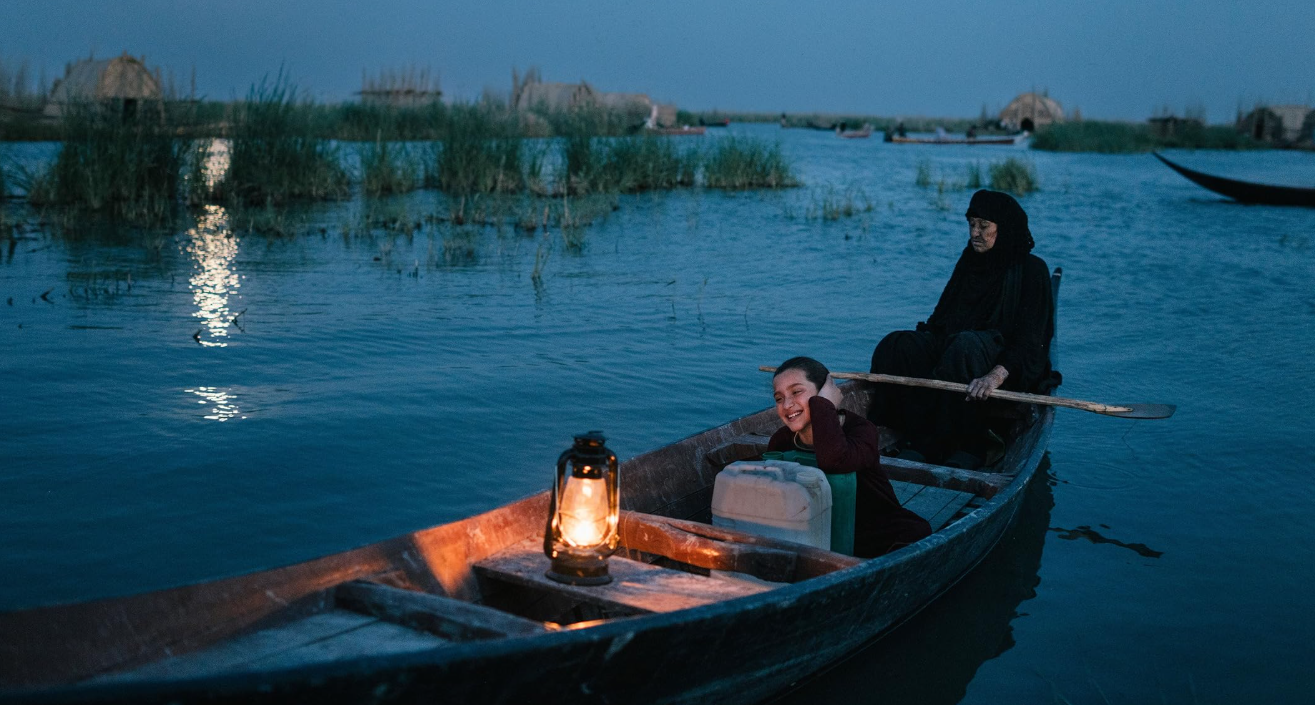
Following this scene of ancient storytelling and the tradition of narration, we see the devastation in which the granddaughter and grandmother live. Yet even amid this destruction, Iraq’s schools continue to function- perhaps less as institutions of education than as instruments of propaganda and popular exploitation. Lamia tells her grandmother that the following day will be a difficult one: Saddam Hussein’s birthday is approaching, and the next day, as in every classroom across Iraq, a lottery will be held in Lamia’s class to determine who will bake the cake for the party organized to celebrate Saddam’s birthday. This is, of course, only one of the many forms of torment that Saddam deemed fit to inflict upon his people.
Before the lottery even takes place, however, we witness what is perhaps the most painful and unexpected example in the entire film of how evil has spread throughout Iraq as a result of war and the embargo. When the students go out for recess, their teacher searches through Lamia’s bag and steals the apple that constitutes her only food. The moral collapse that culminates in a teacher stealing her student’s meal must surely have arisen from an immense darkness.
As we feared, Lamia’s name is drawn in the lottery. When Lamia shares the news with her grandmother, we see the woman take out, one by one, a number of heirloom objects. Lamia—and perhaps some viewers—assume that these will be sold in order to buy the ingredients for the cake. After all, Lamia is, under any circumstances, a good student, and she will, of course, do what her teacher has asked of her. Yet when we look at the grandmother’s gestures and facial expression, we sense that she has very different plans.
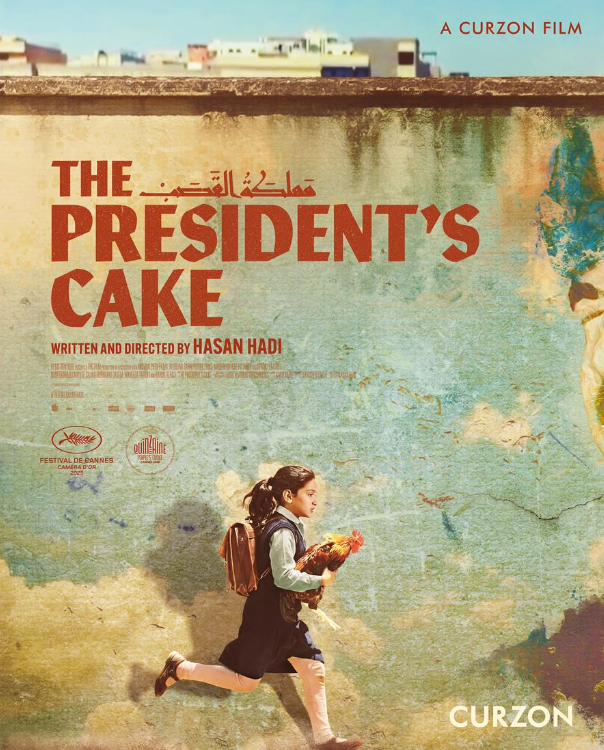
The next day, in any case, Lamia, her rooster, and her grandmother set off for the city. The rooster, which remains almost constantly in Lamia’s arms throughout the film, not only creates a striking visual image but also marks the little girl’s place on the map. Were we to lose the daughter of the marshlands in the city, we would easily be able to find her by the red comb of her rooster. The grandmother, Lamia, and the rooster reach the city by hitchhiking in the car of two men who have been wounded in very different ways by war and the embargo.
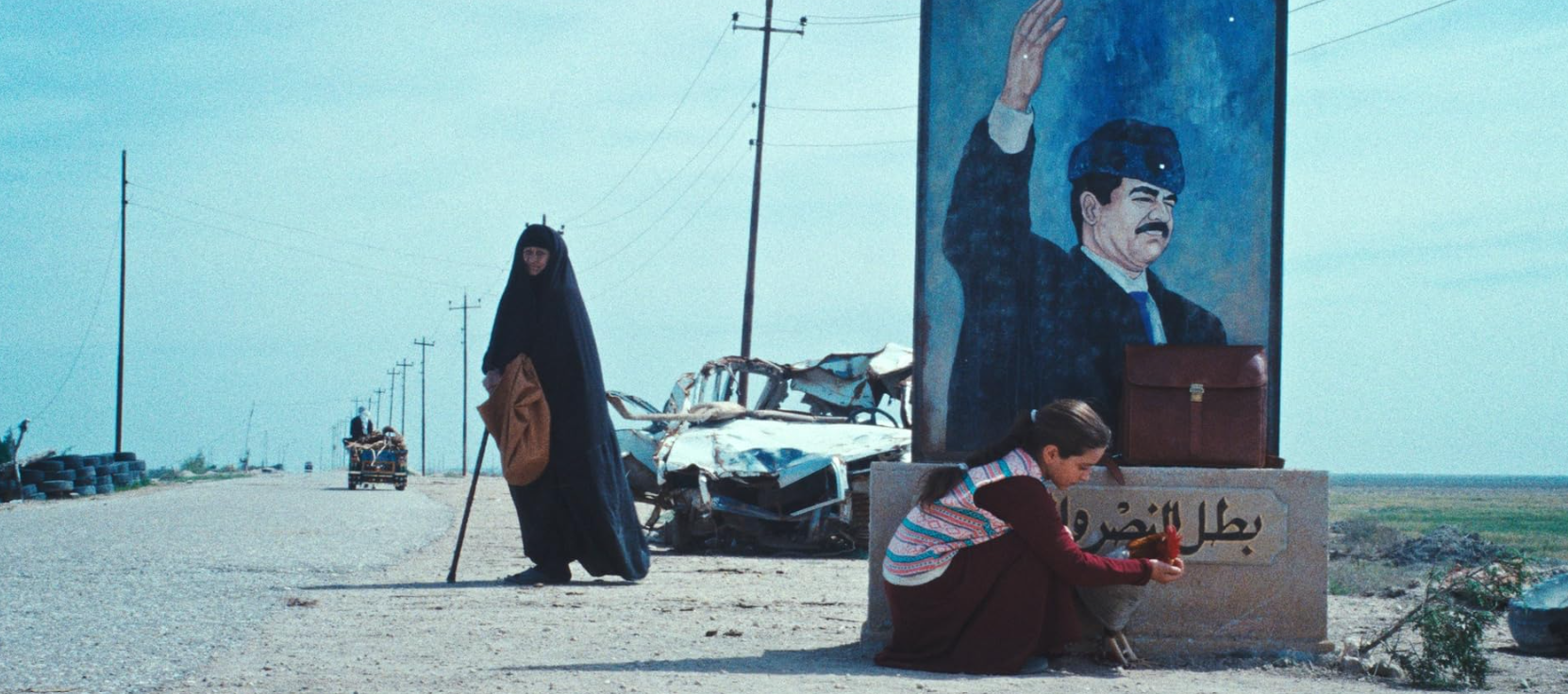
The trio first stops at a stall selling second-hand clothes. The fact that this family, which does not even have enough money to bake a cake, is trying to buy Lamia a new uniform arouses suspicion in the viewer. More striking still, after Lamia puts on the newly purchased uniform, her grandmother takes her to a restaurant. By now, Lamia too senses that something strange is going on. The woman who owns the restaurant offers Lamia food, but Lamia, being a good student and, without doubt, a child who has listened to fairy tales with the utmost attention, refuses it. Later, upon understanding from the conversation between her grandmother and the woman that her grandmother intends to give her up for adoption, Lamia places all her hopes even more firmly in the baking of Saddam’s cake and escapes from the restaurant in an attempt to find flour, sugar, and eggs by any means possible.
Thus, together with Lamia, we set out in pursuit of these three basic foodstuffs in an Iraq caught in the grip of the embargo. With the rooster tucked under her arm, Lamia appears almost like a fairy-tale heroine; each stop on her journey will offer us, if not a wise insight into poverty, then certainly a painful piece of knowledge about it.
In the marketplace, Lamia encounters a classmate whose father is a pickpocket—Saddam and the embargo having made it almost impossible to earn a living in Iraq through lawful means. As her grandmother, worried after losing sight of her granddaughter, finds herself at the police station, we, as viewers, are at least relieved that Lamia now has a friend by her side.
The pair begin their adventure by trying to sell Lamia’s father’s watch. It is quite obvious to the viewer that the reluctant-looking second-hand dealer is cheating the children, yet our heroes leave the shop with whatever money they have managed to obtain. Then, like all children, they cannot resist entering a pastry shop as they pass by it. When they try to spend part of their earnings, it turns out that the money the watch seller gave them is counterfeit. In the shops they enter afterwards, we likewise see that the tradespeople are constantly engaging in deception, using their small spheres of influence over the people to the fullest, like little Saddams. These betrayals wound me most when they take place in a caravanserai-like market resembling the hans of Eminönü. This perhaps five-hundred-year-old han, which ought to be a stronghold of honest earnings, craftsmanship, and the ethical guild tradition of ahi brotherhood, is now filled with people trying to deceive one another.
Yet even in this han, Lamia and her friend are able to catch their breath and plan their next steps. More importantly, they play the game of “who will look away first,” which they also play at school and which, when repeated at the end of the film, will move us to tears. These two children, constantly betrayed by adults, have no one to hold on to but each other. Despite all the scenes that wound human dignity which they witness in the shops, the two continue their search for the ingredients; meanwhile, with the help of the rooster as well, director Hadi inserts into the film moments that make the viewer smile and, ultimately, a character who is genuinely decent and morally upright.
This character is the driver who takes Lamia and her grandmother to the city at the beginning of the film. First, at the police station, he finds Lamia’s grandmother after she has taken ill and transports her to the hospital. Later, at another police station, he finds Lamia, who has been accused of theft while trying to save her own life. Although the “international community” has abandoned Iraq, Khidr is still there. Yet, of course, even Khidr can help Lamia only within the limits of this world that has been turned into hell.
Director Hasan Hadi stated at the press conference of the Doha Film Festival that it was important for him to tell the story of these children, who are seen as disposable by the West, and recalled the following exchange between former U.S. Secretary of State Madeleine Albright and a journalist regarding the Iraq War and the embargo:
Journalist: “We have heard that half a million children died. That is more children than died in Hiroshima. Was it worth it?”
Albright: “I think this is a very hard choice, but yes, we think the price was worth it.”
Hadi’s film reminds us that each of those children deemed “permissible to kill” was, even under the harshest conditions, trying to hold on to life. Who among us, looking at Lamia’s face, would not see our own face, the face of our daughter, or the face of our sibling? America’s propaganda will never make us forget that Lamia, Hind, and countless others are children who deserve every form of beauty. In order to ensure that this is not forgotten, our own stories must be told. For this reason, The President’s Cake is an essential film: one that commemorates Iraq’s beautiful children and tells the story of this beautiful country through the eyes of its own people.
*Opinions expressed in this article are the author’s own and do not necessarily reflect Platform: Current Muslim Affairs’ editorial policy.